Effective cash flow management is defined as the disciplined process of controlling cash inflows and outflows to sustain operations and fund growth. The role of cash flow management in growth goes far beyond bookkeeping. Positive operating cash flow combined with consistent sales growth directly reduces the risk of financial distress, making cash flow the most reliable indicator of a company’s health. Businesses that treat cash flow as a growth metric, not just a survival metric, build a compounding strategic advantage over time. Revenue and profit tell you what happened. Cash flow tells you what you can actually do next.
What operational levers drive effective cash flow management for growth?
Cash flow management operates through four primary levers: receivables, payables, inventory, and liquidity reserves. Each lever affects how quickly cash moves through your business. The order in which you address them matters as much as the actions themselves.

Receivables: the fastest lever
Receivables compression is the fastest and most effective way to release cash. Every unpaid invoice is money you have already earned but cannot use. Reducing your Days Sales Outstanding (DSO) by even five days can free up significant working capital without requiring new revenue.
Practical steps to compress receivables include:
- Invoice immediately upon delivery, not at month end
- Segment customers by payment behavior and apply tighter terms to slow payers
- Automate follow-up using accounts receivable software to reduce manual collections time
- Offer early payment discounts where the cost of the discount is less than your cost of capital
Automated receivables management using AI can dramatically reduce manual collections time and improve cash inflow timing. That means your finance team spends less time chasing invoices and more time on decisions that drive growth.
Payables and inventory
Extending payables is a common tactic, but it carries real risk. Pushing supplier payment terms beyond what your relationship supports can damage vendor trust and supply reliability. The better approach is to negotiate longer terms proactively, before you need them.
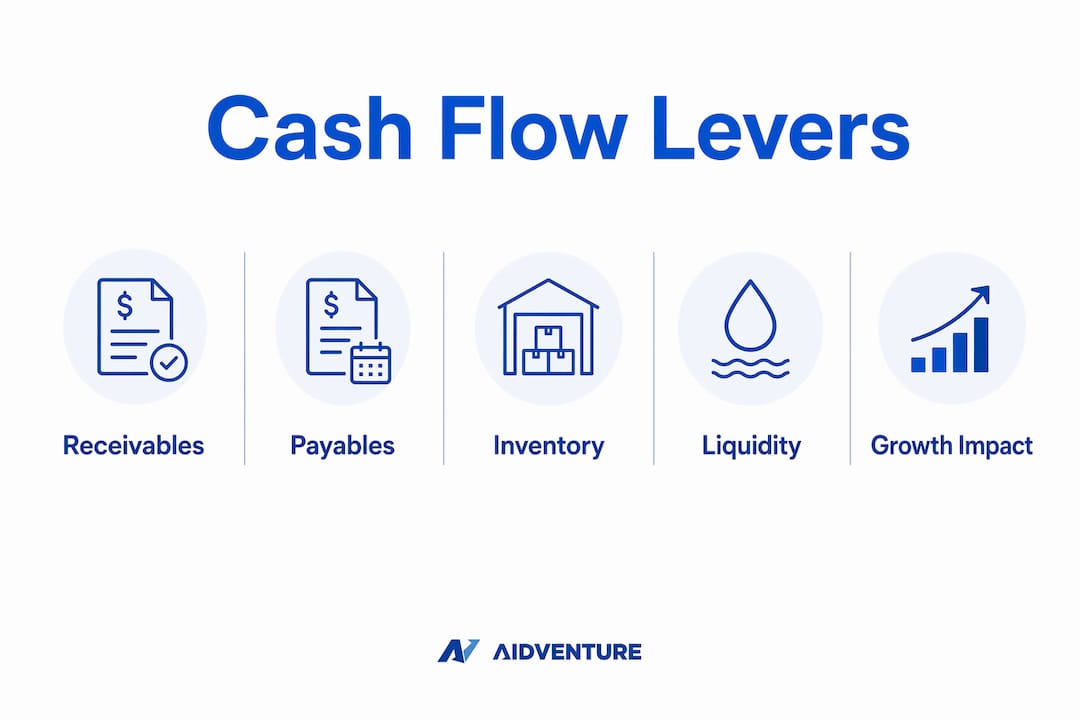
Inventory management is the third lever. Excess inventory ties up cash without generating returns. Linking inventory replenishment directly to demand signals, rather than fixed schedules, keeps cash moving.
Liquidity reserves act as the fourth lever. A cash buffer of 60–90 days of operating expenses gives you the room to invest in growth without triggering a crisis when collections slow.
Pro Tip: Coordinated compression across receivables, payables, and inventory yields disproportionately greater cash releases than fixing any single lever in isolation. Address all three together for maximum impact.
How does cash flow management influence capital allocation and growth strategy?
Capital allocation is where cash flow strategy meets growth ambition. The decisions you make about where to deploy cash determine whether your business scales or stalls. A disciplined framework prevents both under-investment and reckless spending.
The Rule of 40 is the most widely used framework for balancing growth and cash preservation. It works as follows:
- Calculate your annual revenue growth rate as a percentage.
- Add your free cash flow margin (free cash flow divided by revenue, expressed as a percentage).
- If the combined score is below 40, pause or cut investments that lack clear payback evidence within 18 months.
- Recalibrate every quarter as market conditions and unit economics shift.
- Require payback confidence before scaling any new growth investment, not just a promising trend line.
This quarterly discipline prevents the most common capital allocation mistake: continuing to fund growth initiatives that consume cash without producing measurable returns.
Cash runway is the second strategic constraint. A runway below 12 months triggers fundraising crises and forces decisions from a position of weakness. Prudent CEOs target 15–18 months of runway as the threshold that triggers proactive cost reviews, preserving both valuation and negotiating power.
The option value of cash is real. Holding adequate liquidity means you can move quickly when an acquisition target appears, a competitor stumbles, or a market window opens. Growth-stage businesses often run negative cash flow as a deliberate investment. The discipline lies in tying every dollar of burn to a specific milestone, not a vague growth narrative. Scenario planning in finance is the practical tool that makes this discipline operational.
Why do businesses experience cash flow constraints despite revenue growth?
Revenue growth and cash flow improvement do not move in lockstep. A 2026 analysis of 2,313 US public companies showed 6.8% revenue growth alongside 8.9% free cash flow growth, with cash conversion cycles barely improving and receivables actually worsening. That gap reveals a structural problem: growth itself consumes cash before it generates it.
The mechanism is straightforward. When your business grows, it needs more working capital to support higher operational volume.
| Growth driver | Cash impact | Typical timing |
|---|---|---|
| Rising accounts receivable | Cash tied up in unpaid invoices | Immediate |
| Higher inventory levels | Cash locked in stock | 30–90 days |
| Slower customer payment cycles | Extended DSO | Ongoing |
| Upfront supplier payments | Cash out before revenue in | Pre-delivery |
Revenue growth often degrades cash conversion in the early stages due to upfront spending and lagging collections. This is the growth-liquidity paradox: the faster you grow, the more cash you need, and the less cash you have.
The cash conversion cycle (CCC) is the clearest diagnostic metric. CCC measures the number of days between paying for inputs and collecting payment from customers. A rising CCC is an early warning signal, not a lagging indicator.
Pro Tip: Cash flow deterioration follows a predictable signal chain 12–36 months before financial distress. Monitor DSO, inventory days, and payables days monthly. A sustained rise in any two of these three metrics warrants immediate action.
Entrepreneurs who track these signals early avoid the reactive scramble that forces bad decisions: emergency credit lines, deep discounts to accelerate collections, or cutting growth investments at exactly the wrong moment.
How can entrepreneurs implement effective cash flow techniques for sustainable growth?
Execution separates businesses that understand cash flow from those that actually benefit from it. The following practices build a repeatable system rather than a one-time fix.
-
Build a weekly cash flow control loop. Review expected collections, scheduled payables, and cash position every week. Driver-based forecasting focuses on individual cash drivers rather than aggregate balances, which improves forecast reliability and surfaces problems earlier.
-
Run scenario plans before major growth decisions. Before hiring a new sales team or launching a new product, model the cash impact under three scenarios: base, upside, and downside. This is not pessimism. It is the discipline that keeps growth decisions grounded in cash reality.
-
Segment your collections effort. Not all overdue accounts deserve equal attention. Prioritize high-balance, high-probability accounts first. Automate reminders for smaller balances. Assign a specific owner to the top 10 accounts by outstanding value.
-
Link inventory replenishment to demand data. Buying inventory on fixed schedules regardless of actual demand is one of the most common ways growing businesses tie up cash unnecessarily. Connect purchasing decisions to real-time sales velocity.
-
Assign ownership and set metrics. Cash flow improvement requires accountability. Assign DSO ownership to the finance team, inventory days to operations, and payables terms to procurement. Review these metrics in leadership meetings, not just finance reviews.
Top-quartile cash flow efficiency companies exhibit higher market valuations and better acquisition terms over 5–10 years. That outcome is not accidental. It is the result of treating cash flow as an engineering system that integrates finance, operations, and sales execution. For entrepreneurs building toward an exit or a next funding round, this discipline is a direct input to valuation. Reviewing your operating budget framework alongside your cash flow system is a practical starting point.
Key Takeaways
Effective cash flow management is the single most reliable lever for sustainable business growth, combining receivables discipline, capital allocation frameworks, and weekly execution systems.
| Point | Details |
|---|---|
| Receivables first | Compressing DSO is the fastest way to release cash without new revenue. |
| Rule of 40 discipline | Sum revenue growth rate and free cash flow margin; pause investments below 40. |
| Growth consumes cash early | Rising working capital needs mean cash often tightens as revenue grows. |
| Weekly control loops | Driver-based forecasting by individual cash drivers improves reliability and surfaces problems early. |
| Cash runway threshold | Maintain 15–18 months of runway to preserve negotiating power and valuation. |
Why cash flow is the discipline most founders underestimate
I have worked with enough growing businesses to say this plainly: most founders treat cash flow as a finance department problem. They watch revenue climb, assume the cash will follow, and then face a crisis that feels sudden but was actually visible months earlier.
The signal chain is predictable. DSO creeps up by a few days. Inventory levels drift higher because procurement is buying ahead “just in case.” Payables get stretched to cover the gap. By the time the bank account reflects the problem, the window for easy fixes has closed.
What I have found actually works is treating cash flow as an operational discipline, not an accounting output. The businesses that scale without constant liquidity stress are the ones where the CEO reviews cash metrics weekly, where collections ownership sits with a named individual, and where every growth investment is tied to a payback timeline before it is approved.
The uncomfortable truth is that cash flow management is not complex. It is just unglamorous. Founders who build the habit early, before they need it, are the ones who get to make growth decisions from a position of strength rather than desperation. The ones who wait until the problem is visible are the ones negotiating from weakness.
— Sergio
How Aidventure helps entrepreneurs build cash flow systems that support growth

Aidventure works with SaaS founders and entrepreneurs who need financial clarity without the cost of a full-time CFO. The fractional CFO services Aidventure provides are built specifically for growing businesses that need disciplined cash flow execution, capital allocation frameworks, and accurate financial reporting. Clients gain a finance partner who tracks DSO, models runway scenarios, and connects cash flow decisions to growth strategy. If you are managing growth without a clear view of your cash position, Aidventure’s approach to managing finances without a full-time CFO gives you the structure and expertise to scale with confidence.
FAQ
What is the role of cash flow management in business growth?
Cash flow management controls the timing and volume of cash inflows and outflows, giving businesses the liquidity to invest in growth, meet obligations, and respond to opportunities. Positive operating cash flow combined with consistent sales growth directly reduces financial distress risk.
Why does revenue growth sometimes hurt cash flow?
Revenue growth increases working capital requirements through higher accounts receivable, rising inventory, and upfront supplier payments. Cash conversion cycles often worsen in early growth stages before collections and operations catch up.
What is the Rule of 40 in cash flow strategy?
The Rule of 40 adds a company’s annual revenue growth rate to its free cash flow margin. A combined score below 40 signals that unproven investments should be paused until payback evidence within 18 months is established.
How early can cash flow problems be detected?
Cash flow deterioration follows a predictable signal chain 12–36 months before financial distress, visible through rising DSO, increasing inventory days, and extended payables cycles. Monthly monitoring of the cash conversion cycle is the most reliable early warning system.
What is the most effective technique for improving cash flow quickly?
Receivables compression delivers the fastest cash release. Invoicing immediately, segmenting collections by customer payment behavior, and automating follow-up reduce DSO and unlock working capital without requiring new revenue.