Scenario planning in finance is defined as the practice of building multiple coherent, plausible financial models to prepare an organization for a range of future outcomes rather than relying on a single forecast. Unlike traditional budgeting, which sets one fixed target, financial scenario analysis forces finance teams to stress-test assumptions across base, upside, downside, and stress-test cases. The result is a planning system that replaces false precision with quantifiable risk. For SaaS businesses and growth-stage companies, where Annual Recurring Revenue (ARR) and churn can shift quickly, this discipline is not optional. It is the foundation of sound strategic financial planning.
What is scenario planning in finance, and how does it work?
Scenario planning in finance is a structured method for modeling distinct futures by changing multiple business assumptions simultaneously. Each scenario represents a coherent narrative, not just a number tweak. A base case reflects the most likely outcome. An upside case models accelerated growth. A downside case captures a realistic contraction. An optional stress test pushes assumptions to their limits to reveal survivability.
The core insight is that scenario planning builds resilience by preparing pre-decided responses rather than forcing leadership to debate options under pressure. When a scenario materializes, the team executes. That shift from reactive debate to prepared action is where the real value lives.
Relying on a single forecast is the financial equivalent of gambling. Scenario modeling replaces hope-based planning with decisions grounded in defined, plausible outcomes. Finance leaders who have lived through a sudden demand drop or a credit market freeze understand this distinction immediately.

What are the key components and steps in scenario planning for finance teams?
Best-in-class scenario planning follows a structured five-step process. Each step builds on the last, and skipping any one of them produces a model that looks rigorous but fails in practice.
-
Anchor on a trustworthy base case. Your base case is not a wish. It reflects the most probable outcome given current data, contracts, and market conditions. Every other scenario is built relative to this anchor.
-
Select 3–5 critical business drivers. For a SaaS business, these typically include new bookings, churn rate, hiring pace, and key cost categories. Focusing on key drivers rather than adjusting every line item keeps the model clear and maintainable.
-
Build 3–4 distinct scenarios. Most companies benefit from three scenarios: base, upside, and downside, with an optional stress test added when external volatility is high. More scenarios dilute focus and create confusion.
-
Model across all three financial statements. Modeling only the income statement can mask fatal cash flow issues. A revenue drop that looks manageable on the P&L may trigger a liquidity crisis on the cash flow statement or breach a debt covenant on the balance sheet.
-
Define trigger points and management actions. Each scenario needs predefined responses tied to leading indicators. A practical example: freeze hiring if ARR drops below a set threshold for two consecutive months.
Pro Tip: Build your scenario model in a dedicated financial planning tool rather than a spreadsheet. Spreadsheets break under version control pressure, and scenario planning requires frequent updates as conditions change.
How does scenario planning differ from related financial analysis methods?
Financial scenario analysis is one of three core planning methods. Each serves a different purpose, and confusing them leads to gaps in your planning system.
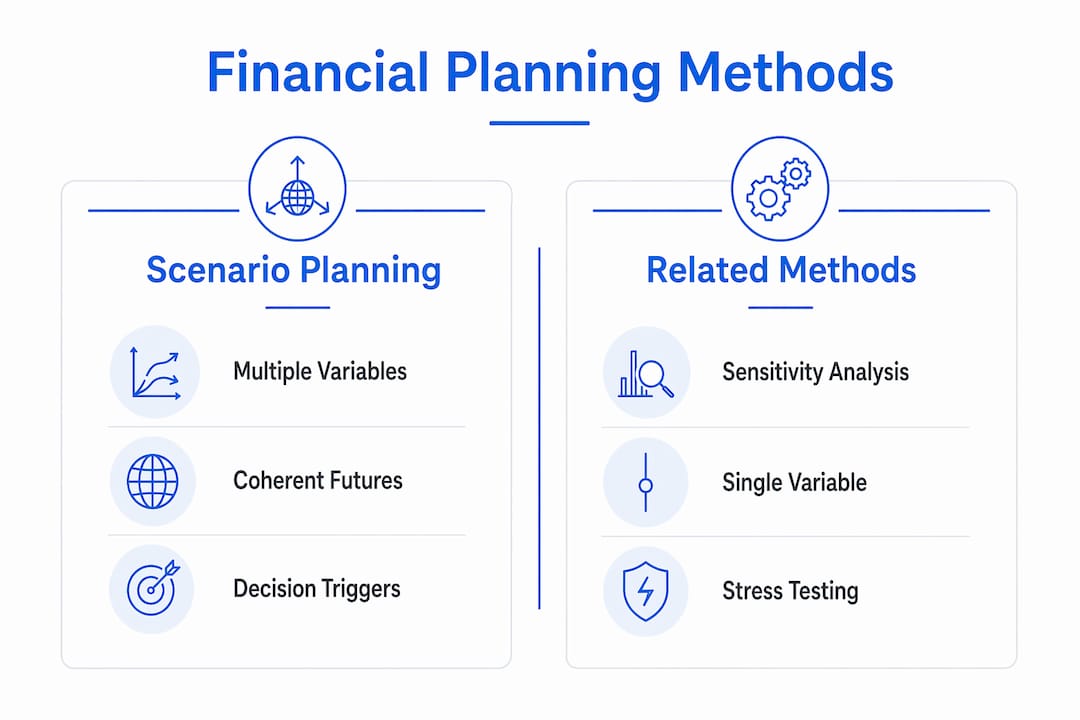
Scenario planning differs from sensitivity analysis because it changes multiple variables simultaneously to build a coherent narrative. Sensitivity analysis isolates one variable at a time. For example, sensitivity analysis answers: “What happens to margin if our cost of goods sold rises 10%?” Scenario planning answers: “What happens to ARR, headcount, cash runway, and margin if we enter a recession and churn doubles while new bookings fall 30%?”
Budgeting sets a fixed performance target for the year. It is a commitment, not a range. Scenario planning prepares the organization for outcomes that deviate from that commitment. Rolling forecasts, budgets, and scenarios form a complete planning system when used together. Rolling forecasts provide trajectory updates, budgets set accountability targets, and scenarios prepare responses to plausible futures.
| Method | Purpose | Variables changed | Output | Typical use case |
|---|---|---|---|---|
| Budgeting | Set performance targets | Fixed assumptions | Annual plan | Accountability and resource allocation |
| Sensitivity analysis | Test single-variable impact | One at a time | Impact range | Pricing, cost, or rate decisions |
| Scenario planning | Prepare for multiple futures | Multiple simultaneously | Coherent scenario set | Capital allocation, risk management |
| Rolling forecast | Update trajectory | Actuals plus forward view | Revised full-year estimate | Ongoing performance management |
Pro Tip: Use sensitivity analysis to stress-test individual assumptions inside each scenario. The two methods complement each other when applied at the right level of analysis.
What are the practical benefits and use cases of scenario planning in finance?
The benefits of scenario planning go beyond risk awareness. They translate directly into better capital allocation, faster decisions, and stronger board confidence.
- Organizational resilience. Pre-decided responses mean the team acts faster when a scenario unfolds. Leadership time shifts from debating options to executing plans.
- Quantified risk management. Scenario modeling turns uncertainty into a defined range of outcomes. Finance teams can present boards with specific downside exposure rather than vague warnings.
- Better capital allocation. Scenario planning supports capital allocation and investment decisions by revealing which actions remain viable across multiple futures and which depend on a single optimistic outcome.
- Board-level decision clarity. Boards can decide to commit, delay, redesign, or abandon an investment when they see quantified upside and downside cases side by side.
- Avoiding false precision. A single forecast creates a false sense of precision, particularly for capital investments or decisions exposed to volatile external factors. Scenario planning corrects that bias.
Common use cases include cash runway assessment for SaaS startups, acquisition planning, market entry analysis, long-term capital investment decisions, and financing strategy. Each of these involves enough uncertainty that a single forecast is genuinely misleading. Aidventure works with SaaS finance teams on exactly these decisions, using scenario frameworks to ground growth strategy in quantifiable outcomes rather than optimism.
How to implement scenario planning effectively
Effective implementation requires the right tools, the right habits, and a clear understanding of what makes scenario planning fail in practice.
- Use purpose-built software. Dedicated financial planning platforms manage multiple scenarios without the version control and formula-error risks of spreadsheets. They also make it easier to update scenarios as actuals come in.
- Keep it simple. Over-modeling dilutes scenario clarity. Select a small set of high-impact drivers rather than adjusting every line item. Complexity does not equal accuracy.
- Make it a recurring practice. Scenario planning done once a year is a presentation slide. Done quarterly or triggered by material changes, it becomes a management tool. Treat it like your rolling forecast cadence.
- Define triggers before you need them. Trigger points tied to leading indicators transform scenario plans into real-time management systems. Without pre-agreed triggers, scenario planning risks becoming theoretical.
- Align finance, strategy, and operations. Scenarios built in isolation by the finance team rarely get used. The drivers, assumptions, and responses need buy-in from the people who will act on them.
- Cover all three financial statements. Model the income statement, balance sheet, and cash flow for every scenario. Revenue changes affect liquidity and credit capacity, not just profit. Your accounting operations need to support this level of financial visibility.
Pro Tip: Link your scenario triggers to your SaaS KPI dashboard. When ARR, churn, or burn rate cross a predefined threshold, the trigger activates automatically rather than waiting for a quarterly review.
Common pitfalls to avoid: building scenarios that are too similar to create distinct management actions, ignoring balance sheet and cash flow impacts, and creating models so complex that no one updates them after the first quarter.
Key Takeaways
Scenario planning in finance is the most effective method for replacing single-point forecast risk with a structured, decision-ready range of plausible outcomes.
| Point | Details |
|---|---|
| Definition and core purpose | Scenario planning builds multiple coherent financial futures to prepare organizations for uncertainty, not predict it. |
| Three-statement modeling | Every scenario must cover the income statement, balance sheet, and cash flow to avoid masking liquidity risks. |
| Trigger points are non-negotiable | Pre-agreed triggers tied to leading indicators turn scenario plans into real-time management tools. |
| Limit scenario count | Three to four scenarios with materially different assumptions produce clearer decisions than a large set of similar models. |
| Complement other methods | Scenario planning works best alongside rolling forecasts and budgeting, not as a replacement for either. |
Scenario planning is the discipline finance leaders can no longer skip
I have worked with finance teams that produce beautiful scenario models and never act on them. The model sits in a shared drive, reviewed once at the board meeting, and forgotten until the next planning cycle. That is not scenario planning. That is scenario theater.
The difference between a model that drives decisions and one that collects dust comes down to two things: trigger points and organizational buy-in. When the CFO and the CEO agree in advance that a specific ARR drop triggers a specific cost action, the scenario becomes a contract. No debate required when the trigger fires.
What I find underappreciated is how much scenario planning improves the quality of board conversations. Boards do not want to debate assumptions in real time. They want to see a defined range of outcomes and make a clear decision. A well-built scenario set gives them exactly that. It also signals that the finance function is operating at a strategic level, not just reporting history.
The volatility of 2025 and 2026 has made this discipline more urgent. Interest rate uncertainty, SaaS market compression, and shifting venture capital appetite mean that a single forecast is genuinely dangerous for growth-stage companies. The teams that built scenario frameworks before the volatility hit responded faster and with more confidence than those scrambling to model options under pressure.
My recommendation: treat scenario planning as a quarterly discipline, not an annual event. Tie it to your rolling forecast cadence. Build it into your board reporting package. And make sure every scenario has a named owner for each trigger action.
— Sergio
How Aidventure supports scenario planning for SaaS finance teams

Aidventure’s fractional CFO services are built for SaaS startups that need scenario planning expertise without the cost of a full-time CFO. The team works directly with founders and finance leads to define critical business drivers, build three-statement scenario models, and establish trigger points tied to ARR, churn, and burn rate. Every engagement focuses on turning scenario analysis into a live management tool, not a static presentation. For SaaS businesses preparing for a fundraise, an acquisition, or a market expansion, Aidventure provides the financial clarity and preparedness that boards and investors expect. Explore how Aidventure’s growth strategy services connect scenario insights to capital allocation and expansion decisions.
FAQ
What is scenario planning in finance?
Scenario planning in finance is the practice of building multiple coherent financial models, each based on a different set of assumptions, to prepare an organization for a range of plausible futures rather than a single forecast.
How many scenarios should a finance team build?
Most finance teams benefit from three to four scenarios: a base case, an upside case, a downside case, and an optional stress test. Additional scenarios beyond four tend to dilute focus and reduce decision clarity.
How does scenario planning differ from sensitivity analysis?
Sensitivity analysis changes one variable at a time to measure its isolated impact. Scenario planning changes multiple variables simultaneously to model a coherent, internally consistent future outcome.
What are the most common pitfalls in financial scenario planning?
The three most common pitfalls are modeling only the income statement while ignoring cash flow impacts, failing to define pre-agreed trigger points, and building scenarios too similar to generate distinct management actions.
When should a business use scenario planning?
Scenario planning is most valuable when a single forecast creates false precision, such as during capital investment decisions, acquisition planning, cash runway assessment, or periods of significant market volatility.