A small business financial audit is an independent examination of your company’s financial statements to verify their accuracy and fairness under accepted accounting standards. This process, formally known as a financial statement audit, gives lenders, investors, and partners objective assurance that your numbers are reliable. With small business financial audit explained clearly, you can stop treating audits as threats and start using them as credibility tools. Standards like GAAP (Generally Accepted Accounting Principles) and frameworks from the AICPA govern how auditors conduct this work, ensuring consistency and rigor. A third-party audit builds stakeholder trust in ways that self-prepared financials simply cannot match.
What types of financial audits exist for small businesses?
Not every audit is the same. Small business owners encounter several distinct types, each triggered by different circumstances and serving different purposes.
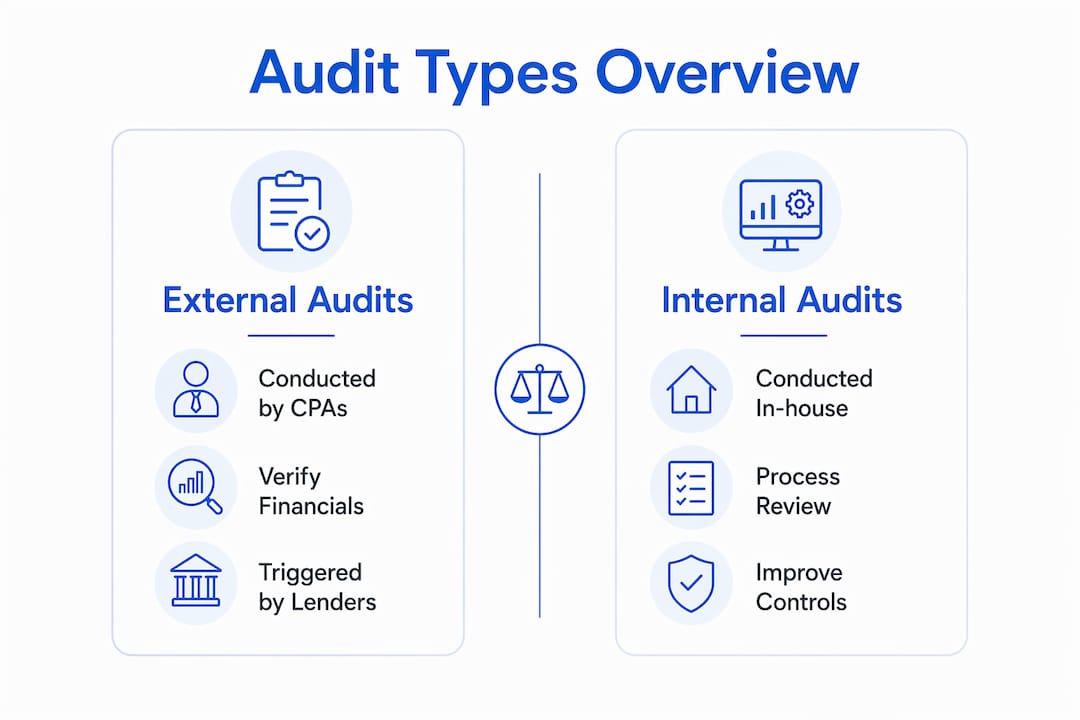
External audits are conducted by independent Certified Public Accountants (CPAs) who examine your financial statements and issue a formal opinion. Banks frequently require them before approving large loans. Investors and venture capital firms often demand them before committing capital. If you plan to sell your business, buyers will almost always request audited financials to validate the purchase price.

Internal audits focus on your own operations rather than external reporting. An internal auditor reviews your processes, internal controls, and risk management practices. Larger small businesses with dedicated finance teams use internal audits to catch problems before an external auditor does.
Tax audits are a separate category entirely. The IRS or a state tax agency conducts these to verify that your tax returns match your actual financial activity. A tax audit is not the same as a financial statement audit. The IRS examines tax compliance; an external CPA examines financial reporting accuracy.
Here is a quick comparison of the three main audit types:
| Audit type | Conducted by | Primary purpose | Common trigger |
|---|---|---|---|
| External financial audit | Independent CPA | Verify financial statement accuracy | Loan, investment, or business sale |
| Internal audit | Internal team or consultant | Review controls and operations | Management decision or governance |
| Tax audit | IRS or state tax agency | Verify tax return accuracy | Unusual deductions or filing errors |
The most common situation for a growing small business is the external financial statement audit. Understanding financial audits at this level prepares you for the conversations lenders and investors will eventually start.
How does the small business audit process work?
The financial audit process follows five defined stages. Knowing each one removes the mystery and helps you respond faster when auditors make requests.
-
Engagement acceptance. The CPA firm reviews your business, assesses risk, and signs an engagement letter outlining the scope, timeline, and fees. This document protects both parties.
-
Planning and risk assessment. Auditors identify which accounts carry the highest risk of material misstatement. They review your industry, your internal controls, and prior financial statements to build their audit plan.
-
Fieldwork and evidence gathering. This is the core of the audit. Auditors request bank statements, invoices, payroll records, accounts receivable aging reports, and contracts. Analytical procedures compare your revenue growth and expense ratios against industry benchmarks to flag anomalies without reviewing every transaction. Auditors also use sampling, selecting a representative set of transactions to test rather than examining all of them.
-
Review and evaluation. The audit team reviews all evidence, resolves open questions, and evaluates whether the financial statements present a fair picture of your business.
-
Audit report issuance. The CPA issues a formal opinion letter. This document is what lenders and investors actually read.
Audit duration typically spans several weeks to months. Poor record-keeping is the most common cause of delays. That single fact should motivate every business owner to maintain clean books year-round, not just before an audit begins.
Pro Tip: Ask your CPA for a preliminary document request list at the start of the engagement. Gathering everything before fieldwork begins can cut weeks off the timeline.
Most small business audits now run remotely through secure digital portals, which means you rarely need to host auditors in your office. This reduces disruption to daily operations significantly.
What triggers a small business financial audit?
Certain business patterns draw auditor attention more than others. Knowing these triggers helps you manage risk before a problem surfaces.
Common audit triggers include:
- Repeated reported losses. Businesses that show losses year after year while continuing to operate raise questions about whether expenses are overstated or revenue is understated.
- Employee misclassification. Paying workers as independent contractors when they function as employees is one of the most frequently cited issues in IRS audits.
- Unreasonably low owner compensation. S-corporation owners who take minimal salaries to reduce payroll taxes attract scrutiny because the IRS has clear guidelines on reasonable compensation.
- Excessive or unusual deductions. Home office deductions, vehicle expenses, and meals claimed at unusually high percentages relative to revenue are common red flags.
- Late or amended filings. Filing extensions or amending returns multiple times signals potential inaccuracies.
- Digital asset transactions. Cryptocurrency holdings and transactions now receive specific IRS attention, particularly when reporting is inconsistent.
Consistent, accurate bookkeeping is your first line of defense. Auditors look for patterns, and clean records with clear expense categorization make those patterns easy to explain.
Pro Tip: Categorize every business expense at the time of purchase, not at year-end. Retroactive categorization introduces errors and inconsistencies that auditors notice immediately.
A SaaS KPI audit can also help startup founders identify financial reporting gaps before an external auditor does, giving you time to correct issues on your own terms.
How to prepare effectively for a financial audit
Preparation is where most small business owners either save themselves significant time or create unnecessary problems. The goal is to give auditors exactly what they need, nothing more and nothing less.
Start with these preparation steps:
- Separate business and personal accounts completely. Commingled accounts are a major red flag and force auditors to spend extra time tracing transactions.
- Reconcile all accounts before the audit begins. Bank accounts, credit cards, accounts receivable, and accounts payable should all be reconciled and current.
- Organize supporting documents by category. Group invoices, contracts, payroll records, and bank statements in a logical structure that mirrors your chart of accounts.
- Strengthen internal controls proactively. Approval hierarchies and expense sign-offs are among the first things auditors review. Weak controls get flagged in the management letter and can affect your audit opinion.
- Work with your accountant year-round. Businesses that engage their CPA only at tax time are rarely audit-ready. Regular monthly or quarterly reviews keep your books in shape.
Providing only specifically requested documents prevents unnecessarily broad audit scopes. Experienced CPAs consistently advise against submitting extra records that auditors did not ask for, because additional documents can open new lines of inquiry.
Pro Tip: Create a single shared folder, organized by document type, before the audit starts. Label everything clearly. Auditors who can find what they need quickly move through fieldwork faster, and that saves you money.
Your accounting operations infrastructure directly affects how long an audit takes. Businesses with documented processes and clean records consistently complete audits faster and with fewer findings.
What does an audit report mean for your business?
The audit report is the deliverable that matters most to your stakeholders. It contains the auditor’s formal opinion, and that opinion carries real financial consequences.
There are four possible audit opinions:
| Opinion type | What it means | Business impact |
|---|---|---|
| Unqualified (clean) | Financials are fairly presented with no material misstatements | Strongest signal for lenders and investors |
| Qualified | Financials are fairly presented except for one specific issue | Lenders may require explanation or correction |
| Adverse | Financials are materially misstated | Serious credibility damage; rarely acceptable to stakeholders |
| Disclaimer | Auditor could not obtain sufficient evidence | Signals major record-keeping or cooperation failures |
An unqualified or clean audit opinion indicates financial statements are fairly presented and free from material misstatements. This is the result every business owner should target.
Beyond the formal opinion, auditors often issue a management letter. Management letters cite internal control weaknesses and provide specific recommendations for business improvements. Many owners overlook this document, but it is one of the most useful outputs of the entire audit process. Addressing the issues it raises before the next audit cycle reduces findings and strengthens your financial operations.
Key Takeaways
A clean audit opinion, supported by strong internal controls and organized records, is the most direct path to financial credibility with lenders and investors.
| Point | Details |
|---|---|
| Audit types differ by purpose | External, internal, and tax audits each serve distinct goals and are triggered by different circumstances. |
| Five-stage process | Audits follow engagement, planning, fieldwork, review, and report issuance in a defined sequence. |
| Triggers are predictable | Repeated losses, misclassification, and excessive deductions are the most common audit risk factors. |
| Preparation determines speed | Organized records and strong internal controls reduce audit duration and minimize findings. |
| Clean opinion builds credibility | An unqualified opinion signals financial integrity and directly supports lending and investment decisions. |
Why audits are an asset, not a liability
Most small business owners I work with come into their first audit with the wrong frame. They treat it as an inspection designed to find fault. That mindset creates friction, slows the process, and sometimes leads to over-documentation that opens new problems.
The better frame is this: an audit is an objective health check on your financial reporting. It tells you, your lenders, and your investors that your numbers can be trusted. Businesses that build audit readiness into their regular financial routines do not scramble when an audit is requested. They respond in days, not weeks.
The management letter is where I see the most missed value. Owners read the formal opinion and file the rest. But the management letter often contains the clearest picture of where your financial controls are weak. Treating those recommendations as a to-do list for the next quarter is one of the highest-return activities a business owner can do.
The owners who benefit most from audits are the ones who stop asking “how do I get through this?” and start asking “what will this tell me about my business?”
— Sergio
How Aidventure supports your audit readiness

Audit preparation is not a one-time event. It requires consistent financial operations, documented controls, and clear reporting throughout the year. Aidventure works with SaaS startups and small businesses to build exactly that foundation. Through fractional CFO services, Aidventure helps business owners establish the internal controls, reporting structures, and financial discipline that make audits faster and cleaner. The team also provides accounting operations support to keep books current and audit-ready at all times. If your business is approaching a funding round, a loan application, or a potential acquisition, having audit-ready financials is not optional. Aidventure makes that standard part of how your business runs.
FAQ
What is a small business financial audit?
A small business financial audit is an independent examination of your financial statements by a CPA to verify accuracy and compliance with accounting standards like GAAP. The auditor issues a formal opinion on whether your financials are fairly presented.
How long does a small business audit take?
Audit duration typically spans several weeks to several months, depending on business complexity and record organization. Disorganized records and slow responses to auditor requests are the most common causes of delays.
What triggers an IRS audit for a small business?
Common triggers include repeated reported losses, employee misclassification, unreasonably low owner compensation, and excessive deductions relative to revenue. Consistent and accurate bookkeeping reduces exposure to these risk factors.
What is a clean audit opinion?
A clean, or unqualified, audit opinion means your financial statements are fairly presented and free from material misstatements. It is the strongest signal of financial credibility you can provide to lenders and investors.
Do I need to meet auditors in person?
Most small business audits are now conducted remotely through secure digital portals, making in-person meetings generally unnecessary. Providing organized digital records through a shared portal is the standard practice in 2026.