IFRS 15 requires an entity to capitalize the incremental costs of obtaining a contract and certain costs to fulfil a contract, but only when specific recoverability tests are met. Everything else gets expensed as incurred. That is the entire rule in one sentence, but the application takes discipline, because the standard draws a hard line between costs you are allowed to defer and costs that just look like they should be deferred.
IFRS 15 paragraphs 91 through 95 set the framework: capitalize incremental costs of obtaining a contract and costs to fulfil a contract as an asset if you expect to recover them. There is also a practical expedient that lets you skip capitalization entirely when the amortization period would run one year or less. For SaaS and subscription businesses signing monthly or annual deals with sales commissions attached, that expedient often decides the whole policy.
Before you build a capitalization policy, run through this immediate checklist:
- Identify candidate costs. Pull every cost tied to contract acquisition (commissions, legal fees, success bonuses) and every cost tied to fulfilment (setup, mobilization, direct labor).
- Test recoverability. Confirm the contract’s expected consideration covers these costs plus a reasonable margin.
- Check the one-year rule. If the amortization period is 12 months or less, expense it and skip the asset entirely.
- Separate scope. Route any cost that falls under IAS 2, IAS 16, or IAS 38 to those standards first, not to IFRS 15.
- Set an amortization pattern. Match capitalized amounts to how the related goods or services transfer to the customer, including anticipated renewals where relevant.
Key Takeaways
IFRS 15 requires capitalizing incremental contract-acquisition costs and qualifying fulfilment costs only when recovery is expected and the one-year expedient does not apply, with amortization matched to the customer’s actual benefit period.
| Point | Details |
|---|---|
| Capitalize only incremental, recoverable costs | Test every cost against both criteria before creating an asset, not just one. |
| Use the one-year expedient deliberately | Expense costs outright when the amortization period would run 12 months or less. |
| Route costs to the right standard first | Send IAS 2, IAS 16, and IAS 38 costs to those standards before applying IFRS 15. |
| Tie amortization to real customer behavior | Base the amortization period on actual cohort renewal data, not a placeholder estimate. |
| Document every judgment call | Keep commission agreements, renewal statistics, and policy memos ready for audit review. |
| Get implementation support where needed | Aidventure helps SaaS finance teams draft policy, build schedules, and prepare audit-ready documentation. |
Table of Contents
- Contract Costs Under IFRS 15: Incremental Costs of Obtaining a Contract
- Which Fulfilment Costs Can You Capitalize?
- How Do You Amortize Capitalized Contract Costs?
- What Triggers Impairment of a Contract Cost Asset?
- Where Do Contract Costs Go on the Balance Sheet?
- Worked Examples: Commissions, Setup Costs, and Renewals
- How Should SaaS Finance Teams Apply This Day to Day?
- Where Contract-Cost Accounting Actually Breaks Down
- How Aidventure Helps You Apply IFRS 15 Without the Guesswork
- Sources
Contract Costs Under IFRS 15: Incremental Costs of Obtaining a Contract
An incremental cost of obtaining a contract is one you would not have incurred if the contract had not been won. That definition, drawn directly from IFRS 15’s contract cost provisions, is narrower than it sounds. A sales commission paid only because a deal closed clears the bar. A sales manager’s base salary does not, because that salary gets paid whether or not any particular contract closes.
The second test matters just as much: you must expect to recover the cost. For a SaaS contract with healthy gross margins and a multi-year term, recovery is usually a straightforward conclusion. For a loss-leader deal signed purely to win a logo, it is not, and expensing the commission immediately may be the more defensible call.
Costs that typically qualify:
- Sales commissions paid specifically because a contract was signed
- Contract-specific success fees paid to a broker or referral partner
- Incremental bonuses tied directly to closing an individual deal
Costs that typically do not qualify:
- General sales bonuses that are not tied to specific contract wins
- Travel or overhead costs the entity would have incurred regardless of the deal outcome
- Salaries of account executives or sales leadership paid independent of contract outcomes
Run new sales-comp plans through this decision sequence before setting a policy:
- Would this cost have been avoided if the contract fell through? If no, expense it.
- If yes, do you reasonably expect to recover it through the contract’s economics? If no, expense it.
- If yes, would the resulting amortization period be one year or less? If yes, you may still elect to expense it under the practical expedient.
- If the amortization period exceeds one year and recovery is expected, capitalize it.
Here is how that plays out in the ledger. Say a SaaS company pays a $10,000 commission on a new three-year contract, consistent with the scale PwC’s illustrative examples use for this exact scenario.
Entry at contract inception (capitalize the commission):
Debit Contract Cost Asset $10,000; Credit Cash $10,000.
Entry at each period-end (amortize over the expected benefit period, here 36 months):
Debit Amortization Expense $278; Credit Contract Cost Asset $278.
If that same commission related to a six-month contract instead, the practical expedient would apply, and the entry would simply be a debit to commission expense and a credit to cash, with no asset ever created. Boards built that shortcut into the standard deliberately, according to PwC’s commentary on the Basis for Conclusions, to spare preparers from tracking immaterial short-lived assets.
Which Fulfilment Costs Can You Capitalize?
Costs to fulfil a contract only qualify for capitalization when they clear three tests at once, set out in IFRS 15 paragraphs 95 through 98: the cost must relate directly to an identified contract (or a specifically anticipated one), it must generate or enhance resources you will use to satisfy future performance obligations, and you must expect to recover it. All three, not two out of three.
That third criterion trips up more preparers than the other two combined. A cost can relate perfectly to the contract and clearly build a resource you will use later, and still fail if the contract economics do not support recovering it. This is where fulfilment-cost analysis intersects tightly with margin analysis on the deal itself.
| Cost type | Typically eligible for capitalization | Typically excluded |
|---|---|---|
| Direct labor | Implementation staff time coding a specific client’s integration | General engineering salaries not tied to a contract |
| Direct materials | Hardware shipped and configured for one customer’s deployment | Materials wasted or scrapped during setup |
| Allocated costs | Depreciation on equipment used directly to fulfil the contract | General and administrative overhead |
| Third-party payments | Subcontractor fees for work tied to the specific contract | Costs related to performance obligations already satisfied |
Before any of this reaches IFRS 15, check whether another standard already claims it. IFRS 15 explicitly requires that costs within the scope of IAS 2 (inventories), IAS 16 (property, plant and equipment), or IAS 38 (intangible assets) follow those standards, full stop. You cannot defer inventory costs under IFRS 15 just because they relate to a customer contract; IAS 2 already tells you how to account for them.

A mobilization example makes the split concrete. Say a SaaS vendor spends $60,000 setting up a new enterprise client: $25,000 on server hardware, $15,000 on purchased software licenses embedded in the client’s environment, and $20,000 on internal implementation labor and data migration. The hardware follows IAS 16. The purchased software licenses likely follow IAS 38. Only the $20,000 in implementation labor and migration work, assuming it meets all three criteria and is not tied to obligations already satisfied, becomes a candidate for capitalization under IFRS 15.
Run each cost line through these questions before booking it anywhere:
- Does another Standard (IAS 2, IAS 16, IAS 38) already govern this cost? If yes, stop and apply that Standard.
- Does the cost relate directly to this contract or one you specifically anticipate winning?
- Does it build or enhance a resource you will use for future performance obligations, rather than ones already delivered?
- Do you expect to recover it through the contract?
How Do You Amortize Capitalized Contract Costs?
Amortize capitalized contract costs on a systematic basis that mirrors the pattern in which the related goods or services transfer to the customer, and that basis can extend to anticipated contract renewals when the original cost benefits those renewals too. That is the core principle in IFRS 15’s contract cost provisions, and it is where SaaS accounting departs most sharply from a simple contract-term amortization.
Two patterns dominate subscription businesses:
- Straight-line over expected customer life. If a commission is paid once but the customer typically renews for years beyond the initial term, amortize the asset over that full expected relationship, not just the first contract period.
- Allocation by units of transfer. For usage-based or milestone-driven contracts, amortize in proportion to the services actually delivered in each period rather than on a flat time basis.
Consider a $12,000 commission on a new enterprise account where the initial term is 12 months, but the company’s historical data shows this customer segment renews for an average of 4 years total. Amortizing over 12 months would front-load expense in a way that misrepresents the asset’s actual benefit period. Spread over 48 months instead, the monthly amortization drops from $1,000 to $250, a meaningful difference in reported margins for a company scaling its sales organization.
When your estimate of customer life changes, and it will as churn data matures, treat the update as a change in accounting estimate, applied prospectively rather than restated retroactively:
- Recalculate the remaining unamortized balance based on the new expected life.
- Determine the revised monthly (or periodic) amortization charge going forward.
- Record the adjusted amortization expense starting in the current period, with no restatement of prior periods.
- Document the basis for the revised estimate, since auditors will ask for it every year the assumption shifts.
The journal entry itself does not change in form, only in amount: debit amortization expense, credit the contract cost asset, using the newly calculated periodic figure.
What Triggers Impairment of a Contract Cost Asset?
You test a capitalized contract cost asset for impairment by comparing its carrying amount to the remaining consideration you expect to receive for the related goods or services, less the remaining costs to provide those goods or services. If the carrying amount exceeds that net figure, you write the asset down. This measurement approach comes straight from IFRS 15’s impairment guidance, and it is a distinct test from the impairment models most finance teams already run under IAS 36.
Work through impairment in this order:
- Test any assets within the scope of other standards first (property, equipment, goodwill) under IAS 36 or the relevant Standard, and combine with cash-generating unit analysis where those rules require it.
- Only then test the remaining contract cost asset specifically under the IFRS 15 recoverability comparison.
- If the asset fails the test, recognize an impairment loss for the excess of carrying amount over the net recoverable figure.
- Reassess in future periods; if conditions improve, IFRS permits reversing a previously recognized impairment loss for these assets, up to the original carrying amount net of amortization that would have been recorded.
A quick numeric case: suppose a capitalized fulfilment cost asset carries a balance of $18,000. The customer contract still has $40,000 of remaining consideration due, and the company expects to spend $30,000 more delivering the remaining services. Net recoverable amount is $10,000, below the $18,000 carrying balance. The entry: debit impairment loss $8,000, credit contract cost asset $8,000. If the customer later expands the contract and the recoverable amount recovers above the reduced carrying balance, IFRS allows reversing that loss, which is a meaningful contrast worth flagging for any group also reporting under US GAAP, since ASC 340-40 does not permit impairment reversals for these assets at all.
Where Do Contract Costs Go on the Balance Sheet?
Capitalized contract costs sit on the balance sheet as an asset separate from contract assets and contract liabilities, never blended into either line. That separation matters to auditors and analysts alike, since collapsing a deferred commission asset into a contract asset balance obscures two very different economic items.
Your disclosure notes should cover, at minimum:
- The accounting policy applied to incremental costs of obtaining a contract and to costs to fulfil a contract
- Closing balances of capitalized contract cost assets, by major category if material
- Amortization expense recognized for the period
- Impairment losses recognized, and any reversals, for the period
- Whether and how the practical expedient (one-year amortization) has been applied
- Key judgments and estimates, particularly assumptions about expected customer life and recoverability
A short disclosure note might read:
The Company capitalizes incremental costs of obtaining customer contracts, primarily sales commissions, when it expects to recover those costs, in accordance with IFRS 15 paragraphs 91 to 94. These costs are amortized on a straight-line basis over the expected customer relationship period, which management estimates at 4 years based on historical renewal patterns. The Company applies the practical expedient in IFRS 15 paragraph 94 to expense costs where the amortization period would be one year or less. Amortization expense of [amount] was recognized during the period, with no impairment losses identified.
Auditors reviewing subscription businesses tend to press hardest on two things: the commission policy itself (is it consistently applied across sales teams?) and the customer life assumption backing amortization (is it supported by actual cohort data, not a round number picked for convenience?). Keep both documented well before fieldwork starts.
Worked Examples: Commissions, Setup Costs, and Renewals
Three scenarios cover most of what a SaaS controller will actually encounter, each drawing on the structure of PwC’s illustrative examples IE189 through IE196.
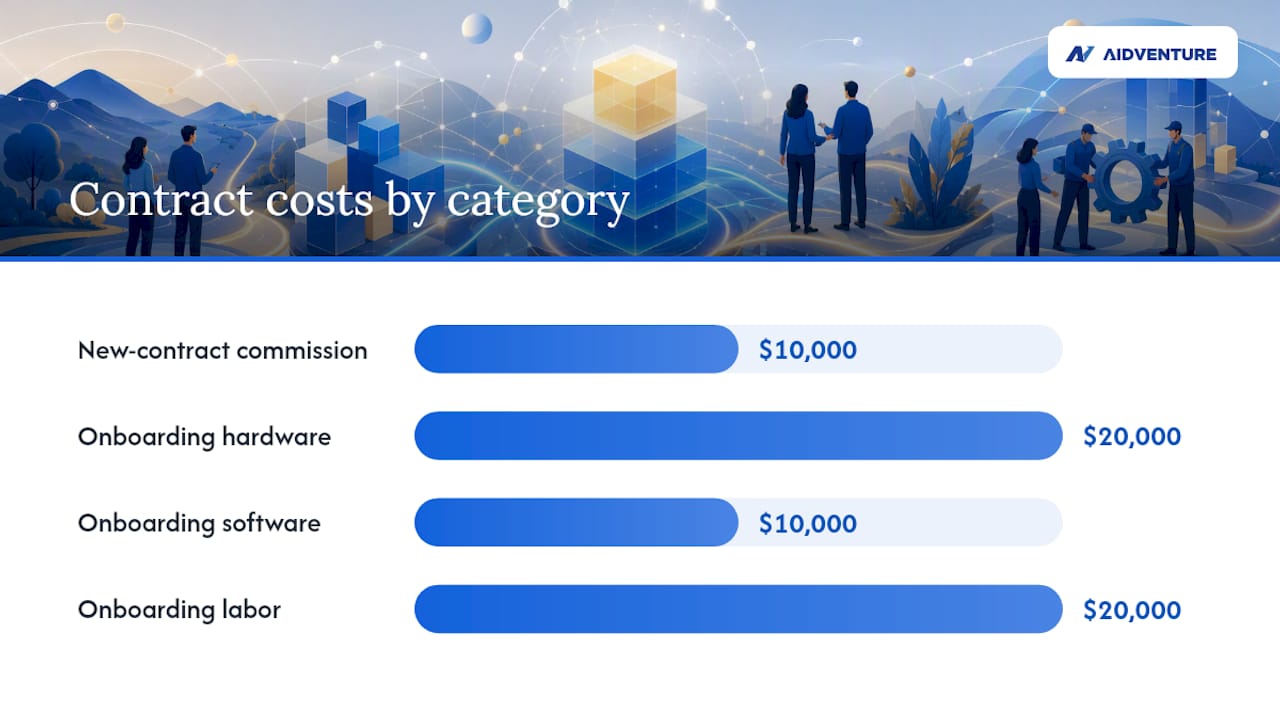
Example 1: Sales commission on a new contract win. A commission is paid on a new multi-year enterprise deal. It is incremental (would not have been paid without the win) and recoverable given the deal’s margin.
- Debit Contract Cost Asset $10,000; Credit Cash $10,000 (at contract inception).
- Debit Amortization Expense; Credit Contract Cost Asset monthly over the expected benefit period.
Example 2: Onboarding and setup costs. A $50,000 onboarding project splits into $20,000 of hardware (IAS 16), $10,000 of licensed software (IAS 38), and $20,000 of implementation labor that meets all three IFRS 15 fulfilment criteria.
- Debit Property, Plant and Equipment $20,000; Credit Cash $20,000 (IAS 16 scope).
- Debit Intangible Assets $10,000; Credit Cash $10,000 (IAS 38 scope).
- Debit Contract Cost Asset $20,000; Credit Cash $20,000 (IFRS 15 scope, implementation labor only).
Example 3: Renewal commission that does not extend the original asset. A separate, smaller commission is paid specifically for a renewal, distinct from the original acquisition commission. Because the original commission did not relate to this renewal period, it should not be amortized further into the renewal term; the renewal commission is assessed as its own incremental cost, tested independently for recoverability and its own amortization period.
| Scenario | Treatment | Amortization period | Impairment trigger |
|---|---|---|---|
| New-contract commission | Capitalize | Expected customer life (e.g., 36 months) | Remaining consideration less remaining costs falls below carrying amount |
| Onboarding: hardware/software | IAS 16 / IAS 38, not IFRS 15 | Per applicable standard | Per applicable standard |
| Onboarding: implementation labor | Capitalize under IFRS 15 | Matches service delivery pattern | Same recoverability test as above |
| Renewal-specific commission | Capitalize separately | Renewal term or expected renewal life | Assessed independently of original asset |
How Should SaaS Finance Teams Apply This Day to Day?
Turning these rules into a repeatable process is what separates a defensible IFRS 15 policy from a spreadsheet nobody can explain during an audit. Start with an itemized workflow:
- Identify every candidate cost at contract signing: commissions, setup fees, subcontractor charges, mobilization spend.
- Map each cost to the specific contract, using a contract ID in the general ledger rather than a generic project code.
- Decide scope first: route anything under IAS 2, IAS 16, or IAS 38 away from IFRS 15 before testing capitalization criteria.
- Document recoverability and the expected customer life assumption, tied to actual cohort renewal data, not an estimate pulled from a board deck.
- Set the amortization method and period, and record the rationale in a policy memo you can hand to auditors without redrafting it.
- Build a recurring impairment review trigger, tied to contract renegotiations, downgrades, or churn signals, rather than waiting for year-end close to notice a problem.
- Record all required disclosures each reporting period, not just in the year the policy was first adopted.
Keep the evidence file that supports every judgment call: signed commission agreements, sales compensation plans showing the incremental trigger, historical renewal and churn statistics behind your customer life assumption, and any board-approved policy memo. Auditors will ask for all four during their first IFRS 15 review, and scrambling to reconstruct them after the fact costs far more time than building the file as you go.
Pro Tip: Tag every capitalized contract cost with the originating contract ID in your ledger from day one. When an auditor or a new controller asks why an asset balance moved, you want a two-minute answer, not a week-long reconstruction project.
For SaaS businesses trying to build this out without a dedicated technical accounting resource, structured outsourced finance support can shorten the path from policy draft to audit-ready documentation considerably faster than building it in-house from scratch.
Where Contract-Cost Accounting Actually Breaks Down
The most common failure mode in IFRS 15 contract-cost accounting is not misreading the standard. It is over-capitalizing because deferring an expense makes near-term margins look better, and nobody wants to be the person who flags that the policy is being stretched. That pressure is real, and it is exactly what the boards tried to guard against by limiting capitalization to incremental, identifiable costs in the first place.
Three errors show up repeatedly in practice:
- Over-capitalizing costs that aren’t truly incremental. Base salaries, general travel, and standard overhead get lumped into commission pools and capitalized wholesale. The remedy is contract-level controls: every capitalized dollar needs a direct, traceable link to a specific signed contract, not an allocation formula.
- Weak documentation of recoverability and customer life. Teams pick a round number for customer life, four years is a popular guess, without cohort data behind it. The remedy is tying the assumption to actual renewal and churn metrics, refreshed at least annually.
- Mismatched amortization periods. Amortizing a commission over the initial contract term when the real economic benefit runs far longer (or shorter) misstates margin in every affected period. The remedy is a sensitivity analysis showing how the amortization charge shifts under a range of realistic churn assumptions, documented and kept on file.
None of this happens in a finance vacuum. Sales needs to confirm which commissions were actually incremental and contract-specific. Legal needs to confirm contract terms and renewal mechanics. Finance needs to translate both into an amortization schedule that will survive audit scrutiny. Getting that coordination wrong is usually a process failure, not a technical accounting one, and it is the piece most companies underestimate until their first IFRS 15 audit cycle.
How Aidventure Helps You Apply IFRS 15 Without the Guesswork
Building an IFRS 15 contract-cost policy from scratch, and defending it in your first audit cycle, takes technical accounting depth most SaaS finance teams don’t have in-house yet. Aidventure works directly with SaaS and subscription businesses to draft the policy, map costs against IAS 2, IAS 16, and IAS 38 boundaries, set up amortization schedules tied to real cohort data, and build the impairment testing cadence auditors expect to see.

Engagements typically run as either a focused advisory project to get the policy and schedules built, or an ongoing retainer where Aidventure’s accounting operations team maintains the schedules, tracks renewal-driven amortization changes, and keeps disclosure notes current every reporting period. Clients walk away with audit-ready documentation instead of a spreadsheet they have to re-explain every quarter. If your commission and setup-cost accounting needs a technical review before your next audit, book a fractional CFO consultation and get a clear read on where your current policy stands.
Sources
For the primary text, go straight to IFRS 15 paragraphs 91 through 104, which cover incremental costs of obtaining a contract, costs to fulfil a contract, amortization, impairment, and disclosure in full.
- International Financial Reporting Standard 15 Revenue from Contracts with Customers (IFRS Foundation, 2021 pdf)
- IFRS 15 Illustrative Examples — PwC viewpoint (IE188–IE196)
This article provides general accounting guidance and is not a substitute for professional advice; confirm current requirements against the full IFRS 15 text or a qualified accountant before finalizing your policy.