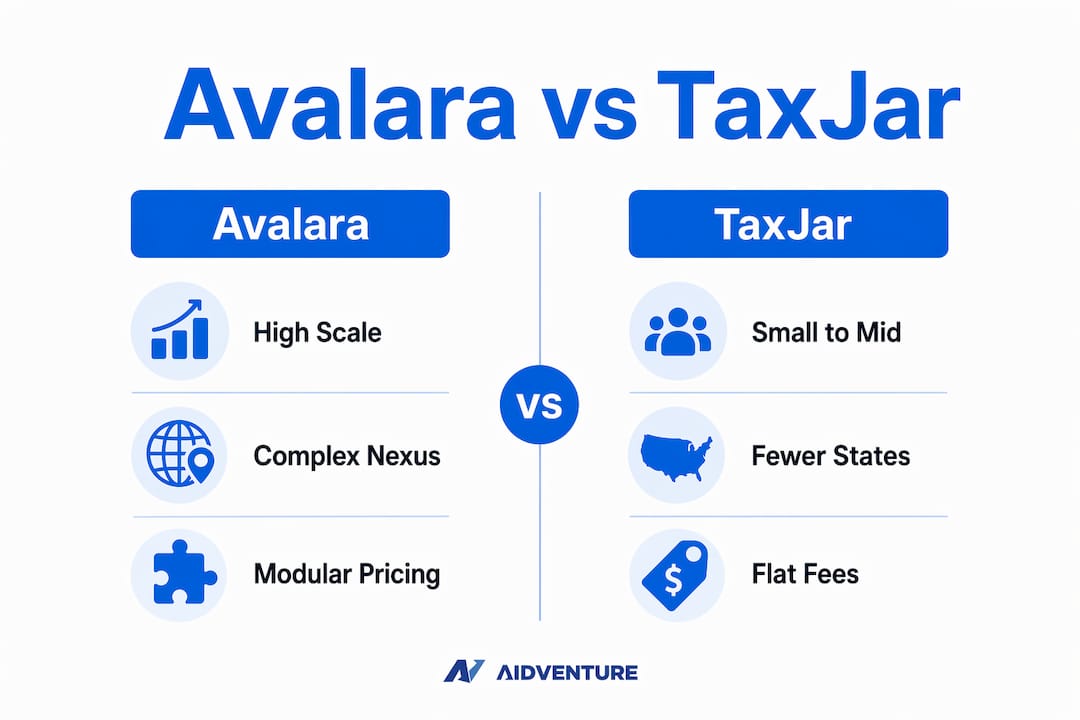
For most SaaS startups under $5M in revenue with a direct-to-consumer channel mix, TaxJar is the right call. Once you cross mid-single-digit million ARR to low double-digit million ARR, file in many states, carry meaningful B2B exemption volume, or face an upcoming raise or acquisition diligence window, Avalara earns its price. If you want audit-ready compliance without building internal tax ops, Aidventure’s managed service is the third path worth considering.
The economic nexus logic driving this decision traces back to South Dakota v. Wayfair (2018), which opened the door for states to tax remote sellers. Most states default to $100,000 in sales or 200 transactions as the trigger, though New York requires $500,000 and more than 100 transactions, and California and Texas set a $500,000 sales-only threshold. Both Avalara and TaxJar monitor these thresholds automatically, but how they handle what comes next, filing, exemptions, and audit trails, is where the two platforms diverge sharply.
- TaxJar wins when you need fast setup (days to weeks), predictable monthly pricing, and your sales are primarily direct-to-consumer through Shopify or Amazon.
- Avalara wins when you need CertCapture for B2B exemption certificates, deep ERP connectors (NetSuite, SAP, Acumatica), or audit-grade reporting for a PE or M&A diligence process.
- Aidventure managed wins when you want a single, accountable partner handling filings, certificate clean-up, ERP connector projects, and diligence-ready reporting under a predictable monthly retainer.
The most expensive compliance mistake SaaS founders make is waiting until diligence to discover a certificate backlog or unfiled states. At that point, remediation costs multiples of what proactive tooling or a managed service would have cost.
Pro Tip: Before signing any vendor contract, ask specifically which ERP connectors are included in the base price and which are sold as paid add-ons. Avalara’s modular pricing means connector fees, CertCapture licensing, and professional services can push year-one costs well above the headline subscription figure.
Table of Contents
- How do Avalara, TaxJar, and Aidventure compare side by side?
- How do you pick the right option for your SaaS startup?
- What do founders actually pay over time?
- What does a migration checklist look like in practice?
- Aidventure experience: what outcomes look like in practice
- Key Takeaways
- A practitioner’s perspective on compliance risk
- Aidventure’s managed compliance service for SaaS founders
- Useful sources and further reading
How do Avalara, TaxJar, and Aidventure compare side by side?
| Dimension | TaxJar | Avalara | Aidventure Managed |
|---|---|---|---|
| Best for | DTC/ecommerce SaaS under $5M | Multi-channel, B2B, 20+ states, enterprise ERP | Founders who want outsourced, audit-ready compliance |
| Core features | Nexus monitoring, AutoFile, basic exemptions | Nexus, Returns, CertCapture, advanced exemptions | Full-service: filings, certificates, reconciliation |
| Audit & reporting | Basic filing history | Audit-grade reports, CertCapture | Diligence-ready packages on demand |
| Global tax (VAT/GST) | Limited | Yes, multi-jurisdictional | Scoped per engagement |
| ERP connectors | Shopify, Amazon, WooCommerce | NetSuite, SAP, Acumatica + more (many paid) | Coordinated with your existing stack |
| Implementation speed ranges from days to weeks for self-serve setups, weeks to months for partner-assisted implementations, and a few weeks to operational baseline for managed services |
| Pricing model varies from flat monthly fees to modular/custom pricing and monthly retainers depending on service complexity |
| Support | Self-serve, community | Partner network, premium tiers (paid) | Dedicated Aidventure team |
| Hidden costs | Minimal | CertCapture, connectors, professional services | None beyond agreed scope |
| Time to value | 1–2 weeks | 4–12 weeks | 2–4 weeks |
TaxJar quick take:
- Fast to deploy; works out of the box for Shopify and Amazon sellers
- Pricing structure is transparent and predictable for some platforms
- Hits a ceiling when B2B exemption volume grows or ERP complexity increases
- Opinionated simplicity is its core advantage and its primary limitation
Avalara quick take:
- Purpose-built for complex, multi-channel, multi-state compliance
- CertCapture handles certificate capture, tracking, and expirations at scale
- Third-party reviews show higher enterprise capability scores but lower ease-of-setup ratings
- Total cost of ownership can scale unexpectedly; budget for modules and connectors separately
Aidventure quick take:
- Replaces the need to hire internal tax ops or manage a vendor relationship
- Covers accounting operations including filings, reconciliations, and certificate management
- Predictable retainer with no surprise add-on invoices
- Ideal for pre-raise, pre-exit, or post-acquisition compliance remediation
How do you pick the right option for your SaaS startup?
Run through this diagnostic before you commit to any path.
Revenue and channel mix:
- Is ARR below $5M with primarily DTC sales? TaxJar is likely sufficient.
- Is ARR above $5–10M, or do you have a meaningful wholesale/B2B channel? Evaluate Avalara.
- Do you lack internal finance ops bandwidth? Consider Aidventure managed.
Nexus and exemption exposure:
4. How many states are you currently filing in? Under 10 favors TaxJar; 20+ favors Avalara or managed.
5. How many active exemption certificates do you hold? More than 30 expiring reseller certificates is a red flag for TaxJar’s basic exemption flagging.
6. Are certificates tracked, current, and auditable? If not, CertCapture or a managed clean-up is needed before your next audit.
Tech stack and timeline:
7. Which ERP are you running? QuickBooks or no ERP favors TaxJar. NetSuite, SAP, or Acumatica points to Avalara.
8. Is a fundraising round, acquisition, or PE diligence within 12 months? This is the single strongest trigger for moving to audit-grade tooling or a managed service immediately.
Red flags requiring immediate escalation:
- Filing in 20+ states with mixed monthly/quarterly calendars
- More than 30 active expiring reseller certificates with no systematic tracking
- An upcoming diligence event with no audit-ready filing history
- An ERP migration in progress with no connector strategy
Recommended next step by outcome:
- Diagnostic points to DTC simplicity: stay on TaxJar, review annually
- Diagnostic shows B2B complexity or 20+ states: plan an Avalara migration with a certified partner
- Diagnostic shows diligence pressure or ops gap: contact Aidventure for a scoped managed engagement
What do founders actually pay over time?
Headline subscription pricing rarely reflects true cost. The real total cost of ownership (TCO) includes five buckets: the base license, module add-ons, ERP connector fees, professional services, and internal headcount to manage exceptions.
Finance leaders should prioritize future integration costs and potential partner fees over headline subscription pricing when forecasting TCO. That guidance matters most for Avalara, where the modular structure means CertCapture, connectors, and a premium support tier each carry separate line items.
Two illustrative TCO scenarios:
| Cost bucket | DTC brand, $3M ARR | Multi-channel brand, $25M ARR, 20+ states |
|---|---|---|
| Year 1 base license costs vary broadly depending on platform and scale | ||
| CertCapture/exemption modules may add substantial additional costs depending on needs | ||
| ERP connectors may incur extra costs based on number and complexity | ||
| Professional services and partner fees can range significantly | ||
| Internal operations headcount requirements depend on scale and complexity | ||
| Estimated Year 1 total | $1–3K | $25–50K |

These figures align with vendor-agnostic case analysis showing a $3M DTC brand spending roughly $1–3K/year on TaxJar and a $25M multi-channel brand budgeting $25–50K/year at Avalara scale.
Implementation timelines vary, with faster setups possible for simpler platforms and longer timelines common for complex ERP integrations and require internal engineering time alongside partner resources.
Pro Tip: When scoping an Avalara contract, ask the vendor to itemize every connector and module you need before signing. Get the connector fees in writing. A multi-month implementation that stalls on an unbudgeted NetSuite connector can delay your go-live by weeks and add thousands in professional services costs.
What does a migration checklist look like in practice?
A clean migration protects your audit trail and prevents month-end filing gaps. Work through these phases in order.
Phase 1: Pre-migration audit (Weeks 1–2)
- Inventory every state where you have nexus, confirmed and potential.
- Pull all open and expiring exemption certificates; flag those expiring within 90 days.
- Document all current system integrations (ERP, billing platform, marketplace connectors).
- Export historical filing records and reconcile against your general ledger.
Phase 2: Configuration and testing (Weeks 2–5)
5. Map all SKUs and product tax codes to the new platform’s taxonomy.
6. Run parallel calculations in sandbox against known historical transactions.
7. Migrate exemption certificates; update expiring ones before go-live.
8. Validate ERP connector data flow end-to-end with your engineering team.
Phase 3: Pilot filings and go-live (Weeks 5–8)
9. Run one filing cycle in the new system for two to three low-risk states.
10. Reconcile output against prior-period filings before expanding.
11. Confirm AutoFile is active for all enrolled states.
12. Archive the legacy system’s data in a retrievable format for audit continuity.
| Phase | Typical duration | Owner |
|---|---|---|
| Pre-migration audit | 1–2 weeks | Finance / Aidventure |
| Configuration and testing | 2–3 weeks | Engineering + Finance |
| Pilot filings | 1–2 weeks | Finance / Partner |
| Full go-live | Week 6–8 | Finance |
| Post-migration reconciliation | Months 1–6 | Finance / Aidventure |
During the first six months post-migration, reconcile every filing against your billing system’s revenue recognition records. Certificate expirations are the most common post-migration compliance gap; assign a named owner to the renewal workflow on day one.
Pro Tip: Back up your QuickBooks Online data before any migration. A QuickBooks Online backup creates a recoverable snapshot of your pre-migration state, which is invaluable if reconciliation issues surface weeks after go-live.
Aidventure experience: what outcomes look like in practice
Aidventure works with SaaS startups across a range of revenue stages and compliance situations. The patterns below reflect the types of engagements and outcomes the team handles regularly.
Profile A: $4M ARR, DTC SaaS, Shopify-based
Recommendation: Stay on TaxJar with a structured certificate review. Timeline to clean state: two weeks. Outcome: filing accuracy confirmed across 8 states, no remediation required.
Profile B: $18M ARR, B2B SaaS, NetSuite ERP, 28 nexus states
Recommendation: Migrate to Avalara with Aidventure managing the connector project and CertCapture onboarding. Timeline: a couple of months to go-live. Outcome: 140 exemption certificates migrated and renewed, audit-ready reporting in place before a Series B close.
Profile C: $9M ARR, multi-channel, 6 months from PE diligence
Recommendation: Aidventure managed engagement covering certificate clean-up, back-filing review, and monthly returns. Timeline: a few weeks to operational baseline. Outcome: diligence package delivered on schedule, no material tax findings flagged by acquirer’s advisors.
| Client profile | Recommended path | Timeline to value | Key outcome |
|---|---|---|---|
| DTC SaaS, <$5M, Shopify | TaxJar (self-serve) | 1–2 weeks | Clean filings, low overhead |
| B2B SaaS, $10–25M, NetSuite | Avalara + Aidventure managed | 6–10 weeks | Audit-ready, certificates current |
| Pre-diligence, any stage | Aidventure managed | 3–5 weeks | Diligence package, no findings |
Aidventure recommends managed services over vendor migration when the founder’s team lacks internal tax ops bandwidth, when a diligence event is within 12 months, or when certificate backlog exceeds what a self-serve tool can remediate without dedicated project management.
Key Takeaways
For most SaaS startups, the right sales tax automation choice comes down to three variables: revenue scale, B2B exemption volume, and whether a diligence event is on the horizon.
| Point | Details |
|---|---|
| TaxJar for early-stage DTC | Best fit under $5M ARR with Shopify/Amazon channels; costs $1–3K/year. |
| Avalara for complex, multi-state | Justified at $5–10M+ ARR, 20+ states, or when CertCapture and ERP connectors are required. |
| Hidden costs drive real TCO | Avalara’s modules, connectors, and professional services commonly push year-one spend to $25–50K for multi-channel brands. |
| Diligence is the key trigger | An upcoming raise or acquisition is the strongest signal to move to audit-grade tooling or a managed service immediately. |
| Aidventure as managed alternative | Aidventure covers filings, certificate management, and diligence-ready reporting under a predictable retainer, replacing internal tax ops. |
A practitioner’s perspective on compliance risk
The conventional wisdom in SaaS finance circles treats sales tax as a back-office checkbox. The reality, especially post-Wayfair, is that it sits directly in the path of every fundraising round and acquisition. Avalara and TaxJar are both credible tools, but the choice between them is less about features and more about where your company sits on the complexity curve.
What gets underestimated consistently is the certificate problem. A company can have perfect filing history and still fail diligence because its exemption certificates are expired, untracked, or stored in a spreadsheet. CertCapture solves this at scale, but it requires setup time and a process owner. For teams without that capacity, a managed engagement that handles the clean-up and ongoing renewal workflow is the faster, lower-risk path.
The SaaS KPI audit Aidventure runs with new clients regularly surfaces compliance gaps that founders didn’t know existed. That diagnostic is the right starting point before committing to any tooling decision.
Aidventure’s managed compliance service for SaaS founders
Founders who have read this far know the decision is not just about software. It is about who owns the compliance function when your team is focused on growth.

Aidventure’s fractional CFO and accounting operations service covers the full compliance stack: monthly sales tax filings, exemption certificate clean-up and renewal, ERP connector projects, CertCapture onboarding assistance, and diligence-ready reporting packages. There is no need to hire a dedicated tax ops resource or manage a vendor relationship on top of your existing workload. The engagement runs on a predictable monthly retainer scoped to your state count, certificate volume, and ERP complexity.
For founders approaching a raise or an acquisition, Aidventure delivers the audit-ready filing history and certificate documentation that acquirers and investors expect, on a timeline that fits your deal schedule. To discuss scope and indicative retainer pricing, book a discovery call with the Aidventure team.
Useful sources and further reading
- Avalara vs TaxJar Pricing (2026), CostBench — Plan-by-plan pricing comparison including median annual contract data for both platforms.
- TaxJar vs Avalara Comparison, TaxMap.ai — Feature-level breakdown covering nexus monitoring, exemption certificate handling, and AutoFile differences.
- Avalara vs TaxJar in 2026, Eightx — Revenue inflection thresholds, nexus trigger examples, and TCO case scenarios for DTC and multi-channel brands.
- Avalara vs TaxJar Comparison, TaxCloud — Covers TaxJar’s Stripe lineage, self-serve implementation, and Avalara’s modular pricing structure.
- Avalara AvaTax vs TaxJar Pricing 2026, StackScored — Practitioner-focused analysis of hidden costs, connector fees, and TCO forecasting guidance.
- G2 Avalara vs TaxJar Comparison — Aggregate user review scores for ease of use, enterprise capability, and support responsiveness.
- Akika Labs: QuickBooks Online Backup — Details on backup practices for QuickBooks Online; relevant for pre-migration data protection.