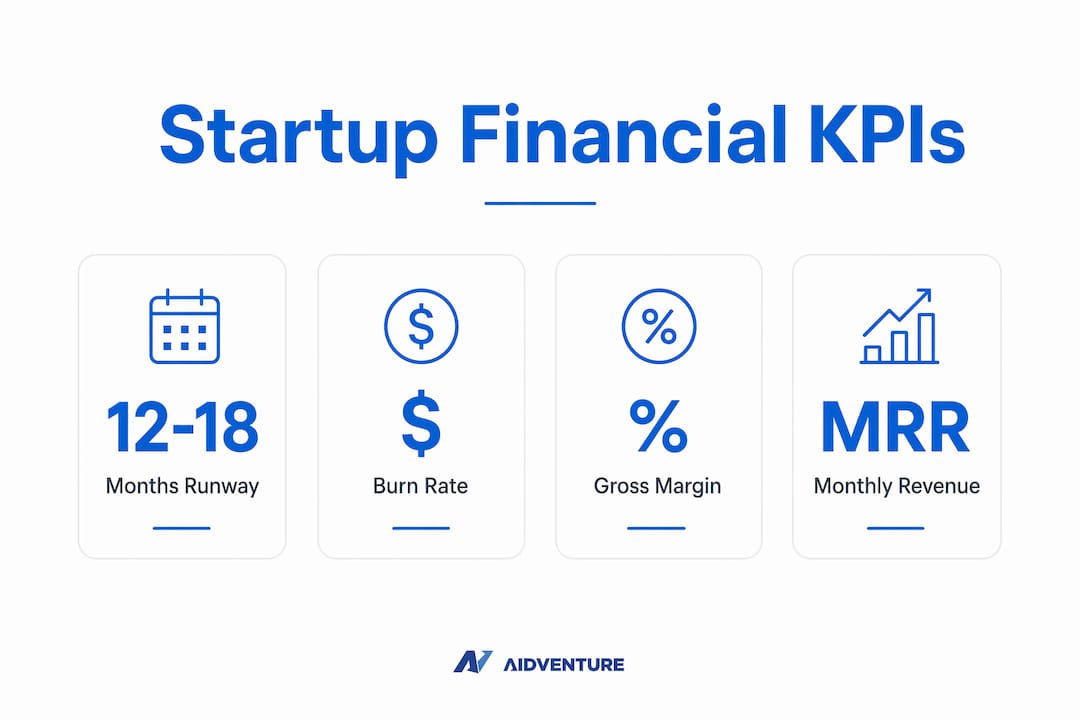
Bootstrap startup financial management is the practice of controlling your startup’s finances through disciplined planning, budgeting, and cash flow oversight to ensure survival and growth without external funding. Every bootstrapped founder needs a clear system from day one. Without one, cash disappears faster than revenue arrives, and the business collapses not from bad ideas but from poor financial discipline. The core benchmarks to target in 2026 are a cash runway of 12–18 months, a CAC payback period under 12 months, and a gross margin above 70% for SaaS businesses. Separating personal and business finances is not optional. It is the foundation every other financial practice builds on.
What financial tools do bootstrap founders need first?
The right tools and habits come before any financial model or dashboard. Without clean data, every forecast is fiction.
The core toolkit for a bootstrapped founder is straightforward:
- Accounting software: Tools like QuickBooks or Wave handle invoicing, expense tracking, and basic reporting without requiring an accountant on staff.
- Cash flow statement: Updated weekly, this shows exactly what cash entered and left the business and when.
- Profit and loss statement (P&L): Updated monthly, this tracks revenue against expenses to reveal true profitability.
- Expense tracker: A simple spreadsheet or built-in accounting feature that categorizes every dollar spent.
- Separate business bank account: Mixing personal and business finances creates tax complications and personal liability risks that can sink a founder.
Reconcile your accounts weekly. Unreconciled books hide errors, duplicate charges, and missed payments that compound over time.
Founder salary is another non-negotiable. Paying yourself a consistent, documented salary keeps your personal finances stable and your business books clean. Set a tax reserve policy from the start. Setting aside 25–35% of profits immediately for taxes prevents the painful surprise of a large tax bill with no cash to cover it.

Pro Tip: Open a dedicated tax reserve account and transfer your tax percentage automatically every time revenue lands. Treat it as untouchable until tax season.
How to build a financial model for a bootstrapped startup
Financial modeling for bootstrappers is not about impressing investors. It is about building an honest roadmap based on actual customers, signed contracts, and proven cost data. The goal is to identify the assumptions that will cause failure early, before real money is spent.
Follow these steps to build a model that works:
- Start with real drivers. List your current customers, average contract value, monthly churn rate, and cost to acquire each customer. These are your inputs.
- Build revenue from the bottom up. Project revenue from actual accounts and realistic new customer additions, not from capturing a percentage of a large market.
- Separate fixed and variable costs. Fixed costs include rent, software subscriptions, and founder salaries. Variable costs scale with customers, such as hosting and support hours.
- Calculate gross margin. Subtract the direct cost of delivering your product from revenue. For SaaS, a gross margin above 70% is the target benchmark.
- Calculate burn rate and runway. Burn rate is your net monthly cash outflow. Runway equals cash on hand divided by monthly burn. Review both every month.
- Build three scenarios. A pessimistic scenario, a realistic scenario, and an optimistic scenario. Focusing on the pessimistic scenario prevents over-hiring and keeps burn discipline intact.
- Set tripwires. Define the specific metrics that signal you need to cut costs or change strategy. For example: “If MRR drops below $X for two consecutive months, we pause all new hiring.”
- Update the model monthly. Models are living documents that become less wrong over time as you replace assumptions with real data.
The table below shows the core financial formulas every bootstrapped founder must know:
| Metric | Formula |
|---|---|
| Monthly burn rate | Total monthly expenses minus monthly revenue |
| Cash runway | Cash on hand divided by monthly burn rate |
| CAC payback period | CAC divided by monthly gross profit per customer |
| Gross margin | (Revenue minus cost of goods sold) divided by revenue |
| Burn multiple | Net burn divided by net new ARR |
Pro Tip: Keep your financial model on one tab of a spreadsheet. If it takes more than 10 minutes to update, it is too complex. Simplicity means you will actually use it.
For a deeper look at building transparent, data-driven models, the role of financial modeling for founders covers the full framework.
What are best practices for budgeting and cash flow management?
Cash flow timing is the most misunderstood concept in bootstrapped startup finance. Revenue on your P&L is not the same as cash in your bank account. A customer who owes you $10,000 but pays in 60 days cannot cover payroll next week.
The best practices for managing cash flow and budgeting as a lean team are:
- Invoice upfront or on short terms. Billing upfront and shortening payment terms are the fastest levers to improve cash runway without cutting costs.
- Delay payables strategically. Pay vendors on the last acceptable day of their terms. This keeps cash in your account longer without damaging supplier relationships.
- Run zero-based budgeting monthly. Every expense must justify itself each month. Cancel auto-renewing subscriptions and low-value tools without hesitation.
- Maintain a cash buffer. Keep 1–3 months of operating expenses in reserve. This buffer absorbs delayed payments, unexpected costs, and slow sales months.
- Prioritize payments in order. Taxes first, then payroll, then critical suppliers, then optional spend. This order protects legal standing and team trust.
- Review cash flow weekly and monthly. Monthly checklists that include reconciling accounts, reviewing outstanding invoices, and cutting dead spend identify problems before they become crises.
For a complete framework on budgeting best practices built for early-stage startups, Aidventure’s resource covers the full process.
Pro Tip: Send invoices the same day you deliver work or activate a subscription. Every day you delay invoicing is a day you delay getting paid.
How to build a lean startup financial dashboard
A financial dashboard is only useful if founders actually open it. Complex dashboards get abandoned. Fewer, better metrics drive real decisions.
The core KPIs for a bootstrapped startup dashboard are:
- Cash balance: The single most important number. Review it daily.
- Monthly burn rate: How much cash the business consumes each month net of revenue.
- Runway: How many months of operation remain at the current burn rate.
- CAC payback period: How many months it takes to recover the cost of acquiring one customer.
- Gross margin: The percentage of revenue remaining after direct costs. Tracks product health.
The table below shows recommended review frequency for each metric:
| KPI | Review frequency |
|---|---|
| Cash balance | Daily |
| Burn rate | Weekly |
| Runway | Monthly |
| CAC payback | Monthly |
| Gross margin | Monthly |
Lean dashboards focused on few key metrics give founders the real-time visibility to make fast, confident decisions. Automate data pulls from your accounting software where possible. Highlight trends over time, not just point-in-time snapshots. A dashboard that shows three months of burn rate movement tells you far more than a single number.
Aidventure’s fractional CFO services include dashboard setup and KPI tracking tailored to lean SaaS teams that need clarity without a full finance department.
What common financial mistakes should bootstrap founders avoid?
The most damaging financial mistakes in bootstrapped startups are predictable. Recognizing them early is the difference between surviving and shutting down.
- Overly optimistic revenue assumptions. Projecting growth based on best-case scenarios leads to over-hiring and over-spending before the revenue materializes.
- Mixing personal and business finances. This creates tax filing complexity, blurs true business performance, and exposes founders to personal liability.
- Ignoring cash flow timing. Booking revenue before it is collected creates a false sense of financial health. Track cash, not accruals, as your primary signal.
- Skipping scenario planning. A single forecast with no pessimistic alternative leaves founders blind to downside risks until it is too late to respond.
- Neglecting tax reserves. Founders who spend all incoming cash without reserving for taxes face a bill they cannot pay, which can force the business to close.
- Overhiring before profitability. Payroll is the largest fixed cost for most startups. Adding headcount before revenue is proven burns runway at an accelerating rate.
Pro Tip: Review your common forecasting mistakes quarterly. Founders who audit their own assumptions catch errors before they become expensive.
Key Takeaways
Disciplined cash flow management, conservative scenario planning, and a lean dashboard of core KPIs are the three pillars of sustainable bootstrapped startup finance.
| Point | Details |
|---|---|
| Target runway of 12–18 months | Maintain enough cash to operate for at least 12 months without new revenue. |
| Reserve 25–35% of profits for taxes | Set aside tax funds immediately to avoid a cash crisis at tax time. |
| Build three forecast scenarios | A pessimistic scenario prevents over-spending and protects runway. |
| Track cash, not booked revenue | Cash flow timing determines survival; invoice upfront and delay payables. |
| Keep dashboards lean | Five core KPIs reviewed regularly outperform complex reports that go unused. |
What I’ve learned from watching founders manage money under pressure
Most founders I work with come in tracking the wrong number. They watch Monthly Recurring Revenue (MRR) like it is the only metric that matters, while their cash balance quietly drops toward zero. MRR is a growth signal. Cash is a survival signal. Confusing the two is the most common and most costly mistake I see.
The founders who survive tight periods share one habit: they run a monthly financial review without exception, even when the business feels like it is going well. That discipline is what catches a slow-growing accounts receivable balance or a vendor auto-renewal before it becomes a problem.
Scenario planning is the other habit that separates resilient founders from fragile ones. Most founders build one forecast and defend it emotionally. The ones who build a pessimistic scenario and genuinely plan for it tend to make calmer, better decisions when things go sideways. They have already thought through the cuts they would make, the payables they would delay, and the revenue levers they would pull.
Lean spending is not the same as cheap spending. The best bootstrapped founders I have seen spend carefully on things that directly generate revenue or protect cash, and they cut everything else without sentiment. That discipline, applied consistently, is what turns a bootstrapped startup into a profitable business.
— Sergio
How Aidventure helps founders manage finances without a full-time CFO
Bootstrapped founders rarely need a full-time CFO. They need the right financial structure, clear metrics, and expert guidance at the right moments.

Aidventure provides fractional CFO services, accounting operations, and data solutions built specifically for SaaS startups and early-stage founders. The team helps founders build financial dashboards, run scenario planning, and establish the budgeting discipline covered throughout this guide. Founders who want to complement their self-managed approach with expert oversight can explore financial management without a full-time CFO to see how Aidventure structures that support. For founders ready to put fractional CFO expertise behind their growth, Aidventure’s CFO services offer a direct path to financial clarity.
FAQ
What is bootstrap startup financial management?
Bootstrap startup financial management is the practice of controlling a self-funded startup’s finances through disciplined budgeting, cash flow oversight, and financial modeling without relying on external investment.
How much cash runway should a bootstrapped startup maintain?
Bootstrapped startups should target 12–18 months of runway at all times. This buffer provides enough time to adjust strategy if revenue growth slows.
How do I manage cash flow on a lean team?
Invoice upfront, shorten payment terms, delay payables to the last acceptable day, and run a monthly cash flow review. Treating cash timing as separate from booked revenue is the core discipline.
What KPIs should a bootstrapped startup track?
The five essential KPIs are cash balance, monthly burn rate, runway, CAC payback period, and gross margin. Review cash balance daily and the remaining four metrics monthly.
How much should I set aside for taxes as a bootstrapped founder?
Set aside 25–35% of profits immediately into a dedicated tax reserve account. Transfer this amount automatically every time revenue arrives to avoid spending funds you will owe.