For most pre-seed through Series A startups, Pulley is the stronger default: public pricing, faster 409A cycles, and a cleaner founder-facing workflow. Carta becomes the pragmatic choice once secondary transactions, institutional fund administration, or Series B investor reporting enter the picture.
TL;DR:
- Pricing clarity: Pulley publishes its tiers openly; Carta requires a sales conversation for most growth-stage plans, which adds procurement friction for lean finance teams.
- 409A turnaround: Pulley’s positioning centers on faster 409A delivery, a real operational advantage when you’re running option grants ahead of a raise.
- Investor familiarity and fund admin: Carta’s institutional footprint, including its CartaX secondary rails and fund administration tools, makes it the default for Series B+ rounds where lead investors and counsel may already be on the platform.
SOC 2 compliance is available on both platforms. The IRS Section 409A safe harbor standard applies regardless of which tool you use, so audit defensibility matters as much as turnaround speed. Aidventure’s fractional CFO practice works with both platforms to bridge cap table data into GAAP-compliant reporting and fundraising models.
Table of Contents
- How do Carta and Pulley compare at a glance?
- What does Carta actually offer, and where does it cost more?
- What does Pulley offer, and why do many early-stage teams prefer it?
- Which platform wins on the dimensions that actually matter?
- How do you decide between Carta and Pulley for your company?
- What does migration actually cost in time and money?
- When does software alone fall short? Aidventure’s practical guidance
- What do users say about Carta and Pulley?
- Real-world startup scenarios: Carta vs. Pulley in practice
- How fast are Carta and Pulley shipping new features?
- Key Takeaways
- A fractional CFO’s honest take on this decision
- Aidventure’s fractional CFO services for equity and accounting alignment
- Further reading and credible sources
How do Carta and Pulley compare at a glance?
| Dimension | Carta | Pulley |
|---|---|---|
| Best for / target stage | Series B+, fund admin, secondary transactions | Pre-seed through Series A/B |
| Core features | Cap table, 409A, fund admin, CartaX secondaries, data products | Cap table, scenario modeling, 409A, option grants |
| 409A support | In-house, audit-defensible; integrated with cap table data | In-house/partner; faster turnaround positioning |
| Integrations | HR, payroll, accounting (QuickBooks, Rippling, others) | HR, payroll, accounting; growing integration library |
| Pricing & transparency | Sales-led quotes for most plans; free Launch tier for tiny cap tables | Public tiers; free up to 25 stakeholders, Growth from $100/month |
| Ease of use / admin burden | Feature-rich but steeper learning curve | Cleaner UX; lower admin burden for founders |
| Scalability / enterprise | Strong; used by large institutional funds | Scales to Series B; lighter enterprise tooling |
| Security & compliance | SOC 2 certified | SOC 2 certified |
| Customer support & onboarding | Dedicated support for higher tiers; onboarding assistance | Responsive onboarding; founder-focused support model |
| Migration effort | Moderate to high for complex cap tables | Moderate; clean cap tables migrate in 2–6 weeks |
A few notes on the table:
- Public pricing vs. sales-led quotes — Pulley’s pricing is listed on its website, which matters when you’re budgeting without a dedicated finance hire. Carta’s growth-stage pricing requires a sales call, which can slow procurement and make year-over-year cost comparisons harder.
What does Carta actually offer, and where does it cost more?
Carta is the market incumbent in U.S. cap table management. Its core position rests on institutional reach: a large base of venture funds, law firms, and investors already operating on the platform, combined with fund administration tools and secondary market infrastructure that no early-stage competitor matches.
Core capabilities:
- Cap table management with real-time equity tracking and stakeholder portals
- In-house 409A valuations integrated directly with cap table data
- Fund administration for venture funds and SPVs
- CartaX secondary market rails for tender offers and liquidity events
- International equity plan coverage for companies with non-U.S. stakeholders
- Data products and market benchmarking (the State of Private Markets report reflects billions in capital raised on the platform quarterly)
- Integrations with QuickBooks, Rippling, and major HR/payroll systems
Pros:
- Institutional recognition: many Series B+ investors and counsel already use Carta for portfolio reporting
- Fund administration depth that no early-stage alternative replicates
- CartaX secondary rails for tender offers and structured liquidity
- Broad integration library and enterprise-grade data exports
Cons:
- Sales-led pricing for most growth plans creates budget uncertainty
- Feature complexity can increase admin burden for small finance teams
- Pricing scales with stakeholder count, which can produce unexpected cost jumps post-raise
- Overkill for pre-seed companies with clean, simple cap tables
Pricing posture: Carta offers a free Launch tier for very small cap tables. Beyond that, pricing is stakeholder-based and requires a sales conversation. Expect costs to rise materially after a priced round adds institutional investors and option pool participants.
Ideal for:
- U.S. startups approaching or past Series B
- Companies planning secondary transactions or tender offers
- Founders whose lead investors or legal counsel already operate on Carta
- Venture funds needing integrated fund administration
Pro Tip: Before your Series B close, ask your lead investor’s fund operations team which platform they use for portfolio reporting. If it’s Carta, staying on Carta eliminates a reconciliation step that otherwise falls on your finance team every quarter.
What does Pulley offer, and why do many early-stage teams prefer it?
Pulley’s core position is founder-friendly: public pricing, a cleaner user interface, and a 409A workflow built for speed. Multiple 2026 comparisons recommend it as the default for pre-seed through Series A companies that prioritize cost predictability and operational simplicity.
Core features:
- Cap table management with a clean, modern UI designed for non-finance founders
- Scenario modeling for round planning and dilution analysis
- 409A valuations (in-house and partner options) with faster turnaround positioning
- Option grant workflows and employee equity portals
- Integrations with HR, payroll, and accounting systems
- Onboarding support with a founder-focused service model
Pros:
- Public pricing tiers eliminate procurement friction; free for up to 25 stakeholders
- Faster 409A cycles reduce the operational drag between grant decisions and IRS-defensible valuations
- Lower admin burden for founders managing equity without a dedicated finance hire
- Cleaner UX makes stakeholder communication and option grant workflows faster
Cons:
- Fund administration and secondary market rails are shallower than Carta’s
- Smaller institutional footprint means some investors and counsel may be less familiar with exports and reporting formats
- Enterprise-scale features are lighter; may require a platform switch at Series C+
Pricing notes: Pulley’s Growth plan starts at $100/month with a free tier for up to 25 stakeholders. This public pricing structure is a genuine advantage for bootstrapped or tightly budgeted seed teams. Carta’s equivalent growth-stage pricing requires a sales call.
Ideal for: Pre-seed through Series A/B startups, founders running frequent option grants, and teams without a full-time CFO who need a platform they can operate themselves.

Which platform wins on the dimensions that actually matter?
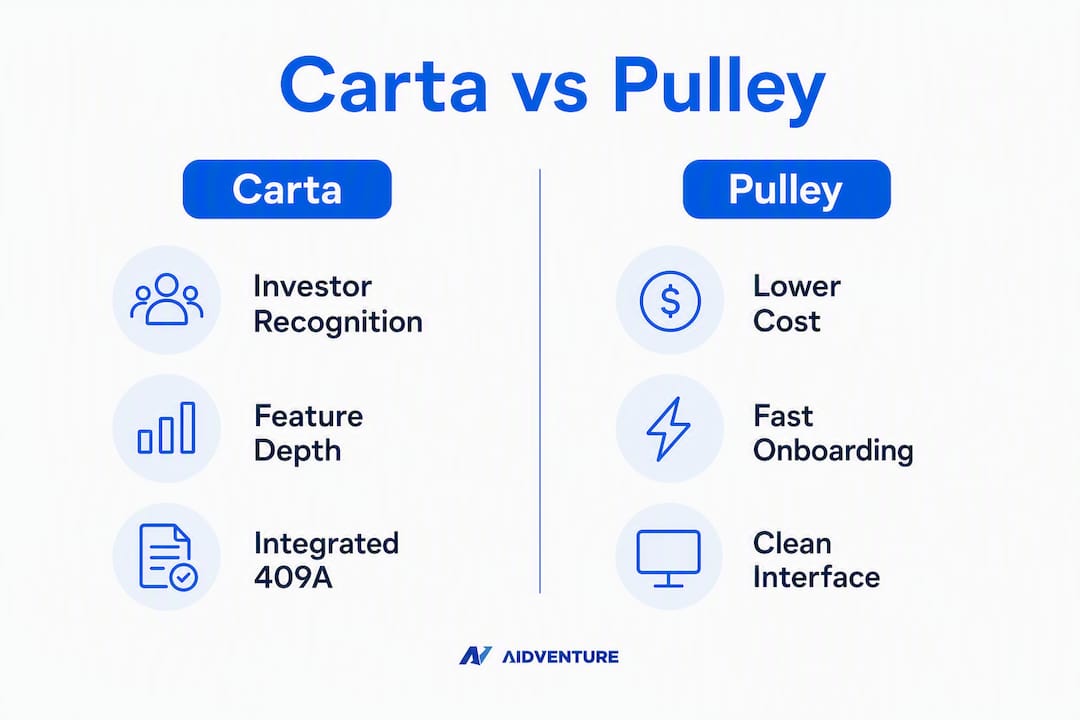
Beancount’s 2026 guide frames the decision cleanly: Carta’s investor recognition and feature depth versus Pulley’s pricing transparency and operational speed. Here’s how those tradeoffs play out across the dimensions finance leaders actually weigh.
| Dimension | Carta edge | Pulley edge |
|---|---|---|
| 409A speed | Integrated, audit-defensible | Faster turnaround for early-stage grants |
| Pricing transparency | — | Public tiers; no sales call required |
| Fund admin / secondaries | CartaX + full fund admin | Not a core offering |
| Ease of use | — | Cleaner UX; lower admin burden |
| Investor familiarity | Strong institutional footprint | Growing but smaller |
| Scalability | Enterprise-grade | Series B ceiling for most teams |
| Security (SOC 2) | Certified | Certified |
409A and valuation speed. Both platforms offer 409A support, but the operational difference matters. Pulley’s faster turnaround is a real advantage when you’re issuing grants ahead of a raise and need an IRS-defensible valuation quickly. That said, verify any accelerated timeline against your auditors: some institutional auditors have preferred providers and specific documentation requirements that automated fast-turnaround services must still satisfy.
Integrations. Carta’s integration library is broader at the enterprise level, covering QuickBooks, Rippling, and major HCM systems. Pulley’s integration coverage is growing and sufficient for most seed through Series A workflows. If your accounting stack includes a less common ERP, confirm compatibility before committing.
Pricing and hidden costs. Subscription fees are only part of the picture. Founders frequently cite operational drag from slow 409A cycles and manual option exercise reconciliation as a bigger hidden cost than the platform fee itself. A platform that reduces reconciliation hours saves real finance team time, which compounds across every grant cycle and audit.
Security and compliance. Both platforms are SOC 2 certified. When running vendor due diligence, ask specifically about encryption at rest and in transit, role-based access controls, and audit log exports. These details matter when your auditors or investors request documentation.
Key signal: StackFYI’s 2026 analysis maps the decision by stage: Pulley is the right default from pre-incorporation through Series B; Carta becomes the better choice when secondaries and institutional fund administration are imminent.
Migration effort. Clean seed-stage cap tables typically migrate in 2–6 weeks. Complexity rises with convertible instruments, multi-entity structures, and outstanding warrants that require legal re-papering. Plan for the longer end if your cap table has any of these.
How do you decide between Carta and Pulley for your company?
Work through this checklist before your next vendor call. The answers will tell you which platform fits your current stage and near-term trajectory.
Decision checklist:
- What is your next expected round, and who is the likely lead investor? If your lead investor’s fund already operates on Carta for portfolio reporting, staying on Carta eliminates a reconciliation step.
- Are secondary transactions or tender offers in your 18-month plan? If yes, Carta’s CartaX rails are a material advantage.
- How many stakeholders are on your cap table, and where are they located? Pulley’s free tier covers up to 25 stakeholders. International stakeholders may require specific plan coverage.
- How frequently do you need 409A valuations? High-frequency grant cycles favor Pulley’s faster turnaround model.
- What accounting and HCM systems do you use? Confirm integration compatibility with both vendors before signing.
- How sensitive is your budget to opaque pricing? If you’re managing runway tightly without a finance hire, Pulley’s public pricing reduces procurement friction.
Red flags to watch for in vendor contracts:
- Stakeholder-based pricing that triggers automatic tier upgrades post-raise
- Gated features (fund admin, secondary rails) that require separate contracts
- Consent language in secondary offering workflows that affects investor relations
- Auto-renewal clauses with limited notice windows
A 7–14 day trial plan:
- Day 1–3: Import a sample cap table and run a round model with dilution scenarios
- Day 4–7: Request a sample 409A timeline and documentation package from each vendor
- Day 8–10: Export an investor-facing report and test your accounting system integration
- Day 11–14: Run a mock option grant workflow end-to-end and time the process
Decision rules:
- If you are pre-seed through Series A with no secondary plans, choose Pulley.
- If your lead investor or counsel already uses Carta, stay on Carta.
- If fund administration or CartaX secondaries are in your near-term plan, choose Carta.
- If you have significant non-U.S. stakeholders with complex international stock plan requirements, evaluate Capdesk alongside both.
- If you incorporated via AngelList and want a bundled equity and banking experience, AngelList Stack is worth evaluating.
Pro Tip: Ask your lead investor’s fund operations contact which platform they use for portfolio reporting before you sign any cap table contract. That single answer often resolves the Carta vs. Pulley decision faster than any feature comparison.
What does migration actually cost in time and money?
Practical migration guidance consistently estimates 2–6 weeks for clean seed or Series A cap tables. That window extends significantly with convertible instruments, multi-entity structures, or unreconciled option exercises.
Preparatory tasks before migration:
- Reconcile all exercised options against your current records
- Clean outstanding warrants and confirm expiration dates
- Finalize your 409A history and confirm documentation is complete
- Notify investors and counsel of the planned migration window
- Freeze secondary transactions and new grants during the active migration period
Cost items to budget:
- Vendor onboarding fees (varies by platform and plan tier)
- Legal re-papering for equity instruments that require updated plan documentation
- 409A valuation fees if a new valuation is required at migration
- Internal finance hours for reconciliation and data validation
- Director and investor coordination time for consent or acknowledgment workflows
Implementation owner: Assign a single internal owner, typically your CFO, Head of Finance, or a fractional CFO, to lead the migration. Involve legal counsel for re-papering and your accounting team for reconciliation sign-off. Do not run a migration during an active fundraising process.
Common pitfalls:
- Unreconciled exercised options that surface mid-migration and require manual correction
- Multi-entity complexity that extends timelines by weeks
- Investor reporting mismatches when the new platform’s export format differs from what investors expect
- Missing 409A documentation that delays the first post-migration valuation
Pro Tip: Get investor sign-off on the migration plan before you start. Freezing secondary actions and new grants for a defined 2–4 week window prevents data conflicts and gives your legal team a clean cut-over point.
When does software alone fall short? Aidventure’s practical guidance
Cap table software manages legal ownership records. It does not automatically translate equity data into GAAP-compliant financial statements, fundraising models, or audit-ready reports. That gap is where fractional CFO support adds material value.
Scenarios where Aidventure’s fractional CFO practice reduces risk:
- Aligning cap table data with ASC 718 stock-based compensation expense under GAAP
- Preparing audit-ready equity schedules for Series A or B diligence
- Integrating option exercise records with payroll and tax reporting
- Building board-ready equity reports that reconcile cap table data with financial statements
- Managing multi-entity equity accounting across subsidiaries or international entities
A 30–90 day fractional engagement playbook:
- Days 1–30: Reconcile cap table records against accounting ledgers; validate 409A history; identify gaps in option exercise documentation.
- Days 30–60: Integrate cap table exports with your accounting system and financial dashboards; establish recurring grant and exercise workflows.
- Days 60–90: Operationalize board reporting, investor equity schedules, and audit-ready export processes for ongoing use.
Expected deliverables:
- Audit-ready cap table exports reconciled to the general ledger
- Reconciled option exercise records with tax withholding documentation
- Board-ready equity reports suitable for Series A+ diligence packages
- Documented grant and exercise workflows for the finance team
Founders often discover the gap between their cap table software and their financial statements only when an auditor or investor asks for a reconciliation. Closing that gap before a raise, not during one, is the single highest-leverage thing a fractional CFO does in the first 30 days of an engagement.
For teams evaluating whether to manage finances without a full-time CFO, Aidventure’s fractional CFO services cover the full equity-to-accounting workflow, from cap table reconciliation through fundraising readiness.
What do users say about Carta and Pulley?
User sentiment across review platforms and practitioner write-ups follows a consistent pattern. Carta users at later stages value its institutional depth and the fact that investors and counsel are already familiar with its reporting formats. The most common complaints center on pricing opacity and the learning curve for smaller teams.
Pulley users consistently cite the cleaner interface and faster onboarding as the primary reasons for choosing it over Carta. Founders running frequent option grants appreciate the reduced admin burden. The most common limitation noted is shallower fund administration and secondary market coverage, which becomes relevant as companies scale toward Series C.
VCBeast’s 2026 comparison captures this split directly: Carta’s in-house 409A integration and CartaX secondary rails versus Pulley’s founder-oriented UX and published pricing tiers. Neither platform dominates on every dimension; the right choice depends on stage and near-term equity events.
Real-world startup scenarios: Carta vs. Pulley in practice
Seed-stage SaaS company, 12 employees, 3 investors. A founder issuing options to the first engineering hires needs a fast 409A, a clean grant workflow, and predictable monthly costs. Pulley’s free tier and faster 409A positioning fit this scenario directly. The admin burden is low enough for the founder to manage without a finance hire.
Series A company, 45 employees, preparing for a Series B. The finance lead needs to reconcile the cap table with GAAP stock-based compensation expense, produce an investor-ready equity schedule, and confirm the platform’s 409A documentation meets the auditor’s requirements. At this stage, the decision often pivots on lead investor preference. If the Series B lead operates on Carta for portfolio reporting, switching to Carta before the round closes reduces ongoing reconciliation work.

Series B company with a secondary transaction planned. CartaX is the clearest differentiator here. Carta’s secondary market rails handle tender offer mechanics and investor consent workflows that Pulley does not replicate. Dr. Comps’ 2026 analysis lists tender offers and multi-entity support as explicit buying triggers for Carta.
International company with significant non-U.S. stakeholders. Neither Carta nor Pulley is the primary recommendation here. Capdesk covers multi-country option schemes and compliance workflows outside the U.S. more directly than either U.S.-focused platform.
AngelList-incorporated founder. If you raised your round on AngelList and already use its ecosystem, AngelList Stack bundles equity management with banking and incorporation services in a way that reduces integration overhead. Capbase is worth evaluating for early-stage founders who want cap table management tightly integrated with legal document automation.
How fast are Carta and Pulley shipping new features?
Both platforms have been active on product development through 2025 and into 2026. Carta’s roadmap has focused on expanding its data products, deepening fund administration workflows, and improving the CartaX secondary market experience. Its State of Private Markets reporting reflects ongoing investment in market intelligence as a product layer.
Pulley has concentrated development on the founder-facing workflow: faster onboarding, improved scenario modeling, and expanding its integration library. The public pricing model creates a natural incentive to keep the product accessible and low-friction for early-stage teams.
For founders making a long-term platform decision, the relevant question is not which platform shipped more features last quarter but which roadmap aligns with your equity complexity over the next 24 months. A seed-stage company that expects to stay on Pulley through Series A should confirm that Pulley’s integration roadmap covers the accounting and HCM systems it plans to adopt. A Series B company evaluating Carta should confirm that fund administration and secondary market features are included in its contracted tier, not gated behind a separate agreement.
Key Takeaways
Pulley is the stronger default for pre-seed through Series A startups; Carta is the pragmatic choice when secondary transactions, institutional fund administration, or Series B investor reporting requirements enter the picture.
| Point | Details |
|---|---|
| Stage drives the decision | Pulley fits pre-seed through Series A; Carta fits Series B+ and fund admin needs. |
| Pricing transparency matters | Pulley publishes tiers openly; Carta requires a sales call for most growth plans. |
| Investor preference can override features | If your lead investor uses Carta for portfolio reporting, switching friction may outweigh Pulley’s advantages. |
| Migration takes several weeks minimum | Clean cap tables migrate in 2–6 weeks; convertible instruments and multi-entity structures extend that timeline. |
| Aidventure bridges the gap | Aidventure’s fractional CFO services connect cap table data to GAAP reporting and audit-ready fundraising packages. |
A fractional CFO’s honest take on this decision
The Carta vs. Pulley debate gets framed as a feature comparison, but the founders who regret their platform choice almost never cite a missing feature. They cite switching costs they didn’t anticipate: the legal re-papering, the investor coordination, the reconciliation work that surfaces when their accounting team tries to tie option exercise records to payroll tax filings.
The practical reality is that switching platforms after Series A is expensive in ways that don’t show up in a subscription comparison. Investor workflows, fund reporting formats, and legal documentation are often tied into the incumbent platform. Moving them requires coordination with institutional investors who have their own timelines and preferences.
The single most useful thing you can do in the next 48 hours: email your lead investor’s fund operations contact and ask which cap table platform they use for portfolio reporting. That answer, combined with your current stage and whether secondary transactions are in your near-term plan, will resolve the decision faster than any feature matrix.
Aidventure’s fractional CFO services for equity and accounting alignment
Cap table software handles legal ownership. Getting that data into audit-ready financial statements, GAAP-compliant stock-based compensation schedules, and investor-ready fundraising models requires hands-on finance expertise, not just a software subscription.

Aidventure’s fractional CFO and accounting operations practice works directly with SaaS startups at the pre-raise and post-raise stages to close the gap between cap table records and financial reporting. The engagement covers cap table reconciliation, ASC 718 expense modeling, audit preparation, and board-ready equity reporting, typically structured as a 30–90 day playbook that operationalizes the process for your internal team.
Engagement triggers include pre-Series A or B diligence preparation, platform migration, and audit readiness. For founders evaluating their financial management options before a raise, a fractional CFO engagement typically costs less than one round of audit corrections.
Schedule a consult with Aidventure to confirm whether your cap table data is ready for your next raise.
Further reading and credible sources
- Carta vs Pulley in 2026: honest cap table verdict | Causo Hub — Best for: a direct head-to-head verdict with practical pick rules by startup stage.
- Carta vs Pulley vs Ledgy: How Startup Founders Should Choose Cap Table Management Software in 2026 | Beancount.io — Best for: understanding pricing posture and investor recognition differences; includes Ledgy as a European alternative.
- SEC Rule 701 | SEC.gov — Best for: confirming the federal exemption framework governing equity compensation plans; relevant when structuring option pools.
Must-read before running a trial this week: Start with the StackFYI guide for stage-based decision rules, then check the Hire Chore migration guide to budget your switching timeline and costs before signing anything.