What are the best fractional CFO alternatives to CFO.ventures?
The strongest alternatives to CFO.ventures are fractional CFO providers matched to your startup’s stage, sector, and capital needs. Choosing the wrong firm costs more than the retainer fee. It costs months of misaligned financial strategy at exactly the moment your business cannot afford it.
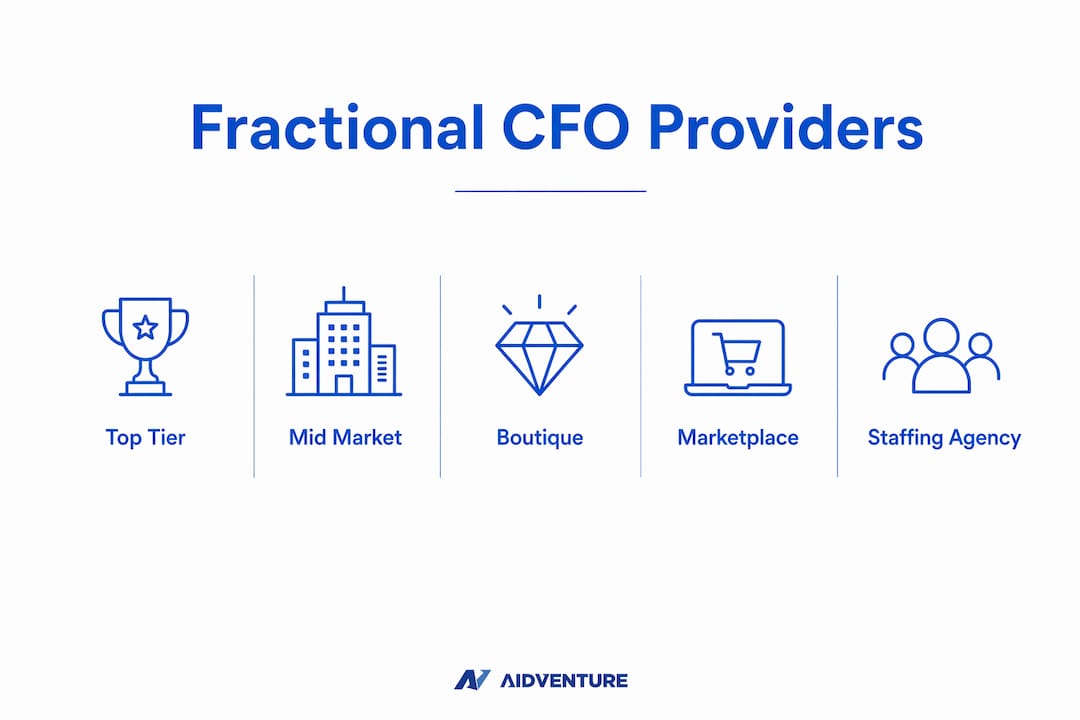
The market breaks into three delivery models: partner-led boutiques, tech-enabled marketplaces, and staffing-agency placements. Boutiques typically onboard over several weeks with a team that includes a CFO, VP, analysts, and bookkeeping support, while marketplaces promise matching within 48 hours. Neither is universally better. The right choice depends on whether you need deep integration or fast access to a specific skill set.
Pricing ranges from $1,500 to $35,000+ per month depending on engagement model and scope. Early-stage tech platforms with light advisory start at $1,500/month, while boutique partner-led retainers for midmarket clients range from $3,000 to $10,000+ per month. Staffing-agency placements add a 25–40% margin on contractor rates, resulting in monthly costs of $18,000–$32,000 after markup; senior-partner-led firms generally range $15,000–$35,000/month.
| Provider | Best For | Key Strengths | Pricing | Industry Focus | Delivery Model |
|---|---|---|---|---|---|
| KORE1 | Mid-sized startups, PE-backed firms | Senior partner-led, investor network access | $$$$ | Multi-industry | Partner-led |
| CFO Hub | SMBs seeking flexible CFO services | Transparent pricing, financial reporting | $$$ | Broad industries | Flexible retainer |
| FocusCFO | Growth-stage startups | Embedded leadership, long-term partnerships | $$$ | Professional services, generalist | Boutique, embedded |
| FLG Partners | Series B+ startups | Operational finance, capital raise expertise | $$$$ | Generalist | Partner-led |
| airCFO | VC-backed SaaS companies | SaaS metrics, bundled accounting and tax | $$$ | SaaS | Full finance stack |
| The Chalifour Consulting Group | Small to mid-market companies | Growth-oriented forecasting, hands-on advisory | $$ | SMB generalist | Boutique |
| McCracken Alliance | $20M–$200M enterprises | Senior-partner engagements, broad verticals | $$$$ | Mid-market generalist | Partner-led |
| Preferred CFO | Generalist startup needs | Project-flexible, adaptable service models | $$$ | Multi-industry | Retainer, project |
| CFOshare | Distressed businesses, M&A | Financial restructuring, wide industry range | $$$ | Multi-industry | Boutique |
| Paro | Flexible freelance finance access | AI-driven matching, vetted talent pool | $$ | Broad | Marketplace |
| CFO Advisors | VC-backed startups | Sequoia-backed specialist network | $$$$ | Venture-backed | Boutique advisory |
| Graphite | Tech startups needing elite talent | Bain and McKinsey alumni, on-demand access | $$$$ | Tech, startups | Marketplace |
SaaS founders should prioritize airCFO or CFO Advisors. Generalist needs across professional services or ecommerce fit Preferred CFO, FocusCFO, or CFO Hub. Businesses in distress or mid-acquisition belong with CFOshare. For on-demand flexibility without a long-term commitment, Paro and Graphite offer marketplace access to vetted finance professionals.
Detailed profiles of leading fractional CFO providers
Industry specialization consistently outperforms generalism in fractional CFO engagements. A SaaS CFO who understands ARR cohorts, net revenue retention, and the rule of 40 delivers measurably different outcomes than a generalist applying a standard P&L lens. That principle shapes how each provider below is best evaluated.
KORE1
KORE1 operates a partner-led model built for midmarket startups and PE-backed companies that need senior strategic finance leadership, not a contractor on their payroll. Every engagement is run by a senior partner with direct investor network connections, which matters most during fundraising rounds or pre-exit preparation. Onboarding is expedited compared to staffing-agency alternatives, and the firm positions itself as a bridge between fractional support and full-time CFO placement.
CFO Hub
CFO Hub covers a broad range of industries with transparent, customizable packages suited to SMBs that want predictable costs. Its financial reporting capabilities are a genuine strength, and the firm handles M&A support and ERP optimization alongside standard CFO functions. Founders who want flexibility without committing to a high-cost boutique retainer often find CFO Hub a practical fit.

FocusCFO
FocusCFO embeds its CFOs directly into client leadership teams rather than operating as external consultants. That model works best for growth-stage businesses that want a financial leader present in weekly operations, not just monthly board prep. The firm emphasizes long-term, collaborative partnerships, and its generalist orientation makes it well-suited to professional services firms and owner-operated businesses scaling past $5M in revenue.
FLG Partners
FLG Partners targets Series B and beyond, where the financial complexity of operational finance, capital raises, and investor reporting demands experienced CFOs with broad skill sets. The firm’s partners have typically held full-time CFO roles at comparable companies, which translates into faster pattern recognition on the issues that matter at that stage.
airCFO
airCFO is purpose-built for VC-backed SaaS companies. The firm bundles CFO services with accounting and tax integration, which eliminates the coordination overhead that comes with managing separate vendors. Its CFOs understand SaaS unit economics natively, including ARR and MRR cohort analysis, deferred revenue, and expansion versus new logo modeling. For a seed-to-Series B SaaS startup, airCFO’s full finance stack approach reduces the number of financial vendors a founder needs to manage.
The Chalifour Consulting Group
The Chalifour Consulting Group focuses on small to mid-market companies that need growth-oriented financial planning without the cost of a large boutique. The firm’s hands-on advisory style and emphasis on forecasting make it a practical choice for founders who want a CFO partner involved in planning cycles, not just reporting.
McCracken Alliance
McCracken Alliance serves the $20M–$200M enterprise segment with senior-partner-led engagements across multiple industry verticals. The firm’s onboarding typically runs 2–3 weeks, faster than staffing-agency alternatives, and its transparent retainer model avoids the markup that agency placements carry. For mid-market companies that need generalist operational finance leadership, McCracken is a consistent shortlist candidate.
Preferred CFO
Preferred CFO positions itself as a high-level financial strategy resource for businesses that want expert guidance without the cost of a full-time executive. The firm’s service model is project-flexible, meaning engagement scope can expand during fundraising or contract during steady-state periods. It serves a wide range of industries and works well for founders who need a CFO partner that adapts to shifting priorities.
CFOshare
CFOshare goes beyond typical fractional CFO duties by including bookkeeping and specialized support for businesses in financial distress or undergoing acquisition. Its industry range spans manufacturing, real estate, tech, and food and beverage, which gives it genuine cross-sector experience. Founders navigating M&A or restructuring will find CFOshare’s breadth more relevant than a narrowly specialized firm.
- Financial restructuring and distressed business support
- Acquisition due diligence and integration finance
- Bookkeeping bundled with CFO services
- Wide industry coverage including manufacturing and real estate
Paro
Paro uses an AI-powered platform to match businesses with vetted freelance finance professionals, including fractional CFOs, accountants, and FP&A specialists. The marketplace model suits founders who want to build a custom finance team on a project basis rather than commit to a single-firm retainer. Matching speed is a genuine advantage, though the depth of integration is typically shallower than a boutique partner-led engagement.
CFO Advisors
CFO Advisors operates as a boutique advisory network with a Sequoia-backed specialist focus on venture-backed founders. The firm’s network connections into the VC ecosystem give it an edge for startups preparing for institutional fundraising, where investor relationships and credibility matter as much as the financial model itself.
Graphite
Graphite runs a marketplace model similar to Paro but with a specific focus on elite finance and accounting talent from top-tier consulting firms, including Bain and McKinsey alumni. Tech startups that need a high-caliber CFO or FP&A lead for a defined project, such as a Series B model build or an acquisition analysis, can access that talent on demand without a long-term retainer. The trade-off is cost: Graphite’s talent tier commands premium rates.
Firms that combine CFO leadership with integrated bookkeeping, FP&A, and tax services tend to support faster growth by reducing the coordination overhead founders otherwise absorb themselves.
How to select the ideal fractional CFO partner for your startup
The single most important selection criterion is industry fit, not firm size or review count. A CFO who has built SaaS financial models for ten VC-backed companies will outperform a generalist with broader credentials every time, because the modeling work for SaaS (ARR cohorts, net revenue retention, rule of 40) is fundamentally different from ecommerce or professional services.
Key evaluation criteria:
- Industry fit: Does the firm’s client roster include companies at your stage and in your sector?
- Engagement model: Partner-led boutique, marketplace, or staffing agency? Each carries different cost structures and integration depths.
- Partner experience: Who specifically will run your engagement? Ask for the individual’s background, not the firm’s aggregate credentials.
- Pricing transparency: Are retainer fees fixed, or does the firm add markup on contractor rates?
- Onboarding process: Does the firm have a defined integration plan, or does onboarding depend on the individual CFO’s style?
On pricing, the range runs from $1,500 to $35,000+ per month depending on scope and provider model. Early-stage tech platforms start at $1,500/month for advisory services. Boutique partner-led retainers for midmarket and growth-stage clients typically range from $3,000 to $10,000+ per month. Staffing-agency models with contractor placement add a substantial margin, often resulting in costs of $18,000–$32,000/month after agency markup, while senior-partner-led firms may charge $15,000–$35,000/month in transparent retainers.
When to move from fractional to full-time
The trigger for a full-time CFO hire is usually a combination of revenue scale, transaction complexity, and board expectations. Most companies operating at higher revenue and with active investor reporting obligations find that a fractional engagement no longer covers the necessary hours. The fractional model works best as a permanent solution for smaller companies, and as a bridge for companies between funding rounds or preparing for an acquisition.
Onboarding timelines
Many elite firms require 2–4 weeks to integrate fully into client systems and operating rhythm, and a 90-day integration sprint is considered best practice for effectiveness. Marketplace platforms can match you with a CFO in 48 hours, but fast matching is not the same as fast productivity. A CFO who joins your weekly leadership meeting in week one without understanding your financial model, your cap table, or your board’s reporting preferences will cost you more time than a slower, structured onboarding.
Pro Tip: Request direct reference checks from at least three current clients in your industry and at your growth stage. Platform ratings are noisy signals; a direct conversation with a founder who used the firm six months ago at a similar revenue run rate will tell you more than any aggregate score.
Red flags to watch for:
- A firm that cannot name the specific partner running your engagement before you sign
- Pricing that changes materially after the initial proposal
- No defined onboarding plan or integration sprint
- References that are all from a different industry or growth stage than yours
- Promises of immediate productivity without a discovery period
What do fractional CFOs do, and why do startups hire them?
A fractional CFO provides the same strategic financial leadership as a full-time CFO, working across multiple client companies simultaneously rather than for one employer. The scope covers the high-level work: financial modeling, board materials, fundraising strategy, and major decision analysis. What it does not cover is daily operational detail or attendance at every internal meeting.
Core fractional CFO deliverables include:
- 13-week rolling cash forecasts, board packs, and fundraising financials
- SaaS unit economic modeling, including ARR cohort analysis and net revenue retention
- KPI monitoring and financial reporting frameworks
- Fundraise preparation and investor relations support
- Strategic decision support on pricing, hiring, and capital allocation
The business case for hiring fractionally rather than full-time is straightforward. A full-time CFO can be very expensive annually, including salary, bonus, equity, benefits, and recruiting fees. A fractional engagement provides senior-level financial leadership at a much lower cost, with no long-term commitment and no equity dilution.
How fractional CFO needs differ by industry
Industry context shapes what a fractional CFO actually does week to week. For SaaS companies, the work centers on ARR and MRR cohort analysis, deferred revenue accounting, expansion versus new logo modeling, and rule-of-40 reporting. For ecommerce and direct-to-consumer brands, the priorities shift to channel-level unit economics, inventory aging, marketplace fee modeling, and 13-week cash forecasts integrated with inventory purchases. Professional services firms need utilization tracking, billing realization analysis, and project profitability reporting. Manufacturing requires work-in-progress schedules, capacity utilization, and product-line margin analysis.
Generalist CFOs can serve professional services and early-stage companies adequately. SaaS and ecommerce companies at Series A and beyond typically see better outcomes with specialists who understand their sector’s specific financial mechanics.
Typical contract terms and service models
Most fractional CFO engagements run on monthly retainers with a defined scope of hours per week, typically 1–2 days. Some firms offer project-based engagements for defined deliverables like a fundraising financial model or an acquisition analysis. Contract lengths vary: boutique firms often prefer 6-month minimum commitments to justify the onboarding investment, while marketplace platforms like Paro and Graphite support shorter project-based arrangements. You can explore managing finances without a full-time CFO as a framework for understanding which engagement model fits your current stage before committing to a retainer.
Aidventure offers a focused alternative for SaaS startups
If the providers compared above feel like a broad market scan rather than a direct answer for your SaaS startup, Aidventure takes a different approach. Rather than a generalist retainer or a marketplace match, Aidventure specializes in financial management for SaaS companies working toward scale, combining fractional CFO services with accounting operations, data solutions, and financial reporting in one integrated engagement.

The practical difference is clarity. Aidventure focuses on the metrics that matter for SaaS growth: ARR, churn, net revenue retention, and the financial reporting frameworks that give founders and investors a clear picture of where the business is headed. For founders who want a financial partner that understands SaaS unit economics without having to educate a generalist CFO on the basics, Aidventure’s model is built around that specific need. You can also review Aidventure’s startup budget planning guidance to assess whether your financial foundations are ready for a fractional CFO engagement.
Key Takeaways
The right fractional CFO alternative to CFO.ventures depends on your startup’s stage, industry, and whether you need deep integration or flexible on-demand access.
| Point | Details |
|---|---|
| Industry fit is the top criterion | Match your provider to your sector: airCFO for SaaS, CFOshare for M&A or distress, FocusCFO for professional services. |
| Pricing ranges from $1,500 to $35,000+ per month | Early-stage tech platforms for light advisory start at $1,500/month; boutique partner-led retainers for midmarket clients typically range from $3,000 to $10,000+ per month. Staffing-agency placements cost $18,000–$32,000/month after markup, and senior-partner-led firms range $15,000–$35,000/month in transparent retainers. |
| Onboarding takes 2–4 weeks at elite firms | A 90-day integration sprint is best practice; fast marketplace matching does not equal fast productivity. |
| Verify providers with direct reference checks | Platform ratings are noisy signals; three direct client references in your industry are far more reliable. |
| Aidventure suits SaaS startups specifically | Aidventure combines fractional CFO services with accounting operations and SaaS metrics reporting in one engagement. |