Days Sales Outstanding (DSO) for SaaS equals (Accounts Receivable ÷ Net Credit Sales) × Number of Days in the period. Investopedia confirms this canonical formula and demonstrates it across a three-month worked example. The one decision you must make before running the math: which denominator to use. OpenView’s operational guidance is clear — use Billings (invoiced) when contracts are firm and non-cancellable; use Recognized/Net Revenue when contracts include rights of return, cancellation clauses, or revenue-reduction adjustments tied to future events.
Quick benchmarks by billing model:
- Card-first / self-serve: DSO of 1–5 days is normal; anything above 10 days warrants investigation.
- Mixed (monthly + annual invoiced): 15–30 days is the healthy range.
- Enterprise invoice-heavy: 30–90+ days is common, though the trend matters more than the absolute number.
SINGOA’s mid-market benchmark data puts the SaaS median at approximately 35 days. Watch the direction of your DSO over three consecutive months before reacting to any single reading.
Key Takeaways
Correct DSO calculation for SaaS requires choosing the right formula variant for your contract structure, using the appropriate denominator, and feeding the result directly into your 90-day cash forecast.
| Point | Details |
|---|---|
| Use the right denominator | Use billings for firm contracts; use recognized revenue when cancellation or return rights apply. |
| Match the method to growth rate | Use countback or 90-day rolling DSO when growing faster than approximately 20% YoY. |
| Segment before you benchmark | Card-first DSO targets (1–5 days) and enterprise targets (30–90 days) must be tracked separately. |
| DSO drives cash forecasting | A rise in DSO can materially impact cash inflows relative to accounts receivable balances, potentially reducing short-term cash availability. |
| Pair DSO with aging mix | A clean blended DSO can mask concentration risk; always track the 61–90-day aging band alongside DSO. |
Table of Contents
- How to calculate DSO for SaaS: formula variants and when to use each
- Step-by-step: pulling the numbers and running the calculation
- SaaS-specific edge cases and accounting policy notes
- What good DSO looks like: benchmarks by billing model
- How DSO feeds your 90-day cash forecast
- Proven tactics to reduce DSO in SaaS
- The Aidventure 30/60/90 DSO implementation playbook
- The metric most SaaS teams are calculating wrong
- Sources
How to calculate DSO for SaaS: formula variants and when to use each
The canonical formula is the starting point, but SaaS businesses need at least four variants in their toolkit because growth rates, contract structures, and billing cycles each distort a single-period snapshot differently.
The four core variants
1. Canonical (period-end AR)
DSO = (AR at period end ÷ Net credit sales for period) × Days in period
Example: AR = $120,000; billings for 30-day month = $200,000. DSO = (120,000 ÷ 200,000) × 30 = 18 days.
2. Average-AR variant
DSO = ((Opening AR + Closing AR) ÷ 2) ÷ Daily credit sales
Smooths the distortion caused by a large invoice batch hitting on the last day of the month. Use this when your billing run is concentrated in the final week of the period.
3. Rolling-window DSO (trailing 30 or 90 days)
Sum AR at the end of the window, divide by total billings over the window, multiply by the number of days. A 90-day rolling figure removes month-to-month timing noise and is the preferred metric for board reporting. SINGOA recommends the countback/rolling approach for any business growing faster than approximately 20% year-over-year, because rapid growth inflates the denominator and makes DSO look artificially low on a single-period basis.
4. Countback / AR-runoff method
Work backward from the AR balance, subtracting the most recent month’s billings first, then the prior month’s, until the AR balance reaches zero. The number of days consumed gives you DSO. This is the most accurate method for annual-contract or prepaid SaaS businesses where a single large invoice can dominate the AR balance for weeks.
Customer-level rolling calculation: Apply the rolling-window formula to each customer segment (or individual enterprise account) separately, then weight by AR balance to produce a blended company DSO. This surfaces which customer cohort is actually driving collection lag.
Variable-definition table
| Variable | Formula symbol | Source system field |
|---|---|---|
| Accounts receivable | AR | AR trial balance (GL control account) |
| Net credit sales / Billings | S | Billing system invoice register |
| Recognized revenue | R | Revenue subledger (ASC 606 schedule) |
| Days in period | D | Calendar (30, 31, 90) |
| Average AR | (AR₀ + AR₁) ÷ 2 | GL opening + closing AR balances |
| Cash collected | C | Cash application / payment receipts report |
Which variant fits your business?
- Growing >20% YoY or seasonal billing peaks: use countback or 90-day rolling.
- Stable, monthly recurring billing with card-on-file: canonical period-end is sufficient.
- Annual or multi-year contracts: countback only; single-period will overstate DSO.
- Mixed billing model (monthly + annual): segment into two buckets, calculate separately, then report a weighted blend.
- Board or investor reporting: 90-day rolling DSO, always.
Step-by-step: pulling the numbers and running the calculation
Correct DSO starts with clean data. A formula applied to mismatched inputs produces a number that looks precise and is wrong.
Step 1: Pull your data sources
- AR trial balance — from your GL (e.g., QuickBooks, NetSuite, Sage Intacct) — use the period-end balance, net of allowances.
- Invoice register — from your billing platform (Stripe Billing, Chargebee, Recurly, Zuora) — filter to credit invoices only; exclude cash-collected-at-point-of-sale transactions.
Step 2: Spreadsheet structure (pseudocode)
Column A: Period (Month-Year)
Column B: AR_End (GL trial balance, period-end)
Column C: Billings (invoice register, period total)
Column D: Days (calendar days in period)
Column E: DSO_Canonical = (B / C) * D
Column F: AR_Avg = (B[prior] + B[current]) / 2
Column G: DSO_AvgAR = (F / C) * D
Column H: Rolling_AR = AR_End (current period)
Column I: Rolling_Billings = SUM(C[t], C[t-1], C[t-2])  // 3-month trailing
Column J: DSO_Rolling90 = (H / I) * 90
Flag any row where DSO_Canonical deviates from DSO_Rolling90 by more than 15 days — that gap usually signals a large invoice batch, a late billing run, or a cash application delay.
Worked example: monthly DSO
- AR at June 30: $180,000
- June billings (credit invoices only): $300,000
- Days in June: 30
DSO = (180,000 ÷ 300,000) × 30 = **18 days**
Worked example: 3-month (Q2) DSO
- AR at June 30: $180,000
- Q2 billings (April + May + June): $820,000
- Days in Q2: 91
DSO = (180,000 ÷ 820,000) × 91 = **20 days**
The quarterly figure is lower here because April and May billings were strong. That is the rolling-window smoothing effect in practice.
Common pitfalls
- Including cash sales: point-of-sale or card-captured revenue that never sits in AR inflates the denominator and understates DSO. Filter your invoice register to credit-term invoices only.
- Mismatched period definitions: AR balance is a point-in-time figure; billings must cover the same period. Mixing a month-end AR with a year-to-date billings figure produces a meaningless ratio.
- Late invoice batching: if your billing team runs invoices on the 3rd of the following month, your period-end AR is understated. Either accrue the unbilled amount or use the average-AR variant.
- Unapplied cash: payments sitting in a suspense account inflate AR and overstate DSO. Reconcile cash application before closing the period.
SaaS-specific edge cases and accounting policy notes
Annual and prepaid contracts
A customer who pays $120,000 upfront for an annual subscription creates zero AR the moment payment clears — but if they are invoiced net-30 before payment arrives, that invoice sits in AR for up to 30 days and spikes your period DSO. The AR-runoff (countback) method handles this correctly because it attributes the AR balance to the most recent billing period first, rather than spreading it across the year.
Prepaid renewals create the opposite distortion: AR drops to near zero at renewal, then rebuilds over the following month. A single-period DSO calculated at renewal month-end will look artificially low. Again, the 90-day rolling figure is the right lens.
Card-on-file and merchant-of-record arrangements
When you collect via card-on-file (Stripe, Braintree) or route through a merchant-of-record (Paddle, FastSpring), the payment typically settles within 1–3 business days. Your AR balance for those customers is effectively a settlement-timing float, not a collection risk. Set a separate internal DSO target for this segment — 3–5 days — and exclude it from enterprise DSO benchmarking. Blending the two inflates your apparent collection performance.
ASC 606 and denominator choice
Under ASC 606, recognized revenue can diverge meaningfully from billings when contracts include variable consideration, usage-based components, or material rights (e.g., renewal options priced below standalone selling price). If your recognized revenue for a period is $200,000 but billings were $350,000 (because you invoiced an annual contract upfront), using recognized revenue as the denominator produces a DSO of roughly 27 days on $180,000 AR — versus 15 days using billings. Neither number is wrong; they answer different questions. Billings-based DSO measures collection speed. Revenue-based DSO measures how long recognized revenue stays uncollected, which is the more conservative credit-risk view.
Recommended reporting disclosure template: “DSO for [Period] is calculated as (AR trial balance ÷ [Billings / Recognized Revenue — specify]) × [Days], consistent with [OpenView / ASC 606 guidance]. Denominator selection reflects [contract firmness / variable consideration policy] as documented in the revenue recognition schedule.”
OpenView’s guidance on denominator selection is the clearest practitioner reference for this disclosure. Adding one sentence like this to your monthly finance package prevents auditors and investors from misreading a billings-based DSO as a revenue-based one.
Churn, refunds, and contract modifications
A mid-period cancellation that triggers a credit memo reduces both AR and the effective billings for that customer. Apply the credit memo before calculating period DSO, not after. Contract modifications that increase the transaction price (upsells, seat expansions) should be treated as new billings in the period they are invoiced, not backdated to the original contract start date.
What good DSO looks like: benchmarks by billing model
A single DSO target for an entire SaaS business is almost always wrong. The right benchmark depends on how you bill.
| Billing model | Typical DSO range | Key driver |
|---|---|---|
| Card-first / self-serve | 1–5 days | Settlement float only |
| Monthly invoiced (SMB) | 10–20 days | Net-15 or Net-30 terms |
| Mixed (monthly + annual) | 15–30 days | Annual invoice timing |
| Enterprise invoiced | 30–90+ days | Negotiated Net-30/60/90 terms |
| Government / regulated | 45–120 days | Statutory payment cycles |
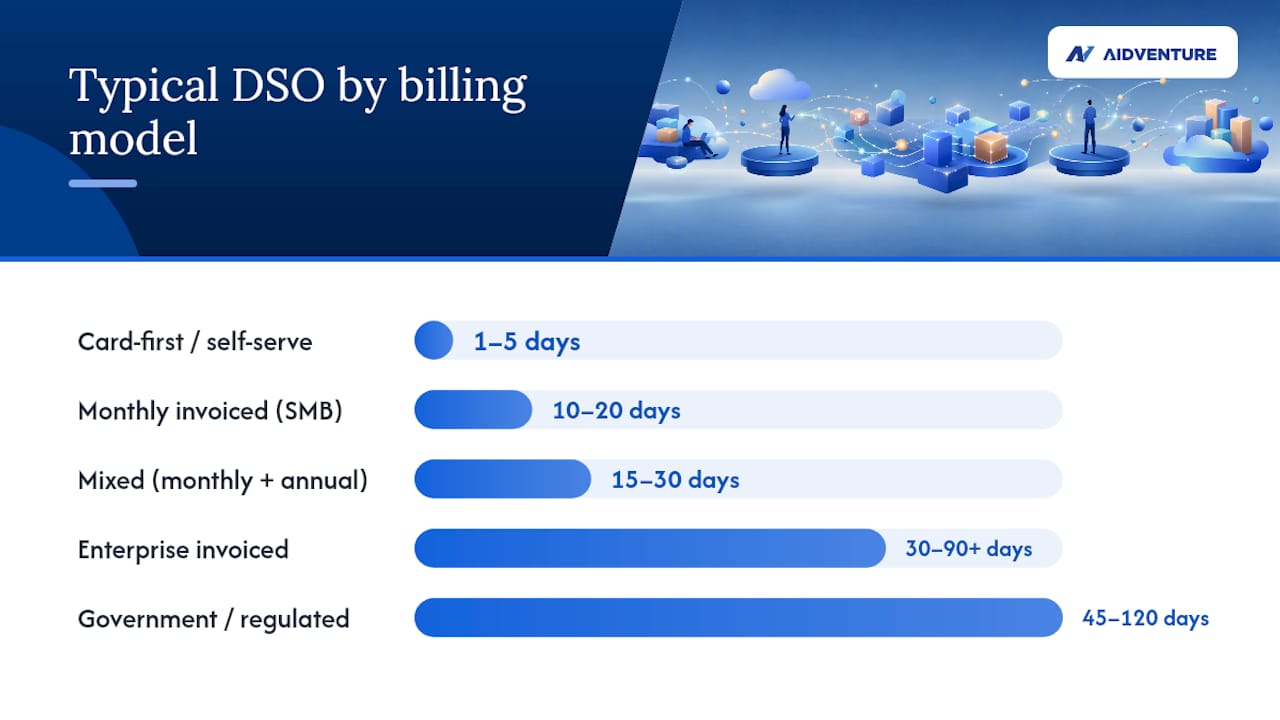
SINGOA’s mid-market SaaS median of approximately 35 days is a reasonable anchor for a mixed-model business. LedgerUp’s practical rule is equally useful: DSO should generally not exceed 1.5× your stated payment terms. On Net-30 terms, that means a target below 45 days.
DSO Efficiency Ratio
To compare DSO across companies with different payment terms, use the DSO Efficiency Ratio:
DSO Efficiency Ratio = DSO ÷ Average stated payment terms (days)
A ratio below 1.0 means you are collecting faster than your stated terms. Above 1.5 signals a collection problem. This normalization is especially useful when benchmarking against peers who offer Net-60 enterprise terms while you offer Net-30.
When a higher DSO is acceptable
- Milestone billing: revenue recognized at project completion; AR sits open until the milestone is accepted.
- Retainage: common in government and regulated-sector SaaS; a percentage of each invoice is withheld until contract completion.
- Long sales cycles with deferred invoicing: if your contract requires a purchase order before invoicing, the PO processing time adds days that are outside your control.
Document these exceptions in your monthly finance package with a note on the expected resolution date. An aging bucket labeled “PO pending” or “milestone in progress” keeps these items from triggering unnecessary collections escalation.
How DSO feeds your 90-day cash forecast
DSO converts directly into a cash-timing input. The formula is:
Expected cash receipt (day X) = AR balance × (1 ÷ DSO) × Days until expected collection
Example: AR = $500,000; DSO = 30 days. Expected cash inflow over the next 30 days = $500,000 × (30 ÷ 30) = $500,000 — assuming no new billings. If DSO rises to 45 days, the same AR balance produces only $333,000 in the same 30-day window, a $167,000 cash shortfall that must be funded from reserves or a credit facility.
For a 90-day SaaS cash forecast, layer DSO by customer segment: card-first customers contribute cash within 3–5 days of billing; enterprise customers contribute cash 30–60 days after invoice date. Summing the segment-level inflows gives a more accurate forecast than applying a single blended DSO to total AR.
Dashboard widgets that surface AR issues early
- Rolling 90-day DSO trend: a rising trend over three months is a leading indicator of collection deterioration, even if the absolute level looks acceptable.
- AR aging mix by band (0–30, 31–60, 61–90, 90+ days): a shift toward the 61–90 band before DSO moves is the earliest warning signal.
- Large-invoice concentration: the top 5 invoices as a percentage of total AR. A single overdue enterprise invoice can move company-wide DSO by 5–10 days.
- Collection velocity by segment: days from invoice date to cash receipt, tracked separately for card-first, SMB invoiced, and enterprise segments.
DSO alone can mask concentration risk. Gartner’s AR efficiency framework recommends pairing DSO with aging-mix and dispute-backlog metrics precisely because a clean blended DSO can coexist with a dangerously concentrated AR book.
Proven tactics to reduce DSO in SaaS
Reducing DSO is an operational problem, not just a finance problem. The highest-leverage changes happen at the billing and contracting stage, not in collections.
Process and contracting levers
- Bill on event, not on schedule: invoice immediately when a subscription activates, a milestone completes, or a renewal date hits. Delayed invoicing is the single most common cause of avoidable DSO inflation.
- Shorten payment terms at contract: move enterprise customers from Net-60 to Net-30 at renewal. A one-page amendment is easier to negotiate at renewal than mid-contract.
- Require a deposit or upfront payment for new enterprise logos: a 25–50% deposit reduces AR exposure on the first invoice and signals payment intent early.
- Add early-pay discounts selectively: a 1–2% discount for payment within 10 days (2/10 Net-30) is worth offering to customers with a history of paying at day 28–35. For cash flow optimization, the discount cost is usually less than the working-capital benefit.
Technology investments
Connecting billing, payments, and AR accounting on a single platform preserves invoice-level traceability from issuance through cash application. Zuora’s AR automation approach demonstrates how unified billing and AR accounting reduces the reconciliation gaps that produce incorrect DSO readings. Other platforms in this category include Chargebee, Maxio, and Stripe Revenue Recognition — each preserving the line-level detail that makes rolling DSO calculations reliable.
Collections SLA and escalation timeline
| Days past due | Owner | Action |
|---|---|---|
| 0–30 | AR specialist | Automated reminder at day 7, day 14, day 25 |
| 31–60 | Collections manager | Personal outreach; confirm invoice receipt and PO status |
| 61–90 | Finance director | Escalate to customer success; flag for executive sponsor |
| 90+ | CFO / legal | Formal demand letter; evaluate credit hold or service suspension |
Dunning automation tools (Chaser, Tesorio, YayPay) handle the 0–30 band reliably. The 31+ band requires human judgment, especially for enterprise accounts where a collections call can damage a renewal relationship if handled poorly.
The Aidventure 30/60/90 DSO implementation playbook
Getting DSO calculation right is a 90-day project, not a spreadsheet fix. Here is the phased roadmap Aidventure uses with scaling SaaS finance teams.
Days 1–30: establish the baseline
- Finance ops: reconcile AR trial balance to billing system invoice register. Identify and resolve any gaps exceeding 2% of AR.
- Revenue ops: confirm the revenue subledger is producing an ASC 606-compliant recognized-revenue schedule. Document the denominator policy (billings vs recognized revenue) in writing.
- Finance ops: build the canonical and rolling-90 DSO spreadsheet using the pseudocode structure above. Calculate the last six months of DSO using both methods.
- Acceptance criteria: a reconciled AR balance, a documented denominator policy, and six months of historical DSO in both canonical and rolling formats.
Days 31–60: build the dashboard and segment
- Finance ops + data/analytics: deploy the four dashboard widgets (rolling DSO trend, aging mix, large-invoice concentration, collection velocity by segment).
- Revenue ops: segment AR into card-first, SMB invoiced, and enterprise buckets. Set separate DSO targets for each bucket.
- Finance ops: run the SaaS KPI audit to validate that DSO, MRR, and CAC are calculated consistently and feeding the same data model.
- Acceptance criteria: a live dashboard with segment-level DSO, aging mix by band, and a dispute-backlog tracker.
Days 61–90: operationalize and forecast
- Finance director / fractional CFO: integrate rolling DSO into the 90-day cash forecast model. Validate that segment-level DSO inputs produce cash-inflow projections within 5% of actual collections.
- Collections manager: implement the SLA/escalation timeline above. Assign ownership for each aging band.
- Finance ops: set guardrails: if the 61–90-day aging band exceeds 15% of total AR, trigger an executive review. If write-offs exceed 0.5% of ARR in any quarter, review the credit-approval process.
- Acceptance criteria: DSO feeds the cash forecast, the escalation SLA is live, and guardrails are documented in the finance policy.
Pro Tip: Aidventure’s fractional CFO engagements consistently show that pairing a dedicated AR automation platform with fractional CFO oversight cuts the time to a reliable rolling DSO from three months to under four weeks. The CFO sets the policy; the platform enforces the data discipline.
The metric most SaaS teams are calculating wrong
DSO is one of the most cited metrics in SaaS finance and one of the most consistently miscalculated. The problem is not the formula. Every finance team knows the formula. The problem is the denominator and the method, and most teams default to whatever their accounting software exports without asking whether that output matches their contract structure.
The conventional advice — “just divide AR by revenue and multiply by days” — is fine for a stable, invoice-heavy business with uniform 30-day terms. It is wrong for a SaaS company with a mix of card-first self-serve, monthly SMB invoices, and annual enterprise contracts. Applied to that mix, a single-period canonical DSO will oscillate by 10–20 days month-to-month based on nothing more than when the annual renewal invoices hit. Finance leaders who report that number to their board without context are reporting noise, not signal.
The countback method is underused because it takes more work to set up. That is the wrong reason to avoid it.
The second gap is the forecasting connection. DSO is almost universally tracked as a reporting metric and almost never wired directly into the cash forecast model. That is a significant missed opportunity. A DSO that rises from 30 to 45 days on a $500,000 AR balance is a $167,000 cash shortfall in the current 30-day window. That number belongs in the forecast, not just the KPI dashboard.
The 30/60/90 playbook above is designed to close both gaps: get the calculation right first, then make it operationally useful.

This article is general information, not a substitute for advice from a qualified financial advisor. Consult a qualified financial professional about your own circumstances before acting on anything here.
Sources
- Understanding Days Sales Outstanding (DSO): Key Calculation and Applications
- Calculating Days Sales Outstanding for SaaS Companies
- How to Calculate DSO: Formula and Benchmarks 2026 | SINGOA | SINGOA
- What Is DSO (Days Sales Outstanding)? Formula, Benchmarks & How to Reduce It | LedgerUp