Cash flow challenges are defined as the gap between when money enters a business and when it must go out, creating liquidity shortfalls that can threaten survival even when revenue looks healthy. Nearly 38% of startups fail because they run out of cash. That statistic makes entrepreneur cash flow challenges explained not just a finance topic but a survival skill. Cash flow is distinct from profitability. A business can show a profit on its income statement while simultaneously lacking the cash to cover payroll next Friday. Mastering cash flow management for entrepreneurs starts with accepting that discipline around timing, not just revenue, determines whether a business lives or dies.
What are the most common cash flow challenges entrepreneurs face?
Cash flow problems arise from a predictable set of causes: late customer payments, high fixed overheads, thin cash reserves, poor revenue forecasting, and unmanaged growth. Each one is manageable, but together they compound quickly.
The most damaging challenges entrepreneurs report include:
- Late accounts receivable payments. Customers paying on net-60 or net-90 terms create a cash gap even when invoices are legitimate and revenue is booked. Aging receivables are the single most common cause of short-term liquidity crises.
- High fixed overhead relative to revenue. Rent, payroll, software subscriptions, and insurance do not pause when sales slow. Fixed costs create a floor of cash outflow every month regardless of what comes in.
- Insufficient cash reserves. Operating without a buffer means one slow month or one large unexpected expense tips the business into crisis.
- Seasonal or lumpy revenue. Businesses with uneven revenue cycles, such as those dependent on annual contracts or holiday demand, face predictable cash gaps that still catch founders off guard.
- Rapid growth without cash planning. Scaling fast requires hiring, inventory, and infrastructure spend before new revenue arrives. Growth accelerates cash burn before it accelerates cash receipts.
- Client concentration risk. Relying on one or two large customers creates payment term mismatches. When that customer delays, the entire business feels it.
- Common mistakes that worsen the situation. Confusing revenue with cash, ignoring quarterly tax obligations, and taking excessive owner draws all drain cash without appearing on a profit and loss statement.
Pro Tip: Set up an accounts receivable aging report and review it every Monday. Any invoice over 30 days old needs a follow-up call, not just an email. Proactive AR collection is the fastest way to improve cash without changing anything else in the business.
Understanding cash flow issues at this level of specificity matters because generic advice like “watch your spending” misses the structural causes. A startup cash flow metrics checklist gives founders a concrete starting point for identifying which of these challenges applies to their specific situation.
Why does more revenue often fail to fix cash flow problems?
Revenue growth without margin improvement or better payment terms can increase cash flow problems rather than solve them. This is the most dangerous misconception in entrepreneurial finance.
When a business lands a large new contract, it typically must spend cash first. It hires staff, buys materials, and delivers the service before the invoice is even sent. If that invoice carries a net-60 payment term, the business has funded 60 or more days of operations before seeing a dollar. Multiply that across several new clients and the cash gap widens with every sale.
“More revenue doesn’t fix a broken cash flow model. If your cost structure is wrong or your payment terms are misaligned, growth just accelerates the problem. You need operational discipline first, then scale.” This insight, drawn from advisors like Dave Berkus and Daniel Marcos, reflects what experienced operators consistently observe: capital and revenue are not substitutes for process.
Lines of credit and fundraising cannot solve structural cash flow gaps caused by business model flaws, poor payment terms, or cost mismanagement. Venture-backed startups have collapsed despite raising millions because the underlying cash conversion cycle was broken. Borrowing to cover a structural gap only delays the reckoning while adding interest expense.
Pro Tip: Before pursuing new revenue, calculate your cash conversion cycle: how many days pass between spending cash and collecting it from customers. If that number exceeds 45 days, fix the cycle before scaling.
The practical fix is not less revenue. It is better terms, tighter cost structure, and a clear view of when cash actually arrives. Entrepreneurs who treat growth strategy as inseparable from cash planning avoid the trap of growing broke.
How to use cash flow forecasting to manage cash effectively
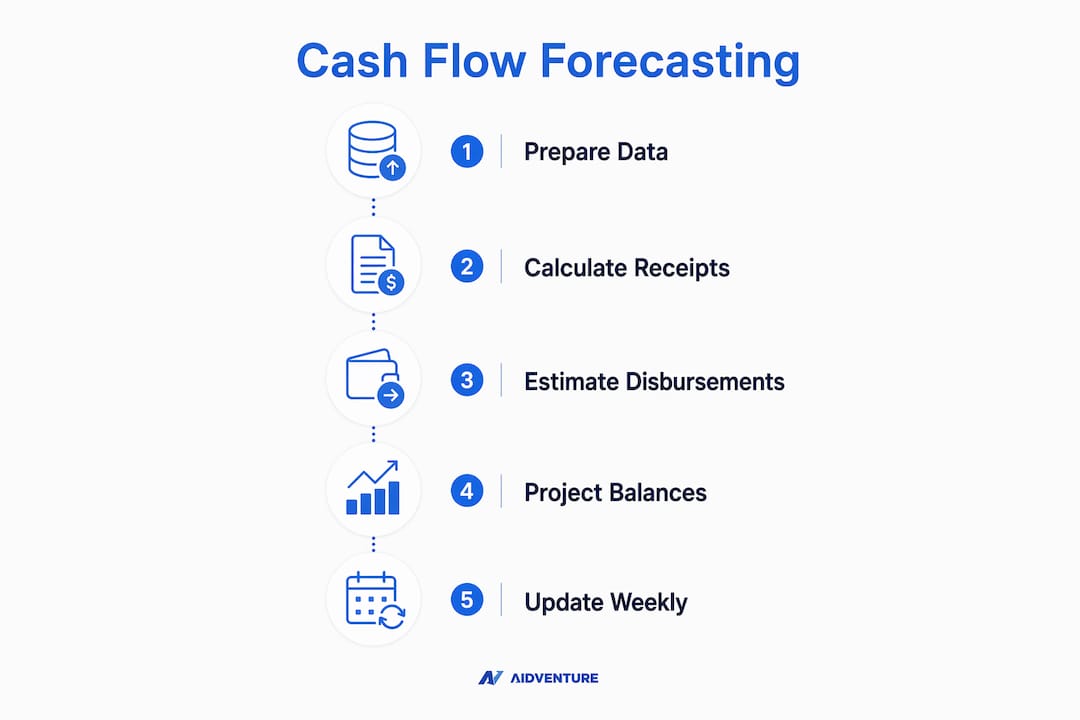
Cash flow forecasting is the most actionable financial tool entrepreneurs have to anticipate liquidity needs and lead proactively. The critical distinction is between a profit and loss statement and a cash flow forecast. A P&L shows whether the business is profitable. A cash flow forecast shows whether the business can pay its bills next week.

The 13-week direct method forecast
The direct method 13-week cash flow forecast tracks actual cash receipts and disbursements, not accrual-based revenue and expenses. It answers one question: how much cash will be in the bank account on each of the next 91 days? This format gives entrepreneurs a 13-week window to see problems before they become crises.
A basic 13-week forecast structure looks like this:
| Week | Opening cash balance | Expected cash in | Expected cash out | Closing cash balance |
|---|---|---|---|---|
| Week 1 | $42,000 | $18,000 | $22,000 | $38,000 |
| Week 2 | $38,000 | $9,000 | $14,500 | $32,500 |
| Week 3 | $32,500 | $25,000 | $11,000 | $46,500 |
The table reveals timing problems that a monthly P&L completely hides. Week 2 in the example above shows a significant cash draw-down. A founder who sees that in advance can accelerate a collection call or delay a discretionary payment.
Five numbers to track every week
Entrepreneurs must track five key numbers weekly to manage cash with confidence:
- Current bank balance across all operating accounts
- Aged accounts receivable, broken down by 0–30, 31–60, and 61-plus days
- Accounts payable with specific due dates for the next two weeks
- Upcoming payroll costs and the exact pay dates
- Fixed monthly commitments such as rent, subscriptions, and loan payments
These five numbers take less than 30 minutes to compile. They give a complete picture of near-term liquidity without requiring an accounting degree.
Rolling updates and decision levers
Weekly rolling forecast updates allow entrepreneurs to spot cash shortages up to eight weeks before they hit. Eight weeks is enough time to act. The decision levers available in a low-cash scenario are: accelerate inflows by collecting receivables faster or requesting deposits, delay outflows by negotiating extended terms with vendors, cut discretionary costs, or add cash through a line of credit used as a bridge rather than a crutch.
Manual cash flow forecasts often err by up to 30%, while AI-powered forecasting tools reduce error rates to under 10%. That accuracy gap matters when a 30% error on a $50,000 forecast means a $15,000 surprise. Founders who want to avoid common forecasting mistakes should prioritize updating their forecast with actual data every week, not just at month-end.
Pro Tip: Set a cash floor equal to eight weeks of fixed operating expenses. Treat that number as untouchable. When your balance approaches the floor, trigger your decision levers immediately rather than waiting to see if things improve.
How can entrepreneurs improve cash flow management practices?
Strong cash flow management rests on a set of disciplines that compound over time. No single action fixes the problem permanently. Consistent practice across several areas builds the financial resilience that lets a business survive slow months and capitalize on growth opportunities.
The most effective practices include:
- Maintain clean, current bookkeeping. Stale books produce stale decisions. Reconcile accounts weekly, not quarterly. An operating budget for entrepreneurs only works when the underlying data is current.
- Negotiate payment terms aggressively. Offer a 1% or 2% early payment discount to customers who pay within 10 days. Push vendor payment terms to net-45 or net-60 where possible. The gap between what you collect and what you owe is your working capital.
- Build a cash reserve equal to eight weeks of fixed costs. This buffer absorbs seasonal dips, slow-paying clients, and unexpected expenses without forcing emergency decisions.
- Run monthly scenario planning. Model a best case, base case, and worst case for the next quarter. Knowing what happens to cash if revenue drops 20% lets you prepare rather than react.
- Track financial KPIs consistently. Days Sales Outstanding (DSO), current ratio, and operating cash flow are the three metrics that signal cash health before a crisis appears. Founders who track business financial KPIs catch problems weeks earlier than those who rely on gut feel.
- Avoid using lines of credit as a structural fix. A revolving credit line is a bridge for timing gaps, not a solution for a broken business model. Founders who rely on credit to cover recurring shortfalls are borrowing against a problem that will only grow.
- Trim discretionary spend with a zero-based review. Once per quarter, review every expense and justify it from zero rather than simply renewing it. Subscriptions, software tools, and contractor relationships accumulate silently and drain cash without delivering proportional value.
Improving cash flow in business requires treating financial management as an ongoing practice, not a one-time cleanup. Founders who build these habits early create the financial clarity that supports confident decision-making at every stage of growth.
Key Takeaways
Effective cash flow management is the single most important financial discipline for entrepreneurs, because a profitable business can still fail if it cannot pay its obligations on time.
| Point | Details |
|---|---|
| Cash flow differs from profit | A business can be profitable on paper and still run out of cash due to timing gaps. |
| 38% of startups fail from cash shortages | Running out of cash is the leading operational cause of startup failure, not lack of revenue. |
| Revenue growth can worsen cash flow | Scaling without fixing payment terms or cost structure accelerates cash burn before it adds liquidity. |
| The 13-week forecast is the core tool | A direct method rolling forecast updated weekly reveals shortfalls up to eight weeks in advance. |
| Five weekly numbers drive cash clarity | Bank balance, aged AR, AP due dates, payroll, and fixed costs give a complete near-term cash picture. |
Cash flow mastery is a leadership decision, not a finance function
Most entrepreneurs I work with treat cash flow as something the bookkeeper handles. That assumption is the root cause of most of the crises I see. Cash flow is a leadership instrument. The founder who reviews the 13-week forecast every Monday morning makes fundamentally different decisions than the one who checks the bank balance when something feels wrong.
The blind spot I encounter most often is the confusion between a strong sales month and a strong cash position. A $200,000 month in bookings feels like success. But if $150,000 of that is on net-60 terms and payroll hits in two weeks, the business is actually under pressure. Founders who internalize this distinction stop celebrating revenue and start celebrating collections.
Simplicity is the key to making forecasting stick. A forecast that lives in a complicated spreadsheet nobody updates is worse than no forecast at all. The best cash management systems I have seen are the ones founders actually use: a single tab, updated weekly, with five inputs and one output. That output is the closing cash balance eight weeks from now. Everything else is commentary.
The entrepreneurs who build this habit early do not just survive cash crunches. They use their cash visibility as a competitive advantage. They can say yes to opportunities faster, negotiate from a position of strength, and sleep better. Cash flow discipline is not a constraint on growth. It is what makes growth sustainable.
— Sergio
How Aidventure supports entrepreneurs with cash flow clarity
Aidventure works with SaaS founders and entrepreneurs who need financial clarity without the cost of a full-time CFO. The firm’s fractional CFO services include building 13-week cash flow forecasts, managing accounts receivable aging, and setting up the weekly financial reviews that keep founders ahead of liquidity problems.

Founders who want expert financial guidance without full-time overhead can explore managing finances without a full-time CFO to see how Aidventure structures financial operations for growing businesses. The goal is the same for every client: clear numbers, confident decisions, and a cash position that supports growth rather than threatening it.
FAQ
What is the main cause of cash flow problems for entrepreneurs?
The leading cause is a timing mismatch between when customers pay and when expenses are due. Late accounts receivable payments combined with fixed monthly overhead create gaps that appear even in profitable businesses.
How does a 13-week cash flow forecast work?
A 13-week direct method forecast tracks expected cash receipts and disbursements week by week for 91 days. Updated weekly with actual data, it reveals cash shortfalls up to eight weeks before they occur.
Why does raising more money not always fix cash flow issues?
Lines of credit and fundraising cannot solve structural gaps caused by poor payment terms or misaligned cost structures. Growth funded by capital without fixing the underlying cash conversion cycle accelerates the problem.
What five numbers should entrepreneurs track every week?
Entrepreneurs should track current bank balance, aged accounts receivable, accounts payable due dates, upcoming payroll costs, and fixed monthly commitments. These five metrics provide a complete near-term cash picture in under 30 minutes.
What is a cash floor and why does it matter?
A cash floor is a minimum cash balance set at eight weeks of fixed operating expenses. It acts as a buffer that triggers corrective action before a shortfall becomes a crisis.