Flexible financial planning for an early-stage startup is the process of designing financial systems that adapt to rapid changes in revenue, expenses, and market conditions without compromising operational stability. Most early-stage founders treat budgeting as a one-time exercise, then wonder why their cash position looks nothing like their projections six weeks later. The gap between a static budget and real operating conditions is where startups fail. The frameworks, tools, and disciplines covered here give you a practical system for staying solvent and making confident decisions as your business evolves.
What core financial frameworks support flexible financial planning for early-stage startups?
Adaptable financial planning starts with two foundational structures: a rolling 12-month cash forecast and a clear separation between profit and loss accounting and actual cash flow management. These are not the same thing, and confusing them is one of the most common startup financial planning gaps.
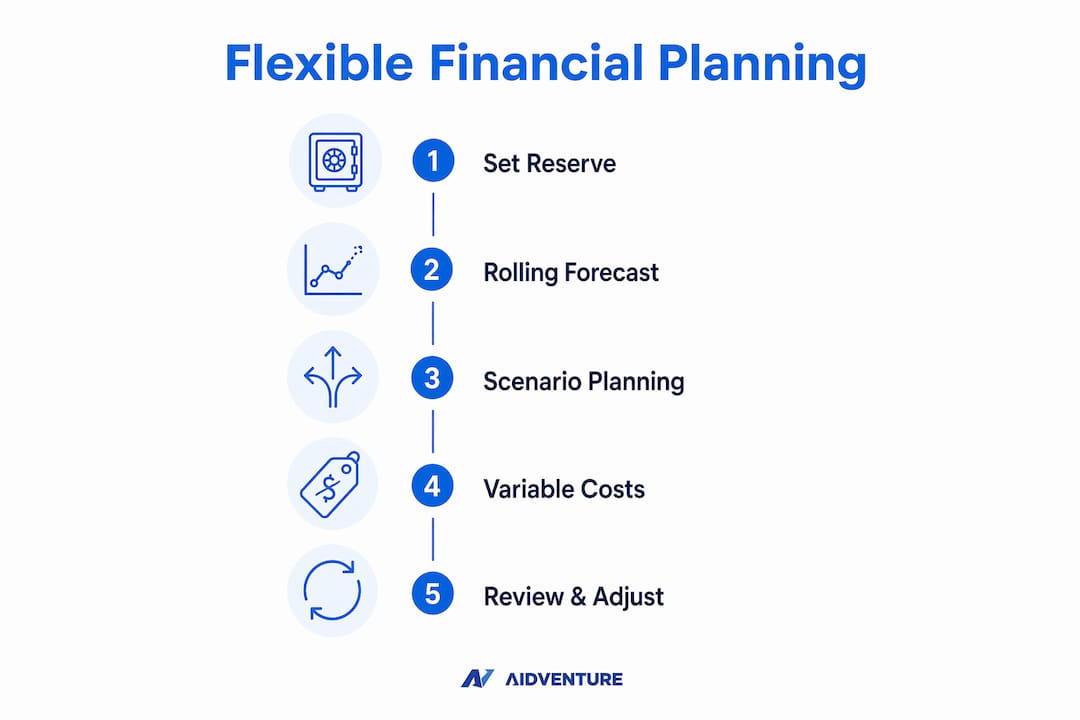
A rolling 12-month forecast updated monthly gives you a live view of your cash position under changing assumptions. It replaces the annual budget, which becomes obsolete the moment your first major customer delays payment or a vendor raises prices. Pair that forecast with a contingency reserve covering 3–6 months of essential operating expenses. That reserve is not idle cash. It is the buffer that lets you make decisions from a position of stability rather than panic.

Profit and loss statements alone are misleading for startup cash management. A profitable startup on paper can burn cash due to payment term lags and delayed collections. You need a model that tracks when cash actually moves, not when revenue is recognized.
Key financial controls to put in place early
- Separate business and personal finances from day one. Commingled accounts make it impossible to read your true burn rate.
- Distinguish fixed costs from variable costs. Fixed commitments like long-term leases restrict your ability to pivot.
- Build scenario planning into your monthly review. Model at least three outcomes: conservative, expected, and accelerated growth.
- Track accounts receivable aging weekly. Days Sales Outstanding (DSO) above 45 days signals a cash timing problem.
- Establish a basic approval process for discretionary spending above a defined threshold.
Pro Tip: Set your contingency reserve target before you need it. Founders who build the reserve during a strong revenue month never have to make desperate cuts during a slow one.
| Framework | Purpose | Update Frequency |
|---|---|---|
| Rolling 12-month cash forecast | Projects cash inflows and outflows under live assumptions | Monthly |
| Contingency reserve | Covers 3–6 months of operating expenses | Reviewed quarterly |
| Scenario planning model | Tests conservative, expected, and accelerated growth paths | Monthly |
| Fixed vs. variable cost analysis | Identifies cost flexibility and pivot capacity | Quarterly |
How to implement dynamic cash flow models and scenario planning for growth?
Cash flow modeling for startups requires tracking the timing of every transaction, not just the total revenue line. Working capital requirements grow dynamically with startup growth due to vendor payment lags, customer acquisition costs, and inventory expenses. If your model treats working capital as a fixed assumption, it will understate your cash needs every time you hit a growth spike.
Build your cash model around actual payment terms. If your enterprise customers pay on net-60 terms, your model must reflect a 60-day lag between invoicing and cash receipt. Billing cycles, collection delays, and payroll timing all belong in the model. Rapid growth intensifies cash burn as acquisition and working capital requirements accelerate. Financial plans must treat growth as a dynamic variable, not a fixed assumption.
Building a rolling scenario forecast in five steps
- Map your cash inflows by source. List every revenue stream with its payment terms and typical collection timeline.
- Map your cash outflows by timing. Separate payroll, vendor payments, software subscriptions, and one-time capital expenses by the date cash actually leaves the account.
- Build three scenarios. Conservative assumes 20% below expected revenue with normal expense growth. Expected uses your current pipeline. Accelerated models a growth surge and its working capital impact.
- Run variance analysis monthly. Compare actual cash movement to each scenario. The variance tells you which scenario you are actually living in.
- Update assumptions, not just numbers. When a key customer churns or a new contract closes, revise the underlying payment timing assumptions, not just the revenue total.
Pro Tip: Cash-in, cash-out models that explicitly capture payment term lags of 30–90 days reveal liquidity risks that a standard P&L will never show. Build this model before you need it, not after a cash crisis forces the issue.
| Scenario | Revenue Assumption | Working Capital Treatment |
|---|---|---|
| Conservative | 20% below pipeline | Extended collection delays modeled |
| Expected | Current pipeline at normal close rate | Standard payment terms |
| Accelerated | 20% above pipeline | Increased CAC and inventory modeled |
How to design financial structures and budgets that maintain flexibility?
Early-stage startups benefit from variable cost structures and avoiding large capital expenditures. Fixed cost commitments restrict your ability to pivot and respond to unexpected changes. The goal is to keep as much of your cost base variable as possible for as long as possible.
Flexible budgeting frameworks allow you to adjust line items in response to unexpected expenses or revenue fluctuations without derailing overall financial planning. This is different from a traditional static budget, which locks spending levels regardless of what revenue actually does. A flexible budget ties spending authority to revenue milestones. If Monthly Recurring Revenue (MRR) hits a target, a planned hire is approved. If it misses, the hire waits.
Practical steps to build a flexible budget structure
- Negotiate short lease terms or use co-working arrangements instead of committing to multi-year office leases.
- Outsource non-core functions like bookkeeping, payroll processing, and IT support rather than hiring full-time staff for each.
- Use performance-based compensation structures where a portion of pay is tied to measurable outcomes.
- Build a contingency reserve by allocating a fixed percentage of monthly revenue, not a fixed dollar amount. This way the reserve grows with the business.
- Avoid excessive debt financing in early stages. High fixed debt service payments eliminate the flexibility you need to respond to market shifts.
- Review your operating budget quarterly and reforecast rather than waiting for an annual review cycle.
Pro Tip: Treat your budget as a living document with a defined review trigger. Any month where actual revenue deviates more than 15% from forecast should automatically trigger a budget reforecast, not just a note in the variance report.
Balancing equity and debt financing also affects flexibility. Equity does not require fixed repayment, which preserves cash flow optionality. Venture capital and angel investment carry dilution costs, but they do not create the cash drain that debt service does during a slow revenue quarter. Early-stage founders should model both structures before choosing.
What tools and practices can enhance flexible financial planning for startups?
Modern financial platforms offer real-time data integration, driver-based planning, and headcount modeling, facilitating more responsive financial management for startups. Driver-based planning connects your financial model directly to operational metrics. When your sales team closes more deals, the model automatically updates revenue, CAC, and onboarding costs. That connection between operations and finance is what makes a model genuinely useful.
Monitoring unit economics like customer acquisition cost (CAC), lifetime value (LTV), and contribution margins is critical to understanding financial health and driving adaptable strategies. Startups should analyze these metrics regularly and adjust marketing, pricing, and cost strategies accordingly. A rising CAC with flat LTV is a warning sign that your growth model is becoming less efficient, and your financial plan needs to reflect that shift.
Core metrics and tools for early-stage financial management
- Monthly Recurring Revenue (MRR) and Annual Recurring Revenue (ARR): Track these weekly for SaaS startups. They are the leading indicators of cash flow trajectory.
- Customer Acquisition Cost (CAC): Divide total sales and marketing spend by new customers acquired in the same period.
- Lifetime Value (LTV): Multiply average revenue per account by gross margin and average customer lifespan.
- Churn rate: Monthly churn above 2% for a SaaS startup signals a product or pricing problem that will compound in your cash model.
- Burn rate and runway: Divide current cash balance by monthly net cash outflow. This number tells you how many months you have before you need new revenue or new capital.
Real-time dashboards connected to your accounting operations remove the lag between financial events and management awareness. When a large customer invoice goes 30 days past due, a dashboard surfacing that data immediately lets you act. Waiting for a monthly close report means you lose three to four weeks of response time. Integrating financial modeling with your accounting platform closes that gap.
Financial planning discipline separates startups that scale successfully from those that fail. Incorporating flexible resource allocation, contingency reserves, and relevant KPIs is what makes growth sustainable rather than accidental.
Key Takeaways
Flexible financial planning for early-stage startups requires rolling cash forecasts, variable cost structures, and continuous unit economics monitoring to sustain growth through uncertainty.
| Point | Details |
|---|---|
| Rolling cash forecasts beat static budgets | Update your 12-month forecast monthly to reflect real payment timing and revenue changes. |
| Contingency reserves are non-negotiable | Maintain 3–6 months of operating expenses in reserve before you need them. |
| Variable cost structures preserve optionality | Negotiate short leases, outsource non-core functions, and tie compensation to performance. |
| Unit economics drive financial decisions | Track CAC, LTV, and churn regularly and adjust your model when the ratios shift. |
| Scenario planning reduces crisis response time | Running three scenarios monthly means you already have a plan when conditions change. |
Why static budgets are the biggest financial mistake I see founders make
Every founder I have worked with who ran into a serious cash crisis had one thing in common: they were managing their business against a budget built six months ago. The market had moved. Their customer mix had changed. Their burn rate had crept up. But the budget had not changed, so the warning signs were invisible until the bank balance made them obvious.
The mindset shift that matters most is treating financial planning as a continuous discipline, not a quarterly administrative task. The founders who scale well check their cash position weekly, update their scenario models when a major assumption changes, and treat variance analysis as a learning tool rather than a report card. They also get expert support early. Waiting until you have a CFO-sized problem to get CFO-level thinking is a costly delay. Managing finances without a full-time CFO is entirely achievable when you have the right systems and the right advisors in place from the start.
The other pattern I see consistently is founders who focus on revenue growth while ignoring working capital. A startup that doubles its revenue in six months and runs out of cash is not a paradox. It is a predictable outcome when the financial model treats growth as purely positive. Growth consumes cash before it generates it. Build that reality into your model from day one, and you will make very different decisions about hiring pace, payment terms, and capital raises.
— Sergio
How Aidventure supports startups with expert financial planning
Early-stage founders need financial clarity from the start, not after the first cash crisis.

Aidventure works with SaaS startups to build the financial systems that support real growth. From fractional CFO services that bring senior financial leadership without the full-time cost, to tailored cash flow models and ongoing scenario planning, Aidventure delivers the financial discipline that founders need at every stage. The team builds KPI tracking frameworks, connects accounting operations to real-time dashboards, and helps founders avoid the common forecasting mistakes that stall growth. If you are ready to build a financial foundation that scales with your business, Aidventure is the partner to do it with.
FAQ
What is flexible financial planning for a startup?
Flexible financial planning is the practice of designing financial models and budgets that adjust automatically to changes in revenue, expenses, and market conditions. It replaces static annual budgets with rolling forecasts and scenario-based planning.
How many months of reserves should an early-stage startup hold?
Startups should maintain contingency reserves covering 3–6 months of essential operating expenses. This buffer provides the operational stability needed to make decisions without cash pressure forcing the outcome.
Why do profitable startups sometimes run out of cash?
A startup can show profit on a P&L statement while burning cash due to payment term lags and delayed collections. Cash flow models must capture the actual timing of inflows and outflows, not just revenue recognition.
What unit economics should early-stage startups track?
The three most critical metrics are customer acquisition cost (CAC), lifetime value (LTV), and monthly churn rate. Tracking these consistently reveals whether your growth model is becoming more or less efficient over time.
When should a startup adopt financial planning tools?
Adopt financial planning tools before your data becomes too complex to manage in spreadsheets, which typically happens when you pass five employees or begin managing multiple revenue streams. Early adoption of driver-based planning platforms prevents the data gaps that make late-stage financial cleanup expensive.