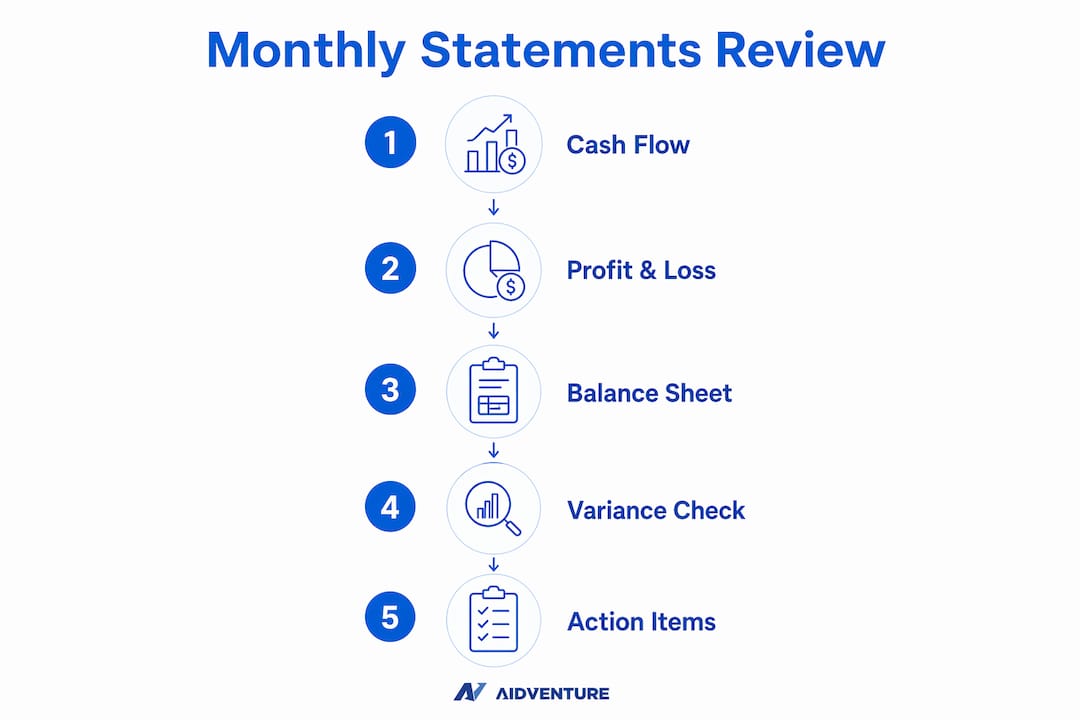
Your monthly financial statements answer three questions at once: Are we profitable? Are we solvent? Did cash actually move the way the P&L suggests? The Income Statement, Balance Sheet, and Cash Flow Statement together form a single toolkit, and reading any one in isolation gives you an incomplete picture. After the books close each month, three actions matter most:
- Reconcile cash first. Confirm your bank balance matches your books before drawing any conclusions.
- Flag variances above your threshold. Any revenue or expense line that deviates materially from budget or the prior period needs a label: expected, one-off, or structural.
- Assign one action item with a deadline. Every review should end with a documented owner, a specific task, and a due date.
Pro Tip: Treat your cash balance as the primary operational signal. Profit is an accounting opinion shaped by accruals and timing; cash is a fact. Start there every month.
Table of Contents
- What the three core monthly reports are and what each one answers
- How to read each statement: a step-by-step monthly review checklist
- Key monthly KPIs every small business should calculate and monitor
- Compare actuals to budget and prior period: three quick steps for variance analysis
- Aidventure’s practitioner monthly review workflow and one-page checklist template
- Common red flags you’ll see in monthly statements and immediate fixes
- Turning insights into decisions: three most common post-review actions
- Key Takeaways
- Why a disciplined monthly review beats reactive firefighting
- Aidventure’s monthly review services for SaaS teams
- Useful sources and further reading
What the three core monthly reports are and what each one answers
The three financial statements are distinct lenses on the same business, and each answers a different decision question.
- Income Statement (P&L): Measures revenue, expenses, and net profit over the month. The question it answers: Did we make money this period?
- Balance Sheet: Captures assets, liabilities, and equity at a single point in time, the last day of the month. The question it answers: What do we own, what do we owe, and what’s left for owners?
- Cash Flow Statement: Tracks where cash came from and where it went during the month, split into operating, investing, and financing activities. The question it answers: Did cash actually move the way the P&L implies?
Reading them together is not optional. A business can show strong net income on the P&L while cash is draining because revenue sits in uncollected invoices on the balance sheet. That gap between profit and cash is one of the most common reasons small businesses run short on liquidity despite “good” months. The integrated read closes that gap.
How to read each statement: a step-by-step monthly review checklist
A reliable first pass through the three reports takes 5–10 minutes when you follow a defined sequence. The key is starting with cash, then moving to profitability, then position.

Pro Tip: Cash first, profit second, position third. This sequence surfaces operational problems before you get distracted by margin percentages.
Income Statement checklist
- Confirm total revenue against your budget and the prior month. Note the variance from expectations.
- Calculate gross margin: (Revenue minus Cost of Goods Sold) ÷ Revenue. Flag any month-over-month compression greater than your threshold.
- Scan the top three expense categories. Identify any line that changed significantly versus budget.
- Check net profit margin. Compare to the prior period and to your target.
- Note any one-time items (severance, equipment write-offs) that distort the recurring picture.
Balance Sheet checklist
- Verify cash and equivalents match your bank reconciliation.
- Review accounts receivable (AR) aging: flag any invoices past 30 days for immediate follow-up.
- Check inventory levels against the prior month. Unexplained growth may signal a sales slowdown or receiving error.
- Confirm short-term debt and credit line balances are current.
- Verify that total assets equal total liabilities plus equity; mismatches indicate reconciliation errors.
Cash Flow Statement checklist
- Read operating cash flow first. Negative operating cash flow in a profitable month signals a working capital problem.
- Review investing activities. Large outflows here are often planned capex; confirm they match your budget.
- Check financing activities for any new debt draws or repayments.
- Reconcile the net change in cash to the difference between your opening and closing bank balances.
- If operating cash flow and net income diverge significantly, trace the gap to AR, inventory, or accrued liabilities on the balance sheet.
Sample reconciliation steps
- Match the closing cash balance on the Cash Flow Statement to the bank statement.
- Tie the AR balance on the Balance Sheet to your AR subledger total.
- Confirm accounts payable on the Balance Sheet matches your AP aging schedule.
- Verify that net income on the P&L flows into the equity section of the Balance Sheet.
Key monthly KPIs every small business should calculate and monitor
Consistent KPI calculation is what turns a monthly read into a trend. Calculate these every month and keep a 12-month rolling view to remove seasonality noise from your interpretation.
| KPI | Formula | Interpretation / Target Guidance |
|---|---|---|
| Gross Margin | (Revenue − COGS) ÷ Revenue | Measures production efficiency; track month-over-month compression as a pricing or cost signal |
| Net Profit Margin | Net Income ÷ Revenue | Shows bottom-line efficiency after all costs; compare to industry benchmarks and your own trend |
| Operating Cash Flow | Cash from Operations (Cash Flow Statement) | Positive and growing signals healthy working capital; negative in a profitable month demands investigation |
| Current Ratio | Current Assets ÷ Current Liabilities | A ratio above 1.0 means short-term obligations are covered; below 1.0 is a liquidity warning |
| Quick Ratio | (Cash + AR) ÷ Current Liabilities | Strips out inventory; a tighter liquidity test than the current ratio |
| DSO (Days Sales Outstanding) | (AR Balance ÷ Monthly Revenue) × 30 | Measures how fast you collect; rising DSO means cash is sitting in unpaid invoices |
| DPO (Days Payable Outstanding) | (AP Balance ÷ Monthly COGS) × 30 | Measures how long you take to pay suppliers; extending DPO conserves cash |
| Inventory Turns | COGS ÷ Average Inventory | Low turns signal slow-moving stock tying up cash |
| Burn Rate | Total Monthly Cash Outflows | Critical for pre-revenue or early-stage businesses; track against funding milestones |
| Runway | Cash Balance ÷ Average Monthly Expenses | Answers “how many months can we operate if revenue stopped?”; monitor receivables aging alongside this figure |
A few practical notes on using this table:
- DSO and DPO together reveal your cash conversion cycle. Shortening DSO while extending DPO improves cash position without touching revenue.
- Runway deserves its own line in every monthly review. Calculate it fresh each month; a single large expense can cut runway by weeks.
- Keep all ten KPIs in a single spreadsheet or dashboard. A startup cash flow metrics checklist can serve as the template for that tracker.
Compare actuals to budget and prior period: three quick steps for variance analysis
Comparing actuals to budget and prior periods is the fastest way to surface problems before they compound. Run this three-step routine after completing your statement checklist.

Step 1: Compute the variance. For each major line item, calculate: Actual minus Budget = Dollar Variance. Then calculate: Dollar Variance ÷ Budget = Percentage Variance.
Example: Revenue budget was $80,000; actual was $74,000. Dollar variance: −$6,000. Percentage variance: −7.5%.
Step 2: Test materiality. Not every variance warrants investigation. A practical approach is to flag variances that exceed a small percentage band for further review. The right threshold depends on your business size and margin structure, but many practitioners use a range in the low single digits as a starting trigger. Apply the same logic to prior-period comparisons: if this month’s gross margin is meaningfully lower than last month’s, that gap needs a label.
Step 3: Assign a cause category. Once a variance is flagged, classify it before deciding on a response.
Common drivers to check:
- Pricing: Did a rate change, discount, or contract renewal affect revenue or cost?
- Volume: Did unit sales or service hours differ from plan?
- Timing: Was revenue recognized in a different period than expected, or did an invoice arrive early?
- One-off events: Severance, equipment repairs, or a large one-time sale can distort the month without signaling a trend.
- Structural shift: A change in product mix, customer concentration, or supplier pricing that will persist.
Timing and one-off variances require acknowledgment but rarely require a strategic response. Structural variances do.
Aidventure’s practitioner monthly review workflow and one-page checklist template
A monthly review does not need to be a half-day exercise. With a defined workflow and clear ownership, the review can surface issues quickly and produce documented decisions within the first week after close.
Day 1–7 post-close timeline
- Days 1–3 (Bookkeeper): Complete bank reconciliations, post all transactions, finalize AR and AP aging reports, and deliver draft statements.
- Days 3–5 (Owner or Finance Lead): Run the statement checklist above, calculate KPIs, flag variances, and draft action items.
- Days 5–7 (CFO or Advisor): Review flagged variances, validate action items, update the rolling forecast, and confirm ownership of each follow-up.
One-page monthly review template layout
A single page is enough. Structure it as follows:
- Top-line numbers: Revenue, gross margin, net income, cash balance, AR total, total debt.
- KPI snapshot: Current ratio, DSO, runway, burn rate (for growth-stage businesses).
- Variance summary: Top three variances vs. budget and prior period, each with a cause label.
- AR aging highlights: Any invoice past 30 days with a named follow-up owner.
- Action items: Three rows maximum, each with the fields below.
Action-item template
| Field | What to record |
|---|---|
| Root cause | One sentence describing why the variance or issue occurred |
| Owner | Named person responsible for the follow-up |
| Deadline | Specific date, not “ASAP” |
| Expected outcome | Measurable result (e.g., collect $X by [date], reduce expense line by $Y) |
| Status | Open / In Progress / Closed |
Adoption checklist
- Schedule a recurring calendar block on Day 5 post-close for the owner review.
- Store the one-page template in a shared location accessible to the bookkeeper and advisor.
- Open the prior month’s action items first; close or escalate before adding new ones.
- Limit new action items to three per month to maintain focus.
- Archive completed reviews for a rolling 12-month reference.
For teams managing finances without a full-time CFO, this workflow assigns clear responsibilities without requiring a dedicated finance department.
Common red flags you’ll see in monthly statements and immediate fixes
Unusual fluctuations, inconsistent trends, and transactions lacking documentation are the three categories that demand immediate attention. Here are the most common signals and the first action to take for each.
- Negative operating cash flow in a profitable month. First action: trace the gap to AR, inventory, or accrued liabilities. A profitable business with negative operating cash flow is almost always collecting too slowly or building inventory faster than it is selling.
- DSO rising month over month. First action: pull the AR aging report and contact every account past 30 days within 24 hours. Rising DSO is the earliest warning sign of a collections problem.
- Current ratio falling below 1.0. First action: identify which current liabilities are driving the decline. If it is accounts payable, negotiate extended terms with key suppliers before the due dates arrive.
- Unexplained inventory growth. First action: reconcile the inventory subledger to the general ledger and check receiving records. Unexplained growth often signals a receiving error, a theft issue, or a sales slowdown that has not yet appeared in the P&L.
- Recurring reconciliation items. First action: escalate to the bookkeeper immediately. A reconciling item that appears in two consecutive months is a process failure, not a timing difference.
- Sudden gross margin compression. First action: separate the pricing effect from the cost effect. Calculate what margin would have been at prior-period costs and at prior-period prices to isolate the driver.
Distinguishing structural from one-off. Before responding to any red flag, ask: did this happen last year in the same month? If yes, it may be seasonal. If the pattern is new, treat it as structural until proven otherwise. Overreacting to a seasonal dip wastes management time; ignoring a structural shift compounds the damage. Effective cash flow management depends on making that distinction quickly and consistently.
Turning insights into decisions: three most common post-review actions
A monthly review that ends without a documented decision is an analysis exercise, not a management tool. Convert insights into 1–3 concrete actions and track them to closure.
Pro Tip: Pick one high-impact action per review and write it down with an owner and a deadline. A decision that is not documented is a decision that will not happen.
1. Cash actions
Triggered by: negative operating cash flow, runway below a defined threshold, DSO rising, or current ratio below 1.0.
Options to consider, in order of speed:
- Tighten payment terms on new invoices (net 15 instead of net 30).
- Launch a targeted collections push on AR past 30 days.
- Delay discretionary capex until cash stabilizes.
- Draw on an existing credit line to cover a short-term gap, with a documented repayment plan.
Choose the fastest option that addresses the root cause. Avoid drawing financing to cover an operating cash flow problem without first fixing the underlying collections or expense issue.
2. Profitability actions
Triggered by: gross margin compression, net profit margin declining for two or more consecutive months, or a specific cost category exceeding budget by a material amount.
- A pricing review is warranted when margin compression is driven by revenue-side factors (discounting, mix shift toward lower-margin products).
- A cost audit is warranted when the driver is on the expense side (supplier price increases, payroll creep, software subscription growth).
- A product mix analysis is warranted when overall margin is declining but some lines remain healthy. Shift sales focus toward higher-margin offerings.
3. Operational actions
Triggered by: rising DSO, inventory buildup, vendor payment terms expiring, or a process failure surfaced in reconciliation.
- For collections: send a templated follow-up email to every account past 30 days on the same day the review closes. Name a specific owner for each account.
- For vendor negotiations: identify the top three suppliers by spend and schedule a call to discuss extended terms before the next payment cycle.
- For process fixes: document the reconciliation error, assign a corrective procedure to the bookkeeper, and verify the fix in next month’s close.
Avoiding common financial forecasting mistakes starts with updating your forecast immediately after each review, using the action items as inputs.
Key Takeaways
Reading monthly financial statements together, prioritizing cash, and documenting one concrete action item per review are the three habits that separate businesses that catch problems early from those that react too late.
| Point | Details |
|---|---|
| Read all three statements together | Profit without cash is a warning sign; the integrated read reveals the full picture. |
| Cash is the primary signal | Calculate runway and operating cash flow first; both update every month and demand immediate action when they deteriorate. |
| Use variance thresholds consistently | Flag material deviations from budget and prior period each month; classify each as pricing, volume, timing, or structural before responding. |
| Keep a 12-month rolling view | A single month’s data is noisy; trends across 12 months reveal what is seasonal versus structural. |
| Aidventure accelerates the process | Aidventure’s fractional CFO and accounting operations services help SaaS businesses close faster and produce documented monthly reviews with clear action items. |
Why a disciplined monthly review beats reactive firefighting
Most small businesses do not fail because their owners lack financial intelligence. They fail because the review happens too late, too infrequently, or without a documented outcome. A monthly rhythm changes that. When you review the same six numbers on the same day every month, you build a baseline that makes anomalies obvious. A 3-point drop in gross margin is invisible in isolation; against an 11-month trend, it stands out immediately.
The businesses Aidventure works with most often arrive with the same pattern: strong intuition about their product, weak visibility into their financials. The monthly review is the mechanism that closes that gap. It is not a reporting exercise; it is a decision-making cadence. The one-page template described above exists precisely because a 10-page management report does not get read consistently, but a single page with six numbers and three action items does.
One caution worth naming: the most common human bias in monthly reviews is overweighting a single strong month. One good month after three difficult ones feels like a trend reversal. It rarely is. The 12-month rolling view is the antidote. It forces you to ask whether this month’s result is a genuine shift or a reversion to the mean after an outlier. Routine reduces that error because the question gets asked automatically, not only when the numbers look good.
Aidventure’s monthly review services for SaaS teams
Running a clean monthly close and producing a decision-ready review is faster with the right support structure. Aidventure’s fractional CFO services give SaaS teams an experienced finance lead who owns the Day 5–7 review step: validating KPIs, flagging variances, and delivering a one-page summary with documented action items. No full-time hire required.

For teams that need a sharper metrics foundation before the review process can work, Aidventure’s SaaS KPI audit identifies which metrics are being tracked incorrectly, which are missing entirely, and which dashboards need to be rebuilt. The audit typically surfaces two or three measurement gaps that have been distorting monthly decisions without anyone realizing it. Accounting operations support handles the Day 1–3 close work: reconciliations, subledger tie-outs, and draft statement delivery so the owner review starts with clean data. To see the full range of options, the flexible financial management options page outlines how these services can be combined for different growth stages. Book a discovery call to receive the one-page monthly review template and discuss which service fits your current close process.
Useful sources and further reading
The sources below back the guidance in this article and provide deeper coverage for specific topics.
- SEC: Beginners’ Guide to Financial Statements — Authoritative definitions of the three core statements; the right starting point for anyone new to financial reporting basics.
- Bookkeeping Knight: Monthly Financial Statement Analysis — Practical guidance on variance analysis, rolling views, and monthly review structure for small business owners.
- NetSuite: Financial KPIs — Comprehensive KPI definitions and formulas; useful for ratio benchmarking and building a KPI dashboard.
- AccountingCoach: Financial Statements Explanation — Clear explanation of how the three statements link; recommended for understanding accrual accounting and integrated review.
- Mercury: How to Run a Monthly Financial Review — Operational workflow guidance on turning monthly insights into documented action items.
- Weaver: Critical Red Flags in Financial Statement Reviews — Practitioner-level red flag identification; covers margin compression, receivables anomalies, and reconciliation issues.
- WithVisor: How to Read Financial Statements as a Small Business Owner — Accessible guide to the 5–10 minute monthly review; good for owners starting their first structured review process.
- JPMorgan Chase Institute — Research on receivables aging and cash runway; useful for benchmarking working capital management practices.
- Aidventure: Startup Cash Flow Metrics Checklist — Downloadable checklist covering the KPIs and runway metrics described in this article; request it directly from Aidventure.
For deeper work on cash flow modeling and cash flow optimization, the Wealth Assimilation guide covers personal and business cash management tactics that complement the monthly review framework above.