An operating budget is defined as a short-term financial plan that forecasts a business’s expected revenue and expenses over a set period, typically one year, aligned directly with daily operations and profit goals. For any entrepreneur, this document is the financial backbone of the business. It connects revenue targets to expense management and gives you a clear picture of where the business stands at any moment. Understanding what is operating budget entrepreneur means knowing how to use this plan to make confident spending and growth decisions.
What is an operating budget for entrepreneurs?
An operating budget focuses on revenues and expenses tied to daily operations, making it distinct from financial budgets that cover long-term cash positions and capital expenditures. Think of it as your profit and loss statement written in advance. It tells you what you expect to earn, what you plan to spend, and whether the business will be profitable over the coming months.
The operating budget also serves as a control tool. When actual results come in each month, you compare them against the budget to spot problems early. A business that skips this step often discovers financial trouble too late to correct it. The operating budget, when reviewed consistently, translates scattered financial data into a clear roadmap linking revenue targets, expense management, and profitability drivers.
Entrepreneurs often confuse operating budgets with cash flow forecasts. They are related but not the same. The operating budget tracks profitability. The cash flow forecast tracks the timing of actual cash moving in and out of the business. Both are necessary, and neither replaces the other.
What are the main components of an operating budget?
A complete operating budget includes six core categories. Each one feeds directly into your profitability picture.
- Revenue projections. Your sales forecast by product, service line, or customer segment. Use market research and historical data where available.
- Cost of Goods Sold (COGS). The direct costs tied to delivering your product or service. COGS rises and falls with revenue, making it a variable cost.
- Payroll and benefits. Salaries, wages, and employer-paid benefits. This is typically the largest fixed expense for most small businesses.
- Fixed operating expenses. Rent, insurance, software subscriptions, and other costs that stay constant regardless of sales volume.
- Variable operating expenses. Marketing spend, contractor fees, and other costs that scale with business activity.
- Contingency reserves. A buffer built into the budget to cover unexpected costs.
Pro Tip: Contingency reserves should equal 3–5% of total expenses. Skipping this line item is one of the most common budgeting mistakes entrepreneurs make.
The table below shows how each component connects to your financial outcome.
| Budget Component | Type | Impact on Profitability |
|---|---|---|
| Revenue projections | Variable | Drives gross profit ceiling |
| Cost of Goods Sold | Variable | Determines gross margin |
| Payroll and benefits | Fixed | Largest cost driver for most businesses |
| Fixed operating expenses | Fixed | Establishes break-even floor |
| Variable operating expenses | Variable | Scales with growth activity |
| Contingency reserves | Fixed buffer | Protects against unplanned losses |
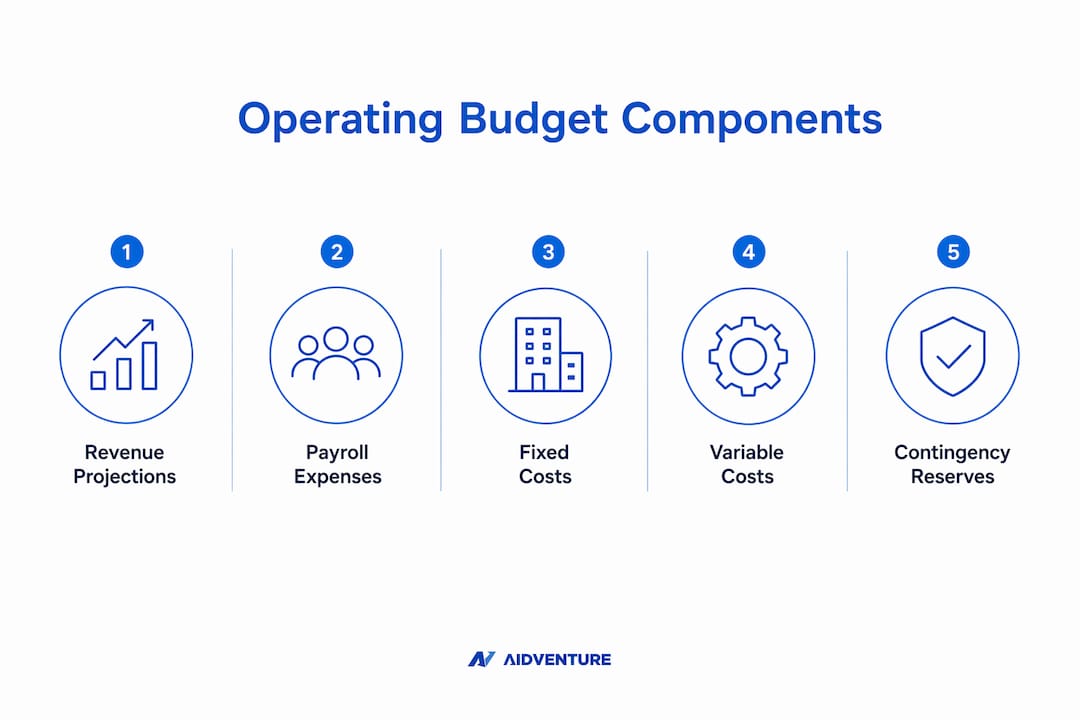
Understanding these components as a system matters more than tracking each one in isolation. When payroll rises faster than revenue, your gross margin compresses. When COGS climbs without a price adjustment, profitability erodes quietly. The budget makes these relationships visible before they become crises.
How should entrepreneurs create and maintain their operating budgets?
Building a budget from scratch requires a bottom-up approach. Startups should build budgets bottom-up, using conservative revenue expectations based on market research and industry benchmarks. This means starting with what you can realistically sell, not what you hope to sell.
Here is a practical process for creating and maintaining your operating budget:
- Forecast revenue conservatively. Use market research, competitor benchmarks, and any existing sales data. If you are pre-revenue, model three scenarios: low, base, and high.
- List every expense category. Include all fixed and variable costs. Pull bank statements and accounting records to avoid missing recurring charges.
- Calculate your contribution margin. Subtract COGS from revenue. This number tells you how much each dollar of sales contributes to covering fixed costs.
- Determine your break-even revenue. Divide total fixed costs by your contribution margin percentage. This is the minimum revenue needed to avoid a loss.
- Add contingency reserves. Build in 3–5% of total expenses as a buffer.
- Set a monthly review schedule. Block time on the first business day of each month to compare actuals against projections.
Entrepreneurs should review their operating budget monthly, dedicating 20–30 minutes to compare actuals against projections. This cadence catches variances before they compound. A 10% overspend in one category is manageable. The same overspend ignored for three months becomes a cash problem.
Pro Tip: If your actuals deviate from projections by more than 15% in any category, treat it as a signal to investigate the cause before adjusting the budget number.

Budgeting is a dynamic process. Entrepreneurs who treat the annual budget as a fixed document miss the point entirely. Markets shift, costs change, and new opportunities emerge. The budget should reflect current reality, not a plan made in january.
How does an operating budget support cash flow management and business survival?
Profitability on paper does not guarantee cash in the bank. A business can show a net profit on its operating budget while simultaneously running out of money to pay suppliers. This happens when revenue is recognized before cash is collected, or when large expenses fall due before receivables clear.
A realistic operating budget integrates closely with cash flow forecasts but focuses on expected profitability rather than cash timing. Both documents are necessary to avoid insolvency. The operating budget tells you if the business model works. The cash flow forecast tells you if the business survives the next 90 days.
Setting aside at least 10% of revenue as a contingency fund protects against cash flow shortfalls. Financial advisors recommend this buffer specifically because profitability does not guarantee survival when cash flow is not managed to meet obligations on time.
Practical steps to align your operating budget with cash flow:
- Map the timing gap between when revenue is earned and when cash is received.
- Identify months where large fixed expenses cluster, such as annual insurance renewals or quarterly software fees.
- Build a rolling 13-week cash flow forecast alongside your annual operating budget.
- Flag any month where the cash buffer drops below one month of fixed operating expenses.
Budget blowouts usually arise not from one massive expense, but from a series of small unchecked decisions made under pressure. A $200 software subscription added without review, a contractor engagement extended without budget approval, a marketing test that ran three months longer than planned. These small decisions compound quickly. The operating budget, reviewed monthly, is the mechanism that catches them.
You can also read about common forecasting mistakes that undermine cash flow planning, which often start with gaps in the operating budget itself.
What are best practices and common pitfalls in operating budgeting for entrepreneurs?
The most effective budgeting approach uses two layers. Practitioners recommend tiered budgeting with a bottom-up survival budget and an aspirational growth plan, where additional spending is unlocked only when revenue milestones are hit. This keeps the business solvent during slow periods while preserving the ability to grow aggressively when conditions allow.
| Approach | What it does | When to use it |
|---|---|---|
| Survival budget | Covers fixed costs and minimum operations | When revenue is below target |
| Growth budget | Adds marketing, hiring, and expansion spend | When revenue milestones are met |
| Percentage-based tracking | Measures each category as a share of revenue | Always, as a control discipline |
Tracking budget categories as percentages of revenue rather than static dollar amounts gives entrepreneurs better control and clearer signals of financial health. If payroll is 45% of revenue in a strong month and 62% in a slow month, the percentage reveals the problem immediately. A fixed dollar view might miss it entirely.
Common pitfalls to avoid:
- Over-optimistic revenue projections. Build the budget on conservative assumptions. Optimism belongs in the growth scenario, not the base case.
- Ignoring fixed costs. Rent, payroll, and insurance do not pause when sales slow down. These must be funded regardless of revenue performance.
- Quarterly instead of monthly reviews. A variance discovered after 90 days is far harder to correct than one caught after 30 days.
- Emotional spending decisions. Buying tools or hiring staff based on excitement rather than budget capacity is a fast path to cash problems.
Pro Tip: Set a personal rule: no new recurring expense above $500 per month gets approved without a budget line item. This single discipline prevents most budget blowouts.
How can entrepreneurs apply operating budgets to strategic growth and decision-making?
The operating budget is not just a control document. It is a decision-making tool. When you know your current payroll as a percentage of revenue, you can evaluate whether a new hire makes financial sense before you post the job. When you track marketing spend against customer acquisition results, you can reallocate budget to the channels that perform.
Specific ways entrepreneurs use operating budget data for growth decisions:
- Evaluate spending efficiency. Compare each expense category against the revenue it supports. Cut categories that show no measurable return.
- Set growth benchmarks. Use the budget to define the revenue level at which you can afford to add headcount, expand to a new market, or increase marketing spend.
- Support scenario planning in finance. Model what happens to profitability if revenue drops 20% or a key supplier raises prices. The budget is the input for every scenario.
- Communicate with stakeholders. Investors, lenders, and board members respond to budget data. A well-maintained operating budget signals financial discipline and builds credibility.
- Manage scaling decisions. When Annual Recurring Revenue (ARR) grows rapidly, the budget prevents the common mistake of scaling expenses faster than revenue.
Entrepreneurs who manage finances without a dedicated finance team can use the operating budget as a substitute for many CFO-level functions. It forces the discipline of regular financial review and creates a paper trail of spending decisions that supports accountability across the organization.
Key takeaways
An operating budget is the single most practical financial tool an entrepreneur can maintain, because it connects daily spending decisions to long-term profitability and survival.
| Point | Details |
|---|---|
| Define the budget clearly | An operating budget forecasts revenue and expenses for daily operations, separate from cash flow forecasts. |
| Include all six components | Cover revenue, COGS, payroll, fixed expenses, variable expenses, and a 3–5% contingency reserve. |
| Review monthly, not quarterly | Dedicate 20–30 minutes on the first business day of each month to compare actuals against projections. |
| Use tiered budgeting | Maintain a survival budget and unlock growth spending only when revenue milestones are reached. |
| Track by percentage of revenue | Measuring each category as a share of revenue reveals financial health faster than fixed dollar tracking. |
Why most entrepreneurs underestimate their operating budget
Most entrepreneurs I work with treat the operating budget as a one-time exercise completed in december and forgotten by february. That is the single biggest budgeting mistake I see, and it costs businesses real money.
The monthly review habit is where the budget earns its value. Thirty minutes on the first business day of each month, comparing what you planned against what actually happened, changes how you run the business. You stop making spending decisions based on how the month felt and start making them based on what the numbers show.
The tiered budgeting approach changed how I think about growth planning entirely. A survival budget and a growth budget are not the same document. The survival budget tells you the minimum revenue needed to keep the lights on. The growth budget tells you what becomes possible when revenue exceeds that floor. Keeping both in front of you prevents the most common mistake: spending at growth-budget levels on survival-budget revenue.
Contingency reserves feel like wasted money until the month you need them. Build the 3–5% buffer into every budget from day one. The entrepreneurs who skip it are the ones who end up making panicked decisions when an unexpected expense hits.
The operating budget does not make decisions for you. It gives you the information to make better ones. That is its entire purpose, and it is worth every minute you invest in maintaining it.
— Sergio
How Aidventure helps entrepreneurs build better budgets
Building and maintaining an operating budget takes financial discipline and the right support structure. Many entrepreneurs manage this without a full-time finance team, which is where specialized expertise makes a measurable difference.

Aidventure provides fractional CFO services tailored to entrepreneurs and SaaS founders who need CFO-level financial oversight without the full-time cost. The team also offers accounting operations that keep your financial data accurate and current, which is the foundation every operating budget depends on. For entrepreneurs who want to audit their current financial performance, the SaaS KPI audit identifies gaps in budget accuracy and financial reporting. Contact Aidventure to build a budget process that supports your growth goals.
FAQ
What is an operating budget for a small business?
An operating budget is a financial plan that forecasts expected revenue and expenses for a set period, typically one year, focused on daily business operations and profitability.
How often should entrepreneurs review their operating budget?
Entrepreneurs should review their budget monthly, spending 20–30 minutes comparing actual results against projections to catch variances early.
What is the difference between an operating budget and a cash flow forecast?
An operating budget tracks expected profitability. A cash flow forecast tracks the timing of actual cash moving in and out. Both are necessary for financial health.
How much should I set aside as a contingency reserve?
Contingency reserves of 3–5% of total expenses cover unexpected costs. Financial advisors also recommend holding at least 10% of revenue as a broader cash buffer.
What is the biggest mistake entrepreneurs make with operating budgets?
The most common mistake is treating the budget as a static annual document. Budgets must be updated in response to variances and market changes to remain useful as a management tool.