You can rebaseline your SaaS finances and test a new growth direction by following five prioritized steps within a short timeframe: freeze your original forecast as a reference point, pull fresh actuals, reprice your open pipeline using current conversion rates and deal velocity, launch targeted outbound validation promptly, and set hard decision dates at strategic intervals within three months. The pivot financial strategy quickly steps that matter most are re-baselining, rapid validation, and deliberate reallocation — not broad cost-cutting. Aidventure’s fractional CFO team can run this entire program with you, starting with a 30-day re-baseline memo and a 60-day outbound test playbook.
Table of Contents
- What are the first steps to pivot your financial strategy quickly?
- How to execute each pivot step with precision
- What does a 30/60/90-day pivot timeline look like?
- Which KPIs tell you whether to accept or kill the pivot?
- When should you bring in a fractional CFO or external strategist?
- Key Takeaways
- What most founders get wrong about a fast financial pivot
- Aidventure’s rapid pivot program for SaaS founders
- Useful sources
What are the first steps to pivot your financial strategy quickly?
Start with this checklist of key steps. Each item has a clear owner and can be completed quickly.
- Freeze original projections (CFO, Day 1): Lock the current forecast as a reference. Never overwrite it. You need the variance baseline.
- Pull fresh actuals (CFO/Controller, Day 1–2): Reconcile month-to-date bookings, cash, and ARR against the frozen forecast.
- Segment the open pipeline (Head of RevOps, Day 2–3): Tag deals as directly exposed, adjacent, or unaffected by the market shift.
- Reprice exposed deals (Head of Sales + CFO, Day 3–4): Apply revised close-probability multipliers only to the exposed bucket — not the entire pipeline.
- Launch an outbound test (CEO/Head of Sales, Day 4–7): Begin 30–50 live conversations to validate the new direction before committing resources.
- Reallocate runway to highest-return experiments (CFO, Day 5–7): Redirect budget from low-signal programs to the two or three experiments with the clearest feedback loops.
- Set hard decision dates (CEO + CFO, Day 7): Commit to go/no-go reviews at day 30, 60, and 90. Write them into the board calendar now.
- Communicate to leadership (CEO, Day 7): Brief the leadership team and key investors on the pivot rationale, the experiment design, and the decision criteria.
Pro Tip: Prioritize outbound conversations over content marketing for early validation. Content is too slow to generate the signal volume you need in 30 days. Direct outbound gets you 30–50 qualified data points in weeks, not months.
How to execute each pivot step with precision
Re-baselining your finances
Rapid-response reforecasting starts with one non-negotiable rule: freeze the original projection and never edit it. Pull fresh actuals for the current period, then run a fast variance analysis across three lines: bookings vs. plan, cash vs. plan, and ARR net of churn. Document every assumption you changed and why. The output is a scenario-weighted range — downside, base, and upside — with assigned probabilities and a short memo explaining what shifted.

Lock a hard “no more revisions” line near the end of each quarter. Continuous last-minute changes cost more in operational disruption than the marginal accuracy they add.
Pipeline repricing
Use a segment-exposure approach. Tag each open deal in one of three buckets:
- Directly exposed: buyer’s budget or use case is directly affected by the market shift
- Adjacent: some risk, but not the primary driver of the deal
- Unaffected: deal velocity and close probability are unchanged
Apply revised close-probability multipliers only to the exposed bucket. A deal that was at 60% close probability might move to 35% if the buyer’s budget is frozen. Leaving adjacent and unaffected deals at their original probabilities prevents over-discounting your entire forecast.
| Deal Bucket | Original Close % | Revised Multiplier | Adjusted Close % |
|---|---|---|---|
| Directly exposed | 60% | — | 35% |
Outbound validation template
Structure your outbound test with an explicit scoring rubric: interest, budget, authority, and timeline (IBAT). Target 30–50 conversations across channels within about a month, as Alex Berman’s pivot validation framework recommends. For each conversation, score the prospect on all four dimensions and flag rubric-positive contacts for immediate conversion to a paid pilot.
Sample qualification questions:
- “Is [new problem framing] something your team is actively trying to solve this quarter?”
- “Do you have budget allocated for this, or would this require a new approval?”
- “Who else would need to sign off on a pilot engagement?”
Prioritize rubric-positive conversations for pilot conversion within the first two months. That conversion rate is your primary validation signal.
Budget reallocation
McKinsey’s guidance for CFOs is direct: link budgets to current strategy, increase cadence for high-risk initiatives, and make default resource allocations intentionally different to avoid inertia. In practice, that means identifying the two or three experiments with the clearest feedback loops — a pilot pricing test, a new outbound SDR, a productized offering build — and redirecting budget from low-signal programs to fund them.
Run a driver-based audit before cutting broadly. Isolate the specific revenue drivers (velocity, slippage, days-to-cash) that are underperforming and adjust only those. Broad cost-cutting destabilizes healthy functions and slows the pivot.
Pro Tip: For scenario planning during a fast pivot, build three models — downside, base, upside — and assign explicit probabilities to each. A single-point forecast is not a plan; it is a guess.
What does a 30/60/90-day pivot timeline look like?
| Phase | Milestone | Decision Checkpoint | Weekly Cadence |
|---|---|---|---|
| Day 1–30 | Re-baseline complete; outbound test launched; pipeline repriced | Is outbound conversion rate above rubric threshold? | Weekly actuals vs. frozen forecast; outbound IBAT scores |
| Day 30–60 | 30–50 outbound conversations complete; MVP offer or live pilot launched | Are rubric-positive contacts converting to paid pilots? | Pipeline velocity; demo-to-pilot rate; days-to-cash |
| Day 60–90 | First revenue validation; scenario model updated; board memo published | Does the pivot show enough traction to justify full reallocation? | ARR net of churn; stage-to-stage velocity; runway impact |
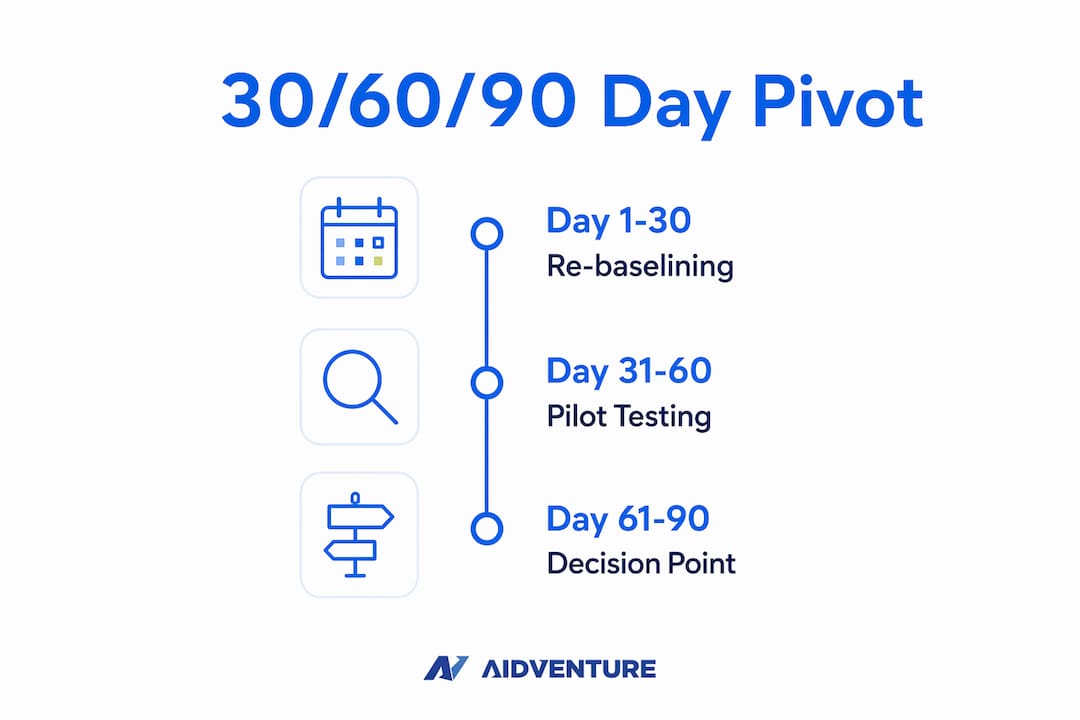
At day 30, the question is whether your outbound signal is strong enough to justify a pilot. At day 60, the question is whether pilots are converting to paid revenue. At day 90, you either commit to the pivot, iterate the offer, or kill the experiment and protect runway. Continuous adaptation — treating strategy as a process of updating convictions as new signals arrive — is what separates companies that pivot well from those that drift.
Which KPIs tell you whether to accept or kill the pivot?
Leading indicators to track weekly:
- Stage-to-stage velocity: Are deals moving through the pipeline faster or slower than the pre-pivot baseline?
- Deal-slippage rate: What percentage of deals are pushing close dates by more than two weeks?
- Outbound conversion rate: Of IBAT-scored conversations, what percentage are converting to demos or pilots?
- Demo-to-pilot rate: Are qualified demos converting to paid pilots within 30 days?
- Days-to-cash: How long from signed pilot to first payment received?
Set runway guardrails before you start. Decide the maximum runway you are willing to consume on the pivot experiment — typically no more than one quarter of remaining runway — and treat that as a hard stop. If you hit the guardrail before reaching day 90, convene an emergency decision review rather than waiting for the scheduled checkpoint.
Report these KPIs weekly to leadership in a single-page dashboard. Evidence-driven decisions require consistent data, not month-end summaries.
When should you bring in a fractional CFO or external strategist?
Four signs that internal capacity is insufficient:
- Your team is anchored to the original plan and resisting the re-baseline (sunk-cost bias)
- Pipeline exposure is unclear and no one owns the repricing analysis
- You lack the forecasting infrastructure to produce a scenario-weighted range quickly
- Outbound validation is not happening at the volume or speed the experiment requires
A fractional CFO engaged for a short-term pivot program typically delivers a re-baseline memo, an outbound test playbook, and a weekly metrics dashboard covering key indicators. The value of managing finances without a full-time CFO is speed and objectivity — an external operator has no attachment to the original plan and can run the re-baseline without the political friction that slows internal teams.
Suggested short scope of work for the first 30 days:
- Freeze original forecast and document assumptions
- Pull fresh actuals and run variance analysis
- Segment and reprice open pipeline
- Build downside/base/upside scenario model
- Publish re-baseline memo to leadership and board
Aidventure’s fractional CFO services are structured specifically for this kind of rapid engagement, with clear deliverables at each 30-day milestone.
Key Takeaways
A financial pivot executed in 30–90 days requires freezing the original forecast, repricing pipeline by exposure bucket, validating outbound within 30 days, and setting hard go/no-go decision dates before spending a dollar on reallocation.
| Point | Details |
|---|---|
| Freeze before you revise | Lock the original forecast as a reference on Day 1; never overwrite it. |
| Reprice by exposure bucket | Apply revised close-probability multipliers only to directly exposed deals, not the full pipeline. |
| Validate outbound in 30 days | Target 30–50 IBAT-scored conversations; rubric-positive contacts move to paid pilots within 60 days. |
| Set hard decision dates | Commit to go/no-go reviews at day 30, 60, and 90 before reallocating runway. |
| Aidventure accelerates the process | Aidventure’s fractional CFO program delivers a re-baseline memo, test playbook, and weekly KPI dashboard within the first 30 days. |
What most founders get wrong about a fast financial pivot
The conventional wisdom says “move fast and cut costs.” That framing causes more damage than the original problem. Broad cost-cutting during a pivot destabilizes the healthy functions that will carry the new strategy once it is validated. The right move is a driver-based audit: identify which specific revenue drivers — velocity, slippage, days-to-cash — are underperforming, and adjust only those.
The second mistake is waiting for month-end data to make decisions. Leading indicators like outbound conversion rate and demo-to-pilot rate give you a signal three to four weeks before the income statement does. If you are only reading month-end reports, you are always deciding on stale information.
The third mistake is underestimating sunk-cost bias. Internal teams that built the original plan will defend it, often unconsciously. An external strategist — whether a fractional CFO or an objective financial advisor — sees the pipeline exposure and the forecast variance without that attachment. That objectivity is often the difference between a pivot that happens in 60 days and one that takes six months.
Aidventure’s rapid pivot program for SaaS founders
SaaS founders who need to change financial direction fast get a concrete advantage from Aidventure’s 30/60/90-day engagement model: a re-baseline memo in 30 days, a validated outbound test playbook in 60 days, and a board-ready scenario model by day 90. There is no long-term contract required and no ramp-up time spent on generic onboarding.

Aidventure’s flexible financial management options are built for exactly this situation: a founder or finance leader who needs fractional CFO-level execution now, not in three months. The team handles re-baselining, pipeline repricing, scenario modeling, and weekly KPI reporting so your internal team can focus on closing pilots and validating the new direction. To get started, visit Aidventure’s fractional CFO services page and book a scoping call.
Useful sources
- Pulse RevOps: Rapid-Response Reforecasting — The definitive guide to freezing projections, repricing pipeline by exposure bucket, and publishing a scenario-weighted range quickly. Supports the re-baselining and pipeline repricing sections.
- Alex Berman: Pivot Business Strategy — Practical guidance on outbound validation volume, IBAT scoring, and converting rubric-positive conversations to paid pilots within 30–60 days. Supports the outbound validation template and 30-day checkpoint.
- McKinsey: Strategic Budgeting for CFOs — Guidance on linking budgets to strategy, increasing cadence for high-risk initiatives, and forcing allocation changes to prevent inertia. Supports the budget reallocation section.
- World Economic Forum: Redefining Corporate Strategy — Frames strategy as a continuous adaptation process and supports the weekly cadence and decision-checkpoint recommendations.
- GrowthGrid: How to Adapt Your Business Plan — Practical tactics for rapid document updates, prioritizing the executive summary and financial projections first. Supports the re-baselining and timeline sections.