SaaS cash flow forecasting is the process of estimating a company’s actual cash inflows and outflows over a defined future period, giving founders and financial decision-makers a clear picture of liquidity at every point in time. Unlike profit, cash tells you whether you can make payroll next month, not just whether the business looks healthy on paper. In SaaS, the gap between those two realities is wider than in most industries: subscription billing cycles, collections lag, deferred revenue, and customer churn all create timing differences that make accounting profit a poor proxy for cash on hand.

A well-built SaaS cash flow forecast tracks three core elements: opening cash balance, projected inflows (collections from customers, investment proceeds, interest), and projected outflows (payroll, infrastructure, debt service, sales and marketing spend). The closing balance from each period rolls forward as the next period’s opening balance. That simple cash flow equation drives every forecast, regardless of complexity.
Why does this matter so much for SaaS startups specifically?
- Runway visibility: Founders need to know exactly how many months of operating expenses current cash covers before raising or cutting costs.
- Liquidity management: Subscription billing creates predictable inflows, but collections timing and churn introduce variance that can catch teams off guard.
- Fundraising readiness: Investors expect founders to know their burn rate, runway, and cash position with precision.
- Avoiding cash crises: Many SaaS companies have failed while technically profitable because they ran out of cash before collections caught up with growth spending.
Aidventure works with SaaS startups to build forecasting models that account for these subscription-specific dynamics, turning what is often a reactive spreadsheet exercise into a forward-looking financial management tool.
Table of Contents
- Which forecasting methods work best for SaaS companies?
- How to build a SaaS cash flow forecast step by step
- Which SaaS metrics drive forecasting accuracy?
- Common SaaS forecasting mistakes and how to avoid them
- How to build a dynamic, team-owned SaaS forecasting model
- Key Takeaways
Which forecasting methods work best for SaaS companies?
1. The direct method
The direct method models actual cash receipts and payments, period by period. It asks your finance team to identify every expected cash inflow (customer collections, tax refunds, asset sales) and every expected cash outflow (payroll, rent, vendor payments, loan repayments) and plot them on a timeline. The result is a granular, bottom-up view of cash that is highly accurate in the near term, typically covering 13 weeks or 90 days.
For SaaS companies, the direct method is the right tool for operational liquidity management. It forces you to model collections timing separately from billing, which is where most forecasting errors originate. A customer billed on the first of the month in a net-30 contract does not generate cash until the following month. If your model treats billing and collection as simultaneous, your forecast will consistently overstate near-term cash.
Key characteristics of the direct method:
- Bottom-up, built from individual cash transactions
- Most accurate for short-term (30–90 day) forecasting
- Time-intensive to build and maintain manually
- Requires reliable accounts receivable (AR) and accounts payable (AP) data
- Directly reflects billing cycle timing and collections lag
2. The indirect method
The indirect method begins with net income from the projected income statement and adjusts for non-cash items (depreciation, stock-based compensation) and changes in working capital (AR, AP, deferred revenue) to arrive at operating cash flow. It is a top-down approach, better suited for board reporting, long-range planning, and communicating with investors.

In SaaS, the indirect method is particularly useful for modeling the impact of deferred revenue. When a customer pays annually upfront, the cash hits immediately, but revenue recognition spreads across 12 months. The indirect method captures this by adjusting for the change in deferred revenue on the balance sheet, giving a more accurate picture of cash generation versus reported earnings.
Key characteristics of the indirect method:
- Top-down, derived from financial statements
- Better for long-term (quarterly, annual) planning and external reporting
- Less granular on day-to-day cash timing
- Handles deferred revenue and non-cash adjustments naturally
- Standard format for board decks and investor reporting
Using both methods together
Most SaaS finance teams run both in parallel. The direct method drives weekly treasury decisions and near-term liquidity management. The indirect method supports strategic planning and investor communications. They answer different questions, and the most effective SaaS financial modeling treats them as complementary rather than competing tools.
How to build a SaaS cash flow forecast step by step
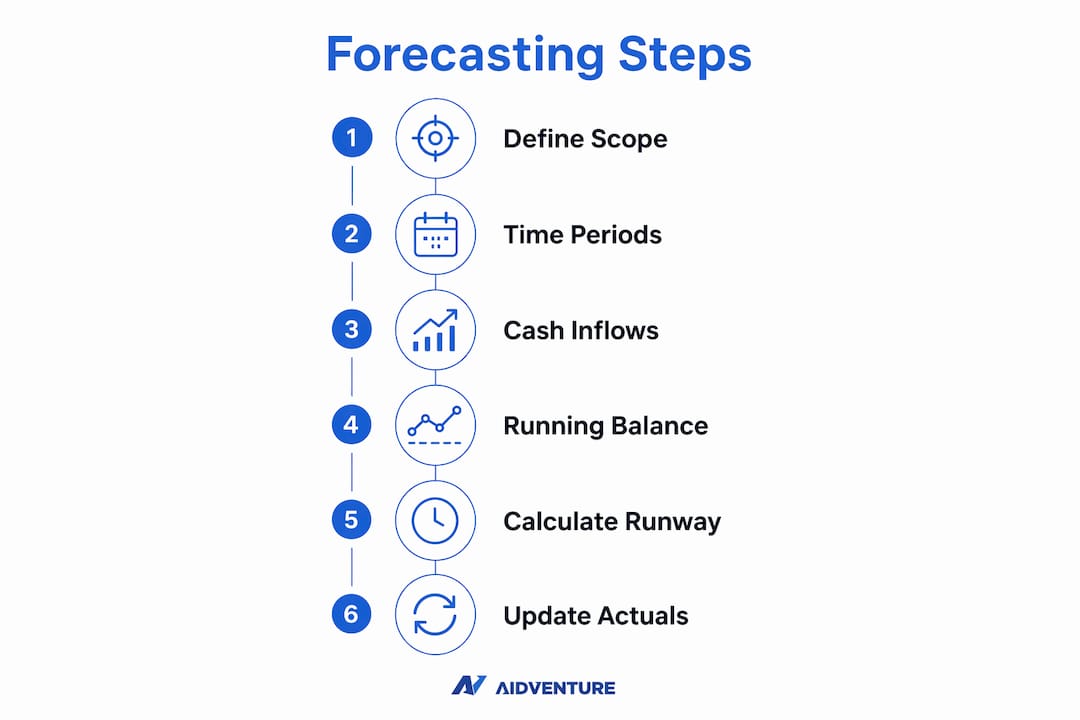
Building a reliable forecast requires discipline in sequencing. The steps below follow the direct method, which is the right starting point for most SaaS startups managing operational cash.
Step 1: Define your forecast scope and opening balance
Choose your forecast horizon: 30, 60, 90 days for near-term liquidity, or rolling 12 months for strategic planning. Set your opening cash balance from your most recent bank statement. This is your starting point, and accuracy here is non-negotiable.
Step 2: Break the forecast into time periods
Divide the forecast into chunks that match your business rhythm. Monthly periods work for most SaaS startups. If you pay biweekly or have significant weekly cash variability, use weekly periods. The granularity should match the decisions you need to make.
Step 3: Forecast cash inflows
Identify every source of cash expected in each period:
- Collections from existing subscribers (based on billing schedule and AR aging)
- New customer collections (based on sales pipeline and expected close dates)
- Annual contract prepayments
- Tax refunds, interest income, asset sales
- Investor funding tranches
Model collections timing explicitly. If your average Days Sales Outstanding (DSO) is 35 days, cash from a January invoice arrives in February. Build that lag into every period.
Step 4: Forecast cash outflows
Repeat the process for outflows:
- Payroll and benefits (largest line item for most SaaS companies)
- Cloud infrastructure and software costs
- Sales and marketing spend, including paid acquisition
- Customer acquisition costs (CAC) tied to hiring and campaigns
- Rent and facilities
- Loan repayments and interest
- Tax payments
Step 5: Build the running cash balance
Plot AR and AP on your timeline. For each period, calculate:
Opening Cash + Cash Inflows − Cash Outflows = Closing Cash
Carry the closing balance forward as the next period’s opening balance. This rolling structure is what makes the forecast a living model rather than a static snapshot.
Step 6: Calculate runway
Divide your current cash balance by your average monthly net cash outflow (burn rate). The result is your runway in months. If closing balances trend toward zero within your forecast window, that is a signal to act, not a reason to revise the assumptions upward.
Step 7: Update with actuals and roll forward
Replace forecasted figures with actual results as each period closes. Analyze variances, adjust assumptions, and extend the forecast window by one period. This roll-forward discipline is what separates a useful forecast from a one-time exercise.
Pro Tip: Set a recurring calendar block every Monday to update your 13-week rolling forecast with the prior week’s actuals. Teams that skip this step find their forecast drifting from reality within 30 days.
Sample monthly cash flow table
March shows a negative net cash flow despite growing inflows, a pattern common when payroll timing or a large vendor payment falls in the same period as a collections gap. Spotting this in advance gives you time to adjust.
Which SaaS metrics drive forecasting accuracy?
SaaS cash flow forecasting does not exist in isolation from the operational metrics that define subscription businesses. The following metrics belong directly in your forecasting model, not just your investor deck.
Monthly Recurring Revenue (MRR) and Annual Recurring Revenue (ARR)
MRR is the foundation of SaaS revenue predictions. It represents the normalized monthly cash you expect from active subscribers. ARR is MRR multiplied by 12, used for annual planning and investor reporting. Both metrics feed directly into your inflow projections, but remember: MRR is a revenue figure, not a cash figure. Collections timing determines when MRR actually becomes cash.
Churn (customer churn and revenue churn)
Churn compounds in ways that are easy to underestimate. A monthly customer churn rate means a significant portion of your customer base churns annually. Small differences in monthly churn produce large differences in annual cash position. Your forecast must model churn as a reduction in future inflows, not just a metric to report. Both gross revenue churn (lost MRR from cancellations) and net revenue churn (lost MRR minus expansion MRR) belong in the model.
Customer Acquisition Cost (CAC)
CAC drives cash outflows. Every new customer acquired requires upfront spending on sales, marketing, and onboarding before that customer generates a single dollar of cash. Modeling CAC accurately means tying your sales headcount plan, marketing budget, and pipeline velocity to specific cash outflow periods, not just annual totals.
Expansion Revenue and Net Revenue Retention (NRR)
Expansion MRR from upsells, cross-sells, and seat additions is one of the most cash-efficient growth levers in SaaS. High NRR (above 100%) means existing customers generate more cash over time without incremental acquisition spend. Tracking net revenue retention gives your forecast a more accurate picture of organic cash growth from the existing base.
Deferred Revenue
When a customer pays $12,000 annually upfront, your bank account receives $12,000 immediately, but your income statement recognizes $1,000 per month. Deferred revenue represents cash received but not yet earned, and it must be modeled carefully. In a cash flow forecast, the full $12,000 is an inflow in the month of payment. Revenue recognition timing is irrelevant to cash, but it matters for the indirect method and for understanding the relationship between your P&L and your cash position.
Usage-Based Metrics
For SaaS companies on consumption or usage-based pricing, API calls, seats activated, or data volume drive revenue variability that pure subscription models do not face. These metrics require additional forecasting layers to translate usage patterns into expected cash collections.
Pro Tip: Build your MRR waterfall (new MRR + expansion MRR − churned MRR − contraction MRR = net new MRR) as a separate schedule that feeds directly into your cash inflow projections. This single structure catches more forecasting errors than any other model component.
Common SaaS forecasting mistakes and how to avoid them
Even experienced finance teams make predictable errors in SaaS cash flow forecasting. Knowing where the traps are is half the battle.
Common mistakes:
- Confusing bookings with collections. A signed contract is not cash. A booked deal becomes cash only when invoiced and collected, often 30–60 days later. Forecasting bookings as immediate inflows overstates near-term cash.
- Ignoring churn in the inflow model. Many founders build inflow projections based on current MRR without reducing for expected churn. The result is a forecast that consistently overestimates future cash.
- Using overly optimistic sales assumptions. Pipeline-based forecasts that assume 100% close rates or aggressive ramp timelines for new sales reps produce inflow projections that rarely materialize on schedule.
- Misinterpreting deferred revenue as earned revenue. Treating deferred revenue as available cash for operating expenses ignores the obligation to deliver the contracted service. If a customer cancels, that cash may need to be refunded.
- Updating the forecast too infrequently. A forecast built in January and reviewed in April has already diverged from reality in ways that make it unreliable for decision-making.
- Modeling outflows at the wrong level of detail. Lumping all operating expenses into a single line obscures the timing of large, irregular payments like annual insurance premiums, tax installments, or equipment purchases.
Best practices:
- Model collections lag explicitly. If your average DSO is 30 days, build a one-period delay between billing and cash receipt into every inflow line.
- Run scenario analysis with at least three cases: base, upside, and downside. The downside case should reflect a realistic churn spike and a 20–30% miss on new bookings.
- Reconcile your forecast to actuals every period. Variance analysis tells you which assumptions are consistently wrong and need recalibration.
- Involve sales, customer success, and product in the forecasting process. Each team owns assumptions that finance cannot reliably estimate alone.
- Keep the forecast scope matched to your runway. If you have 18 months of runway, a 12-month rolling forecast is appropriate. If runway drops below 6 months, shift to a 13-week weekly model.
Pro Tip: Treat your cash flow forecast as a shared document, not a finance deliverable. When sales owns the pipeline assumptions and customer success owns the churn assumptions, forecast accuracy improves because the people closest to the data are accountable for the inputs.
For a structured look at where SaaS forecasting models most often break down, Aidventure’s guide on forecasting mistakes to avoid covers the most costly errors in detail.
How to build a dynamic, team-owned SaaS forecasting model
The most accurate SaaS cash flow forecasts are not built by finance alone. They are living models where each department owns the assumptions it is best positioned to estimate.
Departmental ownership of assumptions
Sales owns close rates, pipeline velocity, and new bookings timing. Customer success owns churn rates and expansion probability. Product owns usage patterns for consumption-based pricing tiers. Finance owns the model architecture, the collections timing logic, and the translation of operational metrics into cash. When assumptions are distributed this way, the forecast reflects actual business dynamics rather than finance’s best guess about sales and retention.
Cash conversion timing, not accounting revenue
The most consequential shift in SaaS financial modeling is moving from revenue recognition timing to cash conversion timing. A deal closed in December under annual billing generates cash in December, regardless of when revenue is recognized. A deal closed in December under net-60 billing generates cash in February. Building the forecast on cash timing rather than accounting revenue eliminates the single most common source of SaaS cash forecast error.
The 13-week rolling forecast
The 13-week rolling forecast is the standard operational liquidity tool for SaaS startups. It provides a 90-day window of weekly cash visibility, updated weekly as actuals come in. Teams update this forecast weekly, or daily when runway falls below 6 months, to support treasury decisions like timing vendor payments, accelerating collections, or triggering a bridge financing conversation.
The 13-week model works alongside a monthly rolling 12-month forecast for strategic planning. The two horizons serve different purposes and should not be collapsed into one.
Handling collections lag in B2B SaaS
In B2B SaaS, AR collection lag of 30 days or more is common. An invoice sent on March 1 under net-30 terms converts to cash on or around April 1. If your model treats the March invoice as March cash, every month’s closing balance will be overstated by approximately one month of billings. The fix is straightforward: build an AR aging schedule that maps each billing period’s expected collections into the correct future period.
Scenario and sensitivity testing
A single-point forecast is a starting position, not a plan. Effective SaaS forecasting models include at minimum:
- A base case built on current trends and pipeline
- A downside case reflecting a churn spike and slower new bookings
- An upside case modeling accelerated growth and expansion revenue
- Sensitivity toggles for key variables: churn rate, average contract value, CAC, and collections timing
Running these scenarios regularly, not just at board meetings, gives founders the visibility to make proactive decisions. For a practical framework on building these scenarios, Aidventure’s flexible financial planning guide covers the mechanics in depth.
Pro Tip: When your 13-week forecast shows closing balances declining for three consecutive weeks, treat that as a trigger for action, not a reason to rebuild the model with more optimistic assumptions. The forecast is working correctly. The business needs to respond.
For additional context on how real-time financial data improves the responsiveness of rolling forecasts, integrating live reporting into your model reduces the lag between actuals and forecast updates significantly.
Aidventure’s fractional CFO services are built specifically for SaaS startups that need this level of forecasting rigor without the cost of a full-time finance executive. The team brings the model architecture, the SaaS-specific metric expertise, and the cross-functional facilitation that makes a forecast genuinely useful.
Key Takeaways
Accurate SaaS cash flow forecasting requires modeling cash conversion timing, not accounting revenue, and distributing assumption ownership across sales, customer success, and finance.
| Point | Details |
|---|---|
| Cash timing beats revenue timing | Model when cash actually arrives, not when revenue is recognized, to avoid systematic overstatement of near-term balances. |
| Direct and indirect methods serve different needs | Use the direct method for operational liquidity management and the indirect method for board reporting and long-range planning. |
| Churn compounds quickly | Small monthly churn rates produce large annual cash shortfalls; model churn as a reduction in future inflows every period. |
| Collections lag must be explicit | In B2B SaaS, AR collection lag of 30 days or more is common and must be built into every inflow projection. |
| Update forecasts on a rolling basis | Teams update the 13-week forecast weekly, or daily when runway falls below 6 months, to keep treasury decisions grounded in current data. |

SaaS founders who want to move from reactive cash management to a proactive, model-driven approach can explore Aidventure’s fractional CFO services to see how expert financial guidance translates directly into better forecasting, cleaner metrics, and more confident growth decisions.