Canada’s SR&ED tax credit is a refundable federal incentive that returns cash to businesses conducting work that addresses scientific or technological uncertainty through systematic investigation. For most Canadian SaaS startups structured as Canadian-controlled private corporations (CCPCs), the verdict is clear: if your engineering team is solving problems where the solution isn’t derivable from publicly available knowledge, you likely have a claim worth pursuing.
Start here in the next 72 hours:
- Identify two or three active development projects where the technical outcome was genuinely uncertain at the outset
- Begin contemporaneous documentation today: dated notes, hypotheses, and experiment results
- Decide whether the Proxy or Traditional method better fits your overhead structure before filing
Table of Contents
- Does your SaaS work qualify for the SR&ED tax credit?
- Which costs can you claim and how is the credit calculated?
- How to document SR&ED inside your dev and finance workflows
- What is the SR&ED filing process and when are the deadlines?
- Why SR&ED is a strategic financing tool, not just a tax filing
- Common SR&ED audit triggers and how to avoid them
- How SR&ED claims work during M&A and restructuring
- Recent SR&ED policy changes affecting SaaS companies
- Key Takeaways
- The part most founders get wrong about SR&ED
- How Aidventure helps SaaS startups capture SR&ED credits
- Useful sources
Does your SaaS work qualify for the SR&ED tax credit?
The CRA eligibility test has three components: the work must advance scientific or technological knowledge, it must address a genuine technological uncertainty, and it must be carried out through systematic investigation or experiment. All three must be present.
A critical distinction founders miss: technical difficulty is not the same as technological uncertainty. If a competent developer could solve the problem using publicly available knowledge, the CRA will not consider it SR&ED-eligible. The bar is whether the solution required experimentation because the answer wasn’t known in advance.
Eligibility checklist for a candidate project:
- Did the project define a specific technological objective (not just a business goal)?
- Was there genuine uncertainty about whether the approach would work?
- Did the team run experiments, test hypotheses, or iterate through failed attempts?
- Were the results documented as they happened?
| Activity | Eligible | Excluded |
|---|---|---|
| Developing a novel ML ranking algorithm | Yes | |
| Prototyping a new microservices architecture to solve unknown scaling limits | Yes | |
| Researching whether a new database engine can handle real-time multi-tenant writes | Yes | |
| Adding a UI theme or color palette | No | |
| Routine bug fixes and QA | No | |
| Standard API integrations with known documentation | No | |
| Market research or customer discovery | No |
Support work (data collection, engineering design, testing) can also qualify when it is commensurate with the SR&ED effort and directly in support of an eligible project. Document the link explicitly.
Pro Tip: When writing project descriptions, frame objectives around the technological uncertainty, not the product outcome. “We investigated whether transformer-based embeddings could reduce query latency below 50ms at 10,000 concurrent users without retraining” is SR&ED language. “We built a faster search feature” is not.
Which costs can you claim and how is the credit calculated?
Eligible expenditure categories for SaaS startups include:
- Salaries and wages of employees directly engaged in SR&ED work (the largest category for most SaaS companies)
- Contractor and subcontractor costs (80% of arm’s-length contract amounts qualify for the investment tax credit, or ITC)
- Materials consumed or transformed during SR&ED experiments
- Overhead under the Traditional method, or a flat Prescribed Proxy Amount (PPA) under the Proxy method
Cloud compute costs and third-party SaaS tools used exclusively in SR&ED experiments can qualify as materials or overhead, but the allocation must be defensible and documented.
Traditional vs. Proxy method: The Traditional method requires tracking every overhead receipt tied to SR&ED. The Proxy method replaces that with a flat PPA calculated at 55% of the SR&ED salary base, eliminating the overhead tracking burden. For most early-stage SaaS startups, Proxy is the practical choice. The election is irrevocable for the filed year, so evaluate both before committing.
ITC rates for CCPCs: Most CCPCs earn a refundable ITC at 35% on qualified expenditures up to the $3 million expenditure limit. Amounts above that limit earn the basic rate of 15%. The 35% enhanced rate is fully refundable on current expenditures, meaning the CRA sends you a cash refund even if you owe no tax.
Quick example: A CCPC with $400,000 in eligible SR&ED salaries elects the Proxy method. The PPA is 55% × $400,000 = $220,000. Total qualified expenditures: $620,000. At 35%, the ITC is $217,000, refundable in cash.
Capital expenditures receive different treatment: the ITC is earned but refundability rules differ, and recapture applies if claimed property is later sold or converted to commercial use.
How to document SR&ED inside your dev and finance workflows
The CRA expects contemporaneous records: evidence created at the time the work happened, not reconstructed at year-end. Dated experiment notes, test results, failed attempts, and decision rationale are the records that survive review.
What to capture for each SR&ED project:
- The technological uncertainty being investigated
- Hypotheses and the approach taken
- Results, including failures and what they revealed
- Who performed the work and when
- Time spent, linked to specific experiments
- Costs incurred
Pro Tip: Embed SR&ED capture directly into existing developer workflows. Add a short “SR&ED fields” block to your GitHub PR template: uncertainty addressed, approach tested, outcome. Annotate git commits with experiment references. Use your time-tracking tool (Harvest, Toggl, or similar) to tag hours to SR&ED project codes. These lightweight habits create audit-ready evidence without adding meaningful overhead.
Time-tracking is particularly important. Developer hours should be logged at the task level, tied to specific experiments, not just to a project name. Payroll records alone are insufficient without the task-level link.

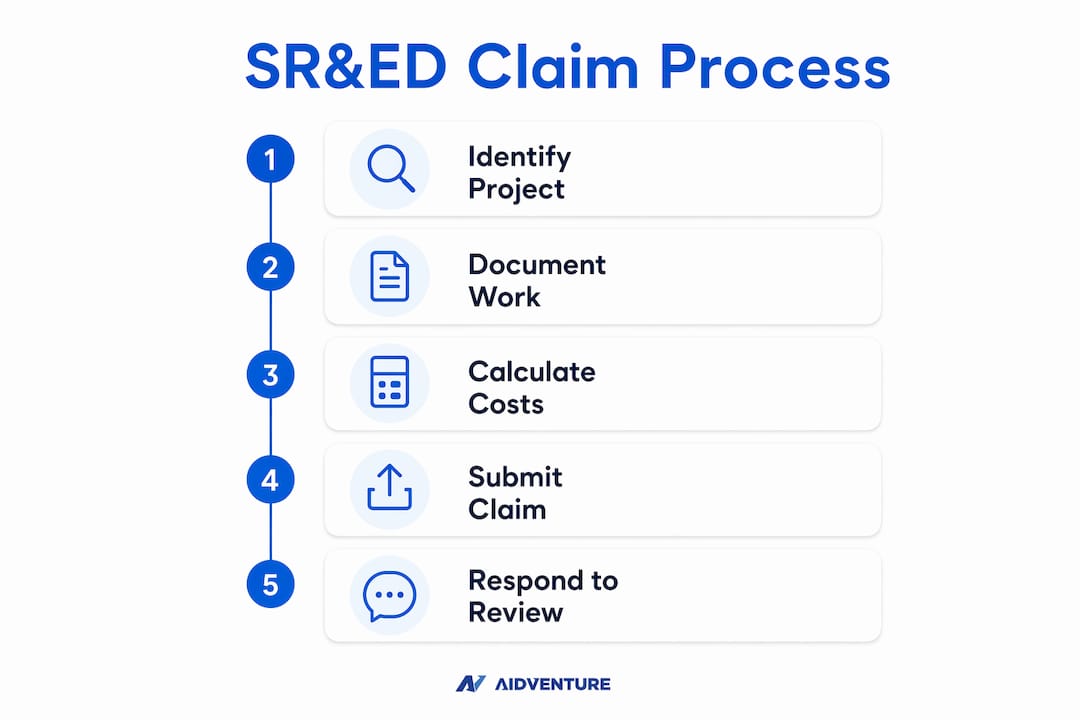
What is the SR&ED filing process and when are the deadlines?
The SR&ED reporting deadline is 12 months after the filing due date of the income tax return for the tax year. For corporations, whose tax return is due six months after year-end, this means an effective window of up to 18 months from the tax year-end.
| Milestone | Timing |
|---|---|
| Corporate tax return due | 6 months after year-end |
| SR&ED claim deadline | 12 months after the return due date (total: 18 months from year-end) |
| Recommended submission | With the annual tax return |
Filing with your tax return is strongly recommended. It speeds processing and gives the CRA a 90-day window to request clarifications before the formal deadline, reducing the risk of outright rejection.
Required forms:
- Form T661: describes SR&ED projects and expenditures
- T2SCH31: ITC claim for corporations
- T2038(IND): ITC claim for individuals
Pre-submission checklist: project descriptions with defined technological uncertainties, cost schedules with time allocations, contractor invoices, signed tax return, and direct deposit instructions for the refund.
Why SR&ED is a strategic financing tool, not just a tax filing
SR&ED credits are non-dilutive. Unlike equity financing, a refund doesn’t cost you ownership. For a CCPC burning $1.5 million annually on R&D salaries, a 35% refundable ITC represents meaningful working capital returned each year without a cap table entry.
Strategic benefits for SaaS founders:
- Extends runway without additional equity rounds
- Validates R&D spending with a government-backed financial signal
- Improves unit economics when SR&ED refunds are modeled against ARR growth
- Reduces short-term dilution pressure during early scaling phases
Model expected SR&ED refunds into your cash flow forecasts as a line item, not an afterthought. A founder who knows a $150,000 refund will arrive in Q2 can time a hiring decision differently than one who treats it as a surprise. That planning discipline is what converts SR&ED from a tax exercise into a genuine financing strategy.
Common SR&ED audit triggers and how to avoid them
The CRA reviews SR&ED claims with particular attention to project descriptions that read as business narratives rather than technical ones, and to cost allocations unsupported by time records.
Common pitfalls:
- Vague project descriptions that describe features, not technological uncertainties
- No contemporaneous records: reconstructed notes fail review
- Mixing excluded activities (UI polish, routine ops) into SR&ED cost pools
- Contractor costs claimed at 100% instead of the 80% ITC-eligible rate
- Time allocations that don’t reconcile with payroll or invoices
If the CRA opens a review, respond promptly with a clear package: contemporaneous experiment logs, time records linked to specific technical tasks, cost schedules, and a point-by-point response to each information request. Assign one internal owner to coordinate the response and engage an advisor before the first reply, not after.
Pro Tip: The CRA focuses on failed experiments and decision logs during reviews. A well-documented failed approach is stronger evidence of genuine SR&ED than a clean success story. Capture what didn’t work and why.
How SR&ED claims work during M&A and restructuring
SR&ED claims in progress at the time of a merger, acquisition, or restructuring require careful handling. Unclaimed ITCs can be carried back three years or carried forward 20 years, but the ability to use them post-transaction depends on corporate continuity rules under the Income Tax Act.
In an asset purchase, SR&ED ITCs generally do not transfer to the acquirer. In a share purchase, the credits remain with the corporation, but the acquirer must confirm the target remains a CCPC post-close to preserve the enhanced 35% rate and refundability. If the acquiring entity is a public company or a non-CCPC, the enhanced rate and refundability may be lost on future claims.
During restructuring, any SR&ED property converted to commercial use triggers recapture of the ITC claimed on that property. Document the SR&ED claim status in the data room and address ITC carryforwards explicitly in purchase agreements. Engage a tax advisor with SR&ED experience before closing, not during post-merger integration.
Recent SR&ED policy changes affecting SaaS companies
The federal government’s 2024 budget proposed expanding SR&ED eligibility and increasing support for Canadian businesses, with consultations ongoing through 2025. As of 2026, the core ITC rates (35% for CCPCs up to the $3 million expenditure limit, 15% basic rate above it) remain in effect, but founders should monitor CRA guidance pages for updates to the expenditure limit phase-out thresholds, which are tied to taxable capital employed in Canada.
One structural change already in effect: for tax years ending after March 18, 2019, previous-year taxable income is no longer a factor in determining a CCPC’s annual expenditure limit. This simplifies eligibility calculations for early-stage startups that may have had variable income in prior years.
SaaS-specific guidance from the CRA has not changed materially, but the agency has signaled closer scrutiny of software claims where technological uncertainty is not clearly distinguished from standard software development. Founders should treat the quality of project descriptions as a compliance priority, not a formality.
Key Takeaways
Canadian SaaS startups structured as CCPCs can earn a refundable SR&ED ITC at 35% on qualified R&D expenditures up to $3 million, converting engineering work into non-dilutive working capital when documented correctly.
| Point | Details |
|---|---|
| Core eligibility test | Work must address technological uncertainty through systematic investigation, not just technical difficulty. |
| CCPC ITC rate | CCPCs earn a refundable 35% ITC on qualified expenditures up to an expenditure limit; a lower rate applies above it. |
| Filing deadline | SR&ED claims are due 12 months after the tax return filing due date, giving corporations up to 18 months from year-end to submit. |
| Documentation priority | Contemporaneous records linking time, cost, and experiment outcomes to specific technological uncertainties are the single strongest audit defense. |
| Aidventure’s role | Aidventure helps SaaS founders scope SR&ED projects, set up documentation workflows, and model refunds into financial planning for runway and fundraising decisions. |
The part most founders get wrong about SR&ED
The most common mistake isn’t missing the filing deadline or choosing the wrong expenditure method. It’s treating SR&ED as a year-end accounting exercise rather than a continuous operational practice.
Founders who wait until Q4 to reconstruct what their engineers did in Q1 face two problems: the evidence is thin, and the claim is exposed. The CRA’s own guidance is explicit that contemporaneous records are the standard. A claim built on reconstructed notes is a claim that invites rejection.
The practical fix is simpler than most founders expect. Embedding SR&ED capture into existing tools, GitHub, Jira, Harvest, or whatever the team already uses, adds minutes per sprint, not hours per week. The return on that investment is a defensible claim and a predictable cash refund that can be modeled into fundraising scenarios with real confidence.
SR&ED isn’t a windfall. It’s a financing mechanism that rewards disciplined R&D operations. Founders who treat it that way tend to claim more, defend it better, and use the refund strategically rather than being surprised by it.
How Aidventure helps SaaS startups capture SR&ED credits
SaaS founders who want SR&ED refunds without the administrative risk need more than a tax preparer. They need a finance partner who understands both the CRA’s technical eligibility standards and the operational realities of a scaling SaaS business.

Aidventure’s fractional CFO services include SR&ED project scoping, contemporaneous documentation setup, bookkeeping structures that support cost allocation, and cash-flow modeling that incorporates expected refunds into runway and fundraising scenarios. The accounting operations team builds the payroll time-tracking and contractor invoice workflows that make SR&ED claims defensible at review. Founders get a structured claim process, not a year-end scramble.
To start, book an SR&ED readiness consult with Aidventure. The conversation covers which of your active projects likely qualify, what documentation gaps exist today, and how to model the expected refund into your next 12-month forecast.
Useful sources
- SR&ED eligibility guidelines — CRA’s core test for eligible work
- Get ready to claim SR&ED — documentation and preparation guidance
- Form T661 guide — complete instructions for completing the SR&ED expenditures claim
- SR&ED ITC rates and refundability — CRA policy on the 35% and 15% rates
- Traditional and Proxy methods — CRA guidance on overhead calculation elections
- Filing requirements and deadlines — official deadline rules for SR&ED claims
- Aidventure SR&ED and financial planning support — book a consult or request an SR&ED readiness review
This article is general information for Canadian SaaS founders and does not constitute tax or legal advice. Confirm current rules and rates with the CRA or a qualified SR&ED advisor for your specific situation.