Strategic financial planning is defined as the process of translating a company’s long-term strategy into a multi-year financial roadmap that allocates resources and guides every budgeting decision. This is the standard term used in corporate finance and FP&A practice. Unlike a simple annual budget, it connects your business vision to measurable financial targets across a 3–5 year horizon. Entrepreneurs who treat financial planning as a one-time spreadsheet exercise consistently underperform those who build it into their decision-making cycle. This guide breaks down what strategic financial planning actually involves, how to build one, and why the discipline of limiting your goals is the most underrated growth lever available to business owners.
What is strategic financial planning and how does it differ from budgeting?
Strategic financial planning and budgeting are not the same thing. Budgeting is the tactical byproduct of a strategic plan. It translates the near-term portion of a multi-year plan into detailed financial operations for the current year. Confusing the two causes a specific and costly failure: your budget ends up funding last year’s priorities instead of next year’s goals.
Traditional budgeting operates on a 12-month cycle. It answers the question “How do we spend what we have?” Strategic financial planning operates on a 3–5 year view and answers a different question: “What do we need to fund to get where we want to go?” The distinction matters because strategy formulation and financial management must be integrated, not run as separate functions.

| Dimension | Traditional budgeting | Strategic financial planning |
|---|---|---|
| Time horizon | 12 months | 3–5 years |
| Primary question | How do we allocate current resources? | What resources do we need to reach strategic goals? |
| Flexibility | Fixed annual targets | Iterative, scenario-tested |
| Decision driver | Historical spending patterns | Forward-looking strategic priorities |
| Output | Annual operating budget | Multi-year financial roadmap |
Static projections also carry a specific risk: they assume the future will resemble the past. Strategic financial planning builds in scenario testing so your numbers flex when market conditions shift. A budget without that flexibility is a plan that breaks the moment reality diverges from assumptions.
Pro Tip: Review your budget quarterly against your strategic plan, not just against last year’s actuals. The comparison that matters is whether your spending is moving you toward your 3-year goal, not whether it matches your 2025 figures.
How to create a financial plan with a strategic foundation
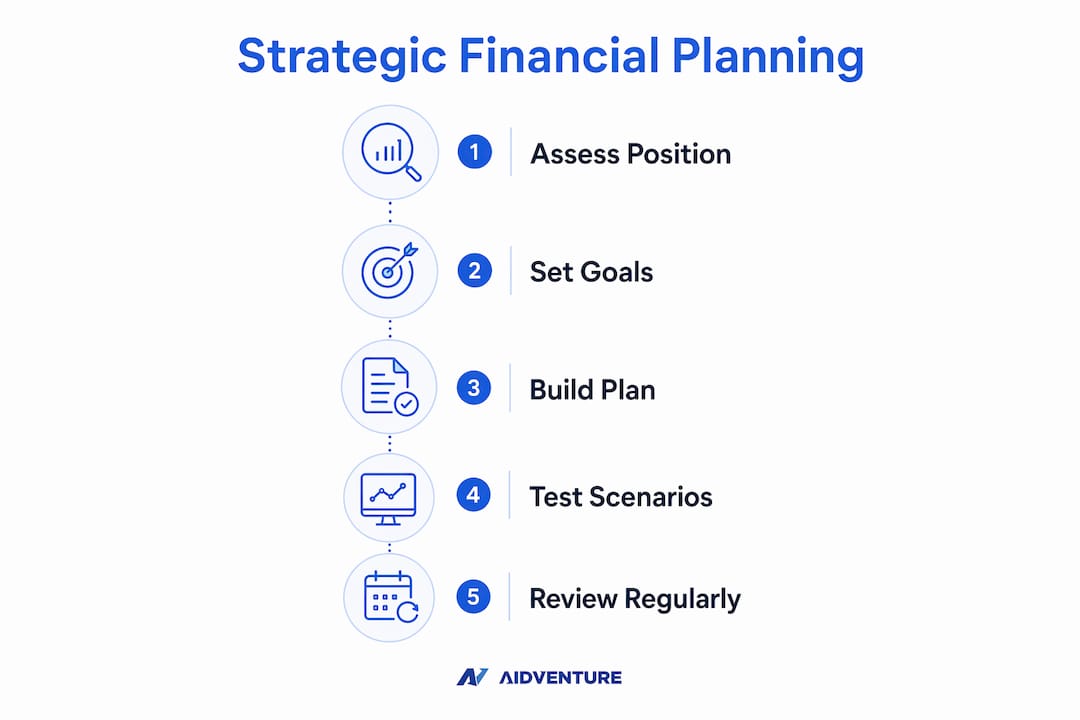
Building a strategic financial plan follows a clear sequence. Skipping steps, especially the early diagnostic ones, produces a plan that looks complete but collapses under real-world pressure.
-
Define your strategic objectives. Start with the business vision, not the numbers. Where does the company need to be in three to five years? What market position, revenue level, or product capability defines success? Every financial decision downstream flows from this clarity.
-
Assess your current financial position. Annual assessment of net worth and cash flow forms the foundation of realistic long-term forecasting. This step includes reviewing accounts receivable, outstanding liabilities, insurance coverage, and any estate or succession considerations for the business.
-
Model the financial implications of each strategic option. Before committing to a direction, run the numbers on what it actually costs. Financial modeling for entrepreneurs translates strategic choices into projected cash flows, capital requirements, and break-even timelines. This step separates ambition from feasibility.
-
Allocate resources to prioritized goals. Funding follows priority. If you have identified three strategic goals but only enough capital to fund two properly, the plan must make that trade-off explicit. Spreading resources across all three produces mediocre results across the board.
-
Translate strategy into near-term budgets and forecasts. The annual operating budget becomes the first year of the strategic plan, not a standalone document. This is where strategic budgeting techniques connect daily financial operations to long-term targets.
-
Build in iterative review cycles. A strategic financial plan is not a document you file and revisit annually. Set quarterly checkpoints to compare actual performance against plan assumptions. Adjust when the data tells you to.
Pro Tip: When assessing your financial position, calculate your monthly cash burn rate and your runway in months before you model any growth scenario. You cannot plan forward without knowing exactly where you stand today.
Why limiting your strategic financial goals produces better results
The instinct to pursue every opportunity is one of the most common and expensive mistakes entrepreneurs make. Concentration of resources on a limited number of strategic goals produces greater market superiority than spreading efforts across many priorities. This is not a motivational principle. It is a resource allocation reality.
Here is what happens when a business pursues too many financial goals simultaneously:
- Capital dilution. Each goal receives partial funding. None receives enough to reach the threshold where it generates a return.
- Management attention fragmentation. Leadership time is finite. Splitting focus across six priorities means none gets the depth of attention required to execute well.
- Delayed feedback loops. When results disappoint, it is harder to diagnose whether the strategy was wrong or simply underfunded.
- Competitive vulnerability. A focused competitor with one clear goal and full resources will outperform a distracted business every time.
Strategic financial planning requires making hard trade-offs, explicitly deciding what the company will not do. This is the discipline most business owners resist. Saying no to a revenue opportunity feels like leaving money on the table. In practice, it protects the resources needed to win where it matters most.
Competitive advantage is perishable. A product line or market segment that generated strong margins two years ago may now be a drain on capital. A sound financial plan forces an honest assessment of which areas to exit so resources can concentrate on defensible, high-impact opportunities.
How do you keep a strategic financial plan relevant over time?
A strategic financial plan that does not change is a plan that has stopped working. Markets shift, competitors move, and assumptions that held in year one rarely survive intact into year three. The solution is not to plan less. It is to plan differently.
“Financial planning is a continuous journey that builds confidence for business owners, with flexibility to adjust as circumstances and markets change. The goal is not perfect prediction but creating a conscious decision-making framework for adapting the plan.”
— Fidelity Financial Planning
Scenario planning and stress testing are the core tools for maintaining plan relevance. Scenario planning models multiple versions of the future, a base case, a downside case, and an upside case, so the business is never caught flat-footed by a single outcome. Stress testing applies specific shocks to the model: What happens to cash flow if Annual Recurring Revenue (ARR) growth drops by 20%? What if a key customer churns? What if venture capital dries up for 18 months?
Best practices for keeping your plan dynamic include:
- Quarterly plan reviews. Compare actuals against plan assumptions, not just against budget. Identify which assumptions are drifting and why.
- Annual strategic reassessment. Revisit the 3–5 year horizon each year. New market data, competitive shifts, or internal capability changes may require adjusting the direction, not just the numbers.
- Trigger-based replanning. Define in advance the conditions that would force a plan revision: a revenue miss of a certain magnitude, a new competitor entering your core market, or a regulatory change affecting your cost structure.
- Separation of discipline and flexibility. Discipline means holding to the strategic direction. Flexibility means adjusting the financial path to get there. Confusing the two leads either to rigid plans that break or to directionless pivots that waste capital.
When strategy and finance operate in silos, budgets fund the past rather than the future. Avoiding that failure requires treating the plan as a living document with scheduled review points, not a static forecast filed at the start of the fiscal year. Entrepreneurs who build this review cadence into their operating rhythm consistently make better capital allocation decisions than those who rely on annual planning alone.
Key Takeaways
Strategic financial planning is the discipline of connecting long-term business vision to a funded, tested, and regularly reviewed multi-year financial roadmap.
| Point | Details |
|---|---|
| Planning vs. budgeting | Budgeting allocates current resources; strategic planning defines what resources you need to reach future goals. |
| 3–5 year horizon | Effective plans require a multi-year view to avoid sacrificing long-term positioning for short-term results. |
| Limit strategic goals | Concentrating resources on fewer priorities produces stronger market results than spreading capital thin. |
| Scenario testing is required | Static projections fail when assumptions change; build downside and upside scenarios into every plan. |
| Continuous review cycle | Quarterly reviews and trigger-based replanning keep the financial plan aligned with real market conditions. |
Why strategy and finance must speak the same language
The most consistent failure I see in growing businesses is not a bad strategy or a weak financial model. It is the gap between the two. The leadership team has a clear vision for where the company is going. The finance function produces accurate reports on where it has been. Neither informs the other in real time, and the result is a budget that reflects historical spending patterns rather than future priorities.
Entrepreneurs often treat financial planning as a compliance task, something to complete before a board meeting or a fundraising round. That framing is expensive. A financial plan built around your strategic goals becomes a decision-making tool you use every month. It tells you whether a new hire accelerates your plan or delays it. It tells you whether a new product line is funded or aspirational. It replaces gut-feel capital allocation with a framework grounded in your actual numbers.
The trade-off discipline is where most owners struggle most. Saying no to a project that could generate revenue feels counterintuitive. But financial clarity drives growth precisely because it forces you to fund your best opportunities fully rather than your average opportunities partially. I have seen businesses triple their growth rate not by finding new revenue streams but by stopping the ones that were consuming capital without a clear path to return.
Treat your strategic financial plan as a living document. Review it when the market moves, not just when the calendar tells you to.
— Sergio
How Aidventure supports your financial planning goals
Growing a business without experienced financial leadership is one of the most common constraints entrepreneurs face. Aidventure provides fractional CFO services built specifically for SaaS startups and scaling businesses that need strategic financial guidance without the cost of a full-time hire.

Aidventure’s team works directly with founders and operators to build multi-year financial plans, run scenario analyses, and translate strategy into funded budgets. If you are making capital allocation decisions without a clear financial roadmap, the gap between your vision and your results will widen over time. Aidventure also publishes practical resources on avoiding forecasting mistakes that derail otherwise sound plans. The right financial partner does not just report on the past. They help you fund the future.
FAQ
What is strategic financial planning in simple terms?
Strategic financial planning is the process of connecting your long-term business goals to a funded, multi-year financial roadmap. It determines what resources you need, how to allocate them, and how to adjust when conditions change.
How does strategic financial planning differ from a regular budget?
A budget allocates resources for the current year based on historical spending. Strategic financial planning defines what resources are needed over 3–5 years to reach specific business goals, with the annual budget serving as its first-year execution layer.
How many strategic financial goals should a business focus on?
Focusing on a limited number of goals, typically two to three core priorities, produces stronger results than pursuing many simultaneously. Concentrating resources on fewer goals generates greater market superiority and avoids diluting capital across underfunded initiatives.
Why is scenario testing part of financial planning?
Scenario testing models multiple versions of the future so the business is prepared when assumptions change. Without it, a static plan breaks the moment market conditions, customer behavior, or competitive dynamics shift unexpectedly.
How often should a strategic financial plan be reviewed?
A strategic financial plan should be reviewed quarterly against actual performance and reassessed annually against the 3–5 year horizon. Trigger-based reviews, tied to specific revenue or market events, keep the plan current between scheduled checkpoints.