Financial modeling is defined as the process of translating business assumptions into structured numerical projections, producing an income statement, cash flow statement, and balance sheet that founders use to guide decisions. The role of financial modeling for entrepreneurs extends far beyond spreadsheets. It is the mechanism that connects your business strategy to measurable outcomes, giving investors, boards, and your own team a shared language built on numbers. Financial modeling helps evaluate pricing decisions, expansion plans, and investment choices while aligning stakeholders around a single version of the truth. Founders who master it raise capital faster and operate with far more confidence.
Why is financial modeling important for startups?
Financial modeling is indispensable for founders because it forces every assumption into the open where it can be tested. A gut feeling about customer growth means nothing to an investor. A model that shows pipeline conversion rates, average contract value, and sales capacity tells a real story.
The practical benefits for startup founders include:
- Cash runway visibility. A model shows exactly how many months of operating capital remain under each spending scenario. This prevents the most common startup failure: running out of cash without warning.
- Burn rate management. Tracking monthly cash consumption against revenue growth tells you whether the business is moving toward profitability or drifting away from it.
- Unit economics clarity. Key metrics like CAC, ARPA, and gross margin reveal whether the business model is fundamentally repeatable. An LTV:CAC ratio above 3 signals a durable business.
- Investor communication. Investors scrutinize specific thresholds. Gross margins should target 70–80%+, payback periods under 18 months signal strength, and a burn multiple under 1.5x is considered excellent.
- Board and stakeholder alignment. A shared financial model removes ambiguity from board discussions and keeps every decision anchored to agreed assumptions.
The importance of financial modeling compounds over time. Founders who build and maintain models develop an instinct for which levers actually move the business. That instinct is what separates operators from founders who are always reacting to surprises.
How should entrepreneurs build investor-ready financial models?
Building a financial model that investors trust requires a specific structure and a disciplined process. The goal is not complexity. The goal is clarity about how the business actually works.

Start with a bottom-up revenue build. Investors reject top-down models built on market share assumptions like “we will capture 1% of a $10 billion market.” Instead, link revenue to operational drivers: sales headcount, quota attainment rates, average deal size, and conversion rates at each pipeline stage. This approach shows real business mechanics.
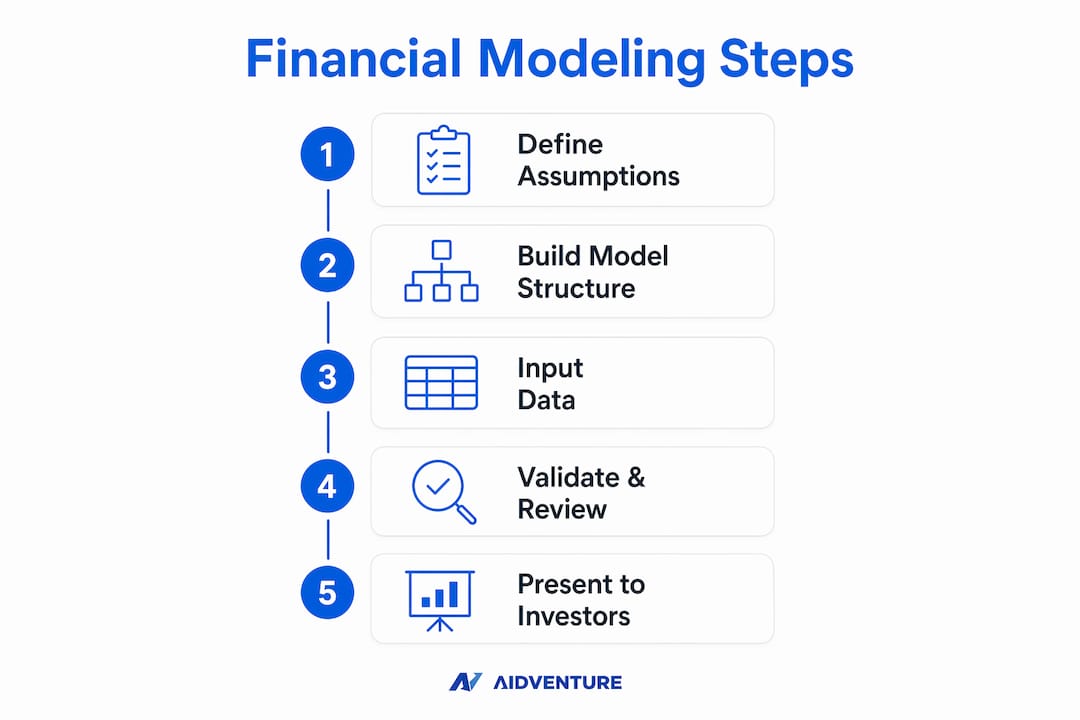
Follow these steps to build a model that holds up under scrutiny:
- Map your revenue drivers. List every input that generates revenue: number of salespeople, leads per rep, close rate, and average contract value. Build formulas that connect these inputs directly to Monthly Recurring Revenue (MRR) or Annual Recurring Revenue (ARR).
- Build the cost stack. Separate fixed costs from variable costs. Tie headcount costs to hiring plans. Tie cost of goods sold to gross margin targets.
- Calculate unit economics. Compute Customer Acquisition Cost (CAC), gross margin per customer, and payback period. These numbers tell investors whether the business scales profitably.
- Produce the three financial statements. The income statement, cash flow statement, and balance sheet must link together. If they do not reconcile, investors will notice immediately.
- Add scenario toggles. Build three cases: base, upside, and downside. The downside should reflect 30% worse performance on your lead metric. A single-case model is a marketing document, not a financial model.
Building a quality model takes roughly 2–3 days of focused work per major section, plus a final review before sharing externally. Budget that time deliberately.
Pro Tip: Never hard-code numbers directly into formulas. Every assumption should live in a clearly labeled input tab so that anyone reviewing the model can change one number and see the full impact cascade through the statements.
What are common pitfalls entrepreneurs face in financial modeling?
Most founder models fail not because of bad math but because of bad inputs and missing structure. Recognizing these errors early saves months of rework and prevents embarrassing investor conversations.
The most damaging mistakes include:
- Unrealistic assumptions. Assumption quality determines model usefulness. A sophisticated formula built on an unrealistic growth rate produces a misleading result, not a credible forecast.
- Overly optimistic single-case projections. Presenting only a best-case scenario signals to investors that the founder has not thought seriously about risk. Scenario testing adds far more credibility than a perfect single projection.
- Missing documentation. A model without a cover tab or assumption log forces investors to ask the founder to explain every number. A clear documentation tab with a plain-language description of key assumptions reduces investor diligence time significantly and builds trust.
- Circular references. These occur when a formula refers back to itself, causing calculation errors that are difficult to trace. They signal poor model construction to any experienced reviewer.
- No sensitivity analysis. Testing how outcomes change when one variable shifts by 10% or 20% reveals which assumptions carry the most risk. Founders who skip this step cannot answer basic investor questions about downside scenarios.
Avoiding common forecasting mistakes requires discipline around documentation and a commitment to testing assumptions before presenting them externally.
Pro Tip: Build a dedicated “Assumptions” tab in every model. List each input, its source, and the logic behind it. This single habit eliminates most investor objections before they arise.
How can entrepreneurs use financial models to attract investors and make better decisions?
A financial model is most valuable when founders use it continuously, not just during fundraising. Scenario planning connected to financial modeling lets you quantify the impact of hiring decisions, market expansions, and pricing changes before committing resources.
The table below shows the most common applications and what each one delivers:
| Application | What it answers | Key output |
|---|---|---|
| Fundraising readiness | How much capital do we need and when? | Cash runway projection, funding ask |
| Pricing decisions | What margin does each pricing tier produce? | Gross margin by segment |
| Hiring plans | When can we afford the next hire? | Headcount cost vs. revenue milestone |
| Market expansion | What revenue is needed to break even in a new market? | Break-even timeline by geography |
| Investor negotiations | What valuation is defensible given our metrics? | ARR growth rate, burn multiple |
Founders who understand every cell in their model close fundraising rounds faster and on better terms. Investor confidence comes from watching a founder walk through their model without hesitation, explaining the logic behind each assumption.
Tracking actual performance against the model each month is equally important. When results deviate from the plan, the model tells you exactly where the gap is and what to adjust. This discipline turns the model from a fundraising tool into a genuine management system. Connecting your growth strategy to model outputs keeps the entire team aligned on what success looks like in measurable terms.
Key Takeaways
Financial modeling is the most direct path from business assumptions to investor-ready, decision-grade clarity for startup founders.
| Point | Details |
|---|---|
| Bottom-up models win | Build revenue from operational drivers like sales capacity and conversion rates, not market share estimates. |
| Scenario testing is non-negotiable | Always model base, upside, and downside cases; single-case models lack credibility with investors. |
| Unit economics are the foundation | Track CAC, gross margin, and payback period to prove the business model is repeatable and scalable. |
| Documentation accelerates fundraising | A clear assumptions tab reduces investor diligence time and signals operational maturity. |
| Models are living management tools | Update the model monthly against actuals to maintain its value beyond the fundraising round. |
What I have learned from watching founders model their way to funding
Sergio here. After working through financial models with dozens of early-stage founders, the pattern that stands out most is this: the founders who close rounds are not the ones with the most sophisticated spreadsheets. They are the ones who can explain every assumption out loud, without looking at notes.
The biggest mistake I see is treating the model as a one-time deliverable. A founder builds it for a pitch deck, raises a seed round, and then never opens the file again. Six months later, they are making hiring decisions based on gut feel while the model sits untouched. That is a missed opportunity. A model updated monthly against actual results becomes a genuine early warning system. It tells you when CAC is creeping up before it becomes a crisis.
The second thing I have learned is that investors are not impressed by complexity. They are impressed by founders who have clearly stress-tested their assumptions. Showing a downside case where lead volume drops 30% and explaining how the business survives that scenario is far more persuasive than a hockey-stick projection with no logic behind it.
My advice: treat your financial model the way a pilot treats a pre-flight checklist. It is not optional, and it is not a formality. It is the thing that tells you whether you are actually ready to fly. If you want to go deeper on scenario planning as part of your modeling practice, that is where the real strategic value lives.
— Sergio
How Aidventure supports founders who need financial modeling expertise
Founders who need financial modeling support but are not ready to hire a full-time CFO have a practical path forward.

Aidventure works with SaaS startups to build investor-ready financial models, run KPI audits, and develop scenario plans that hold up under investor scrutiny. The team brings fractional CFO expertise to founders who need financial clarity without the overhead of a full finance department. From accounting operations that feed accurate data into your model to fractional CFO services that guide your fundraising strategy, Aidventure covers the full financial stack. Founders who want to manage finances without a full-time CFO can start with a focused engagement and scale from there.
FAQ
What is financial modeling for entrepreneurs?
Financial modeling is the process of converting business assumptions into structured financial projections, including an income statement, cash flow statement, and balance sheet. Founders use these outputs to guide decisions, manage cash, and communicate with investors.
Why do investors prefer bottom-up financial models?
Bottom-up models link revenue to operational drivers like sales headcount and conversion rates, showing investors how the business actually generates revenue. Top-down models based on market share capture are dismissed because they reveal no real business mechanics.
What metrics do investors focus on in a startup financial model?
Investors examine gross margin targets of 70–80%+, payback periods under 18 months, and burn multiples under 1.5x as primary signals of investment quality. A payback period over 24 months is treated as a red flag.
How long does it take to build a startup financial model?
Building a quality financial model requires roughly 2–3 days of focused work per major section, with a final review checklist completed before sharing externally. Founders should plan for at least two full weeks of total effort for a complete, investor-ready model.
How often should entrepreneurs update their financial model?
Founders should update their model monthly by comparing actual results to projections. This practice turns the model from a fundraising document into an active management tool that surfaces problems early.