Why tracking personal and business finances together gives you the full picture
Most small business owners manage two financial lives simultaneously, yet treat them as completely separate. That disconnect creates blind spots. Tracking personal and business finances together means running both in one unified system that maintains clear distinctions between accounts while revealing how each side affects the other. The result is a complete cash flow picture, sharper tax planning, and a direct line of sight from business performance to personal financial goals.
The benefits are concrete:
- Comprehensive cash flow visibility: You see all income and expenses, business and personal, in one view, so you always know what is actually available.
- Cleaner tax preparation: Unified tracking auto-categorizes deductions across both domains, reducing the scramble at year-end.
- Smarter decisions: When you can see how a business expense or owner withdrawal affects your household budget, you plan with real data instead of estimates.
- Faster reconciliation: One system means one source of truth, which cuts the time spent matching numbers across disconnected apps.
Financial clarity is not just an accounting goal. For a freelancer or sole proprietor, every invoice, tax payment, and owner distribution touches personal wealth directly. Aidventure’s integrated approach to financial management is built around exactly this reality: business outcomes and personal goals are not separate conversations.
Table of Contents
- Practical methods to track personal and business finances in one system
- Which tools help you manage personal and business finances together?
- How to maintain financial clarity and stay compliant over time
- Common misconceptions about separating personal and business finances
- Aidventure brings expert financial clarity to your business
- Key Takeaways
Practical methods to track personal and business finances in one system
Setting up a unified system does not mean merging accounts. It means connecting them with clear rules from day one.
Step 1: Open dedicated accounts. Maintain at least one business checking account and one personal checking account. This separation is the foundation the IRS recommends for simplifying reconciliations and reducing audit risk.
Step 2: Choose a platform that supports both workspaces. Select software that keeps business and personal data in separate workspaces while displaying them in a single dashboard. This prevents commingling while preserving the unified view.
Step 3: Categorize every transaction at entry. Assign each transaction to a category (business expense, personal expense, owner withdrawal, tax payment) the moment it is recorded. Retroactive categorization is where errors accumulate.
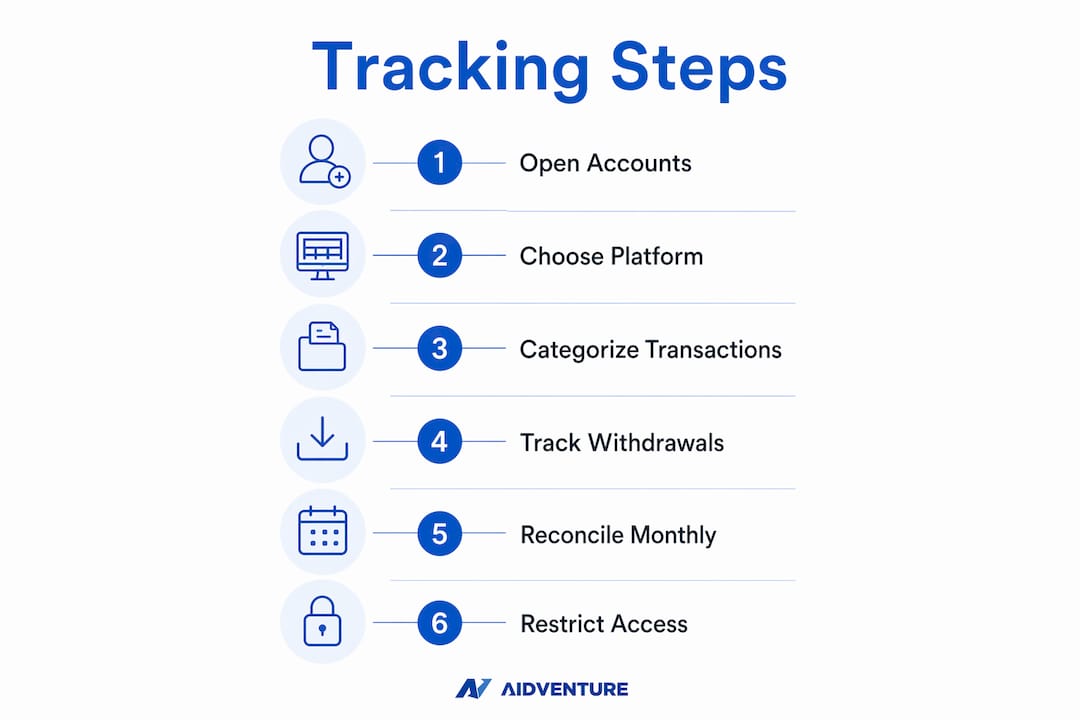
Step 4: Track owner withdrawals and tax payments explicitly. These transactions cross the line between business and personal finances. Label them clearly so they appear correctly in both your profit and loss statement and your personal budget.

Step 5: Schedule monthly reconciliations. Real-time dashboards show current balances, but they do not capture manual adjustments like owner distributions or specific tax withholdings. Monthly reconciliation is what produces a true financial snapshot.
Step 6: Restrict access by role. If you share your platform with an accountant or bookkeeper, use role-based access controls to limit what each person can view or edit. Platforms that use row-level security, such as Pezel, isolate business and personal data at the database level.
Pro Tip: Set up your workspace separation before you record a single transaction. Retrofitting categories onto months of mixed data costs far more time than building the structure correctly at the start.
For founders who want a structured approach without a full-time finance hire, Aidventure’s guide to managing finances without a full-time CFO covers the exact controls and workflows that apply here.
Which tools help you manage personal and business finances together?
The right financial tracking app does more than store transactions. It connects business accounting to personal finance planning in a single interface. Here are the key capabilities to look for, and the platforms that deliver them.
Unified dashboards with separate workspaces. The platform must display business and personal accounts together without mixing the underlying data. Quicken Business & Personal supports up to 10 businesses alongside full personal finance tools, including budgeting, investment tracking, and retirement planning, all in one cloud-based app.
Automated transaction categorization. Manual categorization is the single biggest source of errors in combined finance management. Look for platforms that auto-categorize transactions across both business and personal accounts and let you reclassify with a single tap.
Tax schedule support. For small business owners, tax preparation is the highest-stakes output of financial tracking. Quicken Business & Personal includes built-in support for Schedule C, E, F, A, and B, so deductions are tracked throughout the year rather than reconstructed in April.
Invoicing and accounts receivable. Business-side tools should include customizable invoicing, online payment collection (via integrations like Stripe), and payment tracking. Platforms that combine invoicing with personal budgeting give you the clearest picture of actual cash available.
Spend management and policy controls. For businesses with employees or contractors, Zoho Spend integrates procurement, expense reporting, corporate card management, and payroll into one platform, giving real-time visibility across all spending categories.
Scalable expense automation. SAP Concur’s approach to expense policy compliance enforces spending rules automatically within the reporting process, flagging out-of-policy items in real time before they become entrenched habits.
Security and data isolation. Any platform handling both personal and business data must use strong access controls. Pezel’s workspace-level row-level security ensures personal and business records stay isolated even within the same system.
Pro Tip: Before committing to any platform, verify it supports the specific tax schedules your business files. A tool that handles Schedule C but ignores Schedule E creates a gap you will have to fill manually every year.
How to maintain financial clarity and stay compliant over time
Unified tracking only works if you maintain it consistently. These practices keep your records accurate and your compliance intact.
- Reconcile monthly, not quarterly. Waiting three months to reconcile means three months of errors compounding. Monthly reconciliation catches discrepancies while the context is still fresh.
- Automate receipt capture. Platforms with mobile receipt scanning eliminate the gap between spending and recording. SAP Concur pulls key details from receipts automatically, reducing manual data entry and the errors that come with it.
- Enforce spend policies before the spend occurs. Reactive expense review catches problems after money has left the account. Automating policy enforcement before payments occur embeds compliance into the workflow rather than bolting it on afterward.
- Treat spend management as a whole. Zoho’s approach of integrating procurement, travel, expenses, and payroll into one view reflects a principle worth adopting at any scale: holistic spend visibility enables proactive decisions rather than reactive reporting.
- Back up financial data regularly. Cloud platforms provide continuous backup, but you should also export CSV files of your transaction history periodically. If a platform shuts down or you switch providers, your records travel with you.
- Use a qualified tax professional for year-end review. Automated categorization reduces errors but does not replace expert judgment. Working with a tax CPA who understands both personal and business filings ensures your integrated records translate correctly into compliant returns.
For growing businesses, Aidventure’s budget planning best practices resource covers the policy controls and spend governance structures that scale with your operation.
Common misconceptions about separating personal and business finances
Several widely held beliefs about financial separation actually undermine good tracking.
- Myth: Personal and business finances must be completely isolated. Separation of accounts is required. Separation of visibility is counterproductive. A freelancer who cannot see how business income affects their household savings cannot make informed decisions about owner withdrawals or retirement contributions.
- Myth: Real-time dashboards show your true financial position. Real-time tools display current balances and recent transactions accurately. But true financial health requires periodic reconciliation to incorporate manual items like owner distributions, accrued tax liabilities, and outstanding invoices. The dashboard is a snapshot; reconciliation is the full picture.
- Myth: Commingling accounts is only a problem at tax time. The IRS flags commingled accounts as a compliance risk year-round, not just in April. Mixed transactions make it harder to substantiate deductions, calculate accurate profit and loss, and demonstrate business legitimacy in an audit.
- Myth: Separate tools for business and personal finances give you better control. Switching between apps means reconciling two data sets manually. A unified financial view that links business activity to personal outcomes gives you more control, not less, because you see the full impact of every decision.
- Myth: Owner withdrawals are just transfers and do not need tracking. Every owner withdrawal reduces business cash and increases personal income. Tracking these explicitly in both workspaces is the only way to keep your profit and loss statement accurate and your personal budget current.
Aidventure brings expert financial clarity to your business
Tracking both sides of your financial life accurately takes more than the right software. It takes a clear methodology, consistent execution, and expert oversight when the numbers get complex.

Aidventure works with SaaS founders and small business owners who need financial clarity without the overhead of a full-time finance team. The firm combines accounting operations, fractional CFO services, and data solutions to give you accurate reporting, clean books, and the strategic insight to connect business performance to personal financial goals. Where most tools give you a dashboard, Aidventure gives you a financial partner who interprets what the numbers mean and acts on them with you.
If your personal and business finances are currently tracked in separate systems, or not tracked consistently at all, the practical next step is to review how your current setup maps to the integrated approach outlined here. Aidventure’s fractional CFO services are built for exactly this transition, giving you the structure, controls, and expert guidance to manage both sides of your financial life with confidence.
Key Takeaways
Unified financial tracking, with separate accounts but a connected view, gives small business owners and individuals the clearest path to accurate cash flow, clean tax preparation, and confident long-term planning.
| Point | Details |
|---|---|
| Separate accounts, unified view | Keep business and personal accounts distinct, but track them together to see how each affects the other. |
| Monthly reconciliation is required | Real-time dashboards show current balances; monthly reconciliation captures owner withdrawals and tax adjustments for a true financial snapshot. |
| Tax schedule support matters | Choose a platform with built-in Schedule C, E, F, A, and B support to track deductions year-round, not just at filing time. |
| Enforce policies before spending | Automating spend policy controls before payments occur prevents non-compliant habits from becoming entrenched. |
| Aidventure for expert oversight | Aidventure’s fractional CFO and accounting operations services give small business owners the structure and strategic insight to manage integrated finances accurately. |