Effective financial management without a full-time CFO is achievable for most small businesses and startups through a combination of core accounting operations, fractional CFO services, and financial automation. The industry term for this approach is “alternative finance leadership,” and it covers everything from outsourced bookkeeping to part-time strategic finance. Companies under $1M in revenue typically focus on bookkeeping and accounting before upgrading to fractional CFO support as revenues grow. That benchmark matters because it tells you exactly where to invest your finance budget at each stage. The ways to manage finances without a full-time CFO are well-defined, proven, and within reach for founders who know where to start.
What are the core finance infrastructure components to manage your finances without a full-time CFO?
Every small business needs a financial foundation before it needs a CFO. That foundation has three layers: accurate bookkeeping, timely financial statements, and compliant payroll and tax processes.
Bookkeeping is the baseline. Bookkeepers paired with expert accountants provide 80% of needed finance functions for early-stage startups under $500K ARR. That means clean transaction records, monthly reconciliations, and accurate accounts receivable tracking cover most of what a young company needs day to day.
Financial statements come next. A monthly profit and loss statement, balance sheet, and cash flow statement give you the data to make real decisions. Without these, you are managing by instinct, not by numbers.

Payroll, invoicing, and tax compliance round out the core. Automation of payroll, invoicing, and financial reporting reduces risk and frees internal resources for higher-value work. Connecting your accounting system to payroll and invoicing tools improves compliance and gives you real-time visibility into cash position.
The table below shows the key finance functions, the typical tool category that handles each, and the stage at which each becomes critical.
| Finance function | Tool category | Critical stage |
|---|---|---|
| Bookkeeping and reconciliation | Cloud accounting software | Pre-revenue to $500K ARR |
| Payroll processing | Payroll automation platform | First hire onward |
| Invoicing and accounts receivable | Billing and collections software | First customer onward |
| Tax compliance and filings | Accounting software plus CPA | Annual, from incorporation |
| Financial reporting and dashboards | Reporting and BI tools | $500K ARR and above |
The right tools reduce the manual work that eats founder time. Cloud accounting software, payroll platforms, and billing tools each handle a specific function. Integrating them means your data flows automatically, your books stay current, and your accountant spends less time on cleanup.
Pro Tip: Set a monthly close date and stick to it. Closing your books by the 10th of each month gives you current data when you need to make decisions, not three weeks after the fact.
How can fractional CFO services serve as an alternative to a full-time CFO?
A fractional CFO is a senior finance executive who works with your company on a part-time or project basis. The role is not bookkeeping or tax work. Fractional CFOs translate raw financial data into insights on pricing, hiring, runway management, and fundraising. That distinction matters because many founders confuse the two and either overpay for bookkeeping or underpay for strategy.
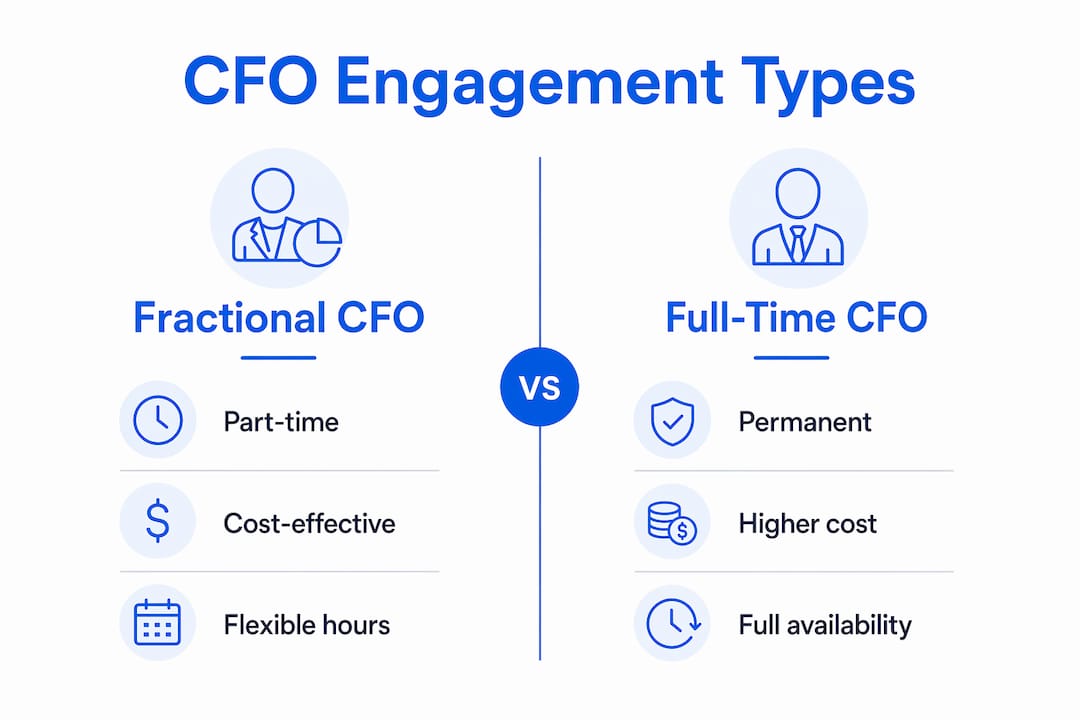
Fractional CFO engagements come in three forms. Monthly retainers cover ongoing strategic support, hourly arrangements handle flexible tasks, and project-based engagements focus on specific deliverables like fundraising preparation or financial model builds. The right structure depends on how often you need senior finance input.
On cost, fractional CFOs typically work 8 to 30 hours per month at $5,000 to $15,000 in monthly retainer fees. A full-time CFO at a comparable experience level costs $200,000 to $400,000 annually in salary alone, before benefits and equity. For a company between $1M and $15M in revenue, the fractional model delivers the strategic leadership without the fixed overhead.
The comparison below shows how fractional and full-time CFO engagements differ across key feature categories.
| Feature category | Fractional CFO | Full-time CFO |
|---|---|---|
| Time commitment | 8–30 hours per month | Full-time, 40+ hours per week |
| Monthly cost | $5,000–$15,000 retainer | $17,000–$33,000+ salary equivalent |
| Strategic scope | Forecasting, KPIs, fundraising, cash planning | All of the above plus daily executive management |
| Best fit | $1M–$15M revenue, moderate complexity | $15M+ revenue, high complexity, investor requirements |
| Equity impact | None | Often includes equity compensation |
Hiring a full-time CFO is usually driven by complexity requiring daily executive management, multiple direct reports, or investor requirements, not just revenue size. Premature hiring adds overhead and equity dilution without proportional benefit.
- Key roles a fractional CFO covers: financial forecasting and scenario planning, cash flow and runway management, board reporting and investor relations, pricing and unit economics analysis, and Annual Recurring Revenue (ARR) growth modeling.
Pro Tip: When vetting a fractional CFO, ask for one example of a financial decision they influenced and the measurable outcome. Vague answers signal a bookkeeper in disguise.
What financial management strategies can small businesses implement without a full-time CFO?
Sound financial management for small businesses rests on four practices: cash flow forecasting, disciplined budgeting, risk reserves, and performance tracking. None of these require a full-time CFO to execute well.
A 13-week rolling cash flow forecast helps small businesses anticipate cash shortfalls before they become crises. The 13-week window balances accuracy with enough lead time to act. Update it weekly, and you will rarely be surprised by a cash gap.
Budgeting without a full-time CFO works best when you build a simple annual budget and review it monthly against actuals. Focus on three numbers: revenue, payroll, and fixed costs. Everything else is variable and easier to adjust. Variance analysis, comparing budget to actual, tells you where your assumptions were wrong and where to correct course.
Small businesses should maintain a cash reserve based on payroll and fixed costs, sized to match operating cycles, customer payment patterns, and seasonality. A reserve equal to two to three months of fixed costs is a practical starting point for most early-stage companies.
Performance tracking without a CFO means choosing five to eight key performance indicators (KPIs) and reviewing them monthly. For SaaS businesses, those KPIs typically include ARR, monthly recurring revenue (MRR), customer acquisition cost (CAC), churn rate, and days sales outstanding (DSO). Aidventure’s SaaS KPI audit is one structured way to identify which metrics matter most for your stage.
Essential financial management practices for small businesses:
- Update your 13-week cash flow forecast every week, not monthly.
- Compare budget to actuals by the 15th of each month.
- Never manage cash by checking your bank balance alone. Bank balance excludes outstanding payables and receivables.
- Build a reserve fund before you think you need one.
- Automate payroll and invoicing to reduce manual errors and late payments.
- Review your top five KPIs in a weekly leadership meeting, even if that meeting is just you.
Pro Tip: If your Days Sales Outstanding (DSO) is above 45 days, your collections process is costing you cash. Tighten payment terms or add automated payment reminders before you look at any other cash flow fix.
How to implement these alternatives and tools effectively
Moving from ad hoc finance management to a structured system takes four steps. Each step builds on the last, and skipping one creates gaps that show up later as cash surprises or compliance problems.
-
Assess your current financial operations. Pull your last three months of bank statements, your most recent profit and loss statement, and your payroll records. Identify what is missing, what is late, and what you do not understand. That gap list is your implementation roadmap.
-
Set finance goals and a 90-day timeline. Pick two or three specific outcomes: close books monthly by the 10th, build a 13-week cash flow model, or reduce DSO from 60 days to 30 days. Concrete goals make progress measurable. Vague goals like “get finances in order” produce no change.
-
Choose and integrate your accounting tools. Select cloud accounting software that connects to your payroll platform and invoicing system. Integration is the priority, not features. A connected system with fewer features beats a disconnected system with more. Aidventure’s accounting operations service helps SaaS companies build this connected foundation.
-
Onboard a fractional CFO when financial decisions outpace your data. When financial decisions are still guesses rather than data-driven choices, that is the signal to upgrade beyond bookkeeping. Scope the engagement clearly. A fractional CFO cannot simultaneously cover bookkeeping, payroll, investor relations, and commercial finance. Define the two or three outcomes you need from the engagement before the first call.
-
Monitor and adjust monthly. Review your KPIs, cash forecast, and budget variance every month. Adjust your tools, your team, or your fractional CFO scope as the business grows. Finance infrastructure that worked at $500K ARR will need updating at $2M ARR.
Pro Tip: Founders benefit most from building a simple 18-month operating model covering revenue, headcount, and cash burn before engaging outside finance expertise. Build it yourself first. The process teaches you more than any report will.
Key takeaways
Managing finances without a full-time CFO is a structured, stage-appropriate approach: start with core accounting operations, add fractional CFO services when strategic decisions outpace your data, and use automation to keep both running efficiently.
| Point | Details |
|---|---|
| Revenue thresholds guide your choice | Focus on bookkeeping under $1M ARR; add fractional CFO support between $1M and $15M. |
| Fractional CFOs are not bookkeepers | They focus on forecasting, pricing, fundraising, and runway, not transaction recording. |
| Cash flow forecasting is non-negotiable | A 13-week rolling forecast prevents cash crises and gives you time to act. |
| Automation reduces risk | Connecting payroll, invoicing, and accounting software improves compliance and visibility. |
| Scope fractional engagements clearly | Define two or three specific outcomes before onboarding a fractional CFO. |
What I have learned from watching founders manage finance too late
Most founders I have worked with made the same mistake: they waited until a cash crisis to take finance seriously. By then, the books were months behind, the cash forecast did not exist, and the fractional CFO they hired spent the first two months on cleanup instead of strategy.
The conventional wisdom says “hire a CFO when you raise a Series A.” That is wrong for most companies. The right trigger is when your financial decisions stop being data-driven. That can happen at $800K ARR or $5M ARR, depending on your business model and how disciplined you have been with your books.
What actually works is building financial discipline before you need it. A founder who maintains a clean profit and loss statement, a 13-week cash forecast, and a simple operating model is ready to get real value from a fractional CFO on day one. A founder who hands over a shoebox of receipts gets a cleanup project, not a strategy partner.
The other misconception I see constantly is that fractional CFOs are expensive. Compared to what? A full-time CFO at $300,000 per year costs more than most early-stage companies spend on their entire finance function. A fractional CFO at $8,000 per month who helps you raise a round, fix your pricing, or cut your burn rate by 20% pays for itself in the first quarter.
Develop basic financial literacy as a founder. You do not need to build the models yourself forever. But you need to understand what the numbers mean. That understanding is what separates founders who make good decisions from those who are always surprised.
— Sergio
Aidventure’s fractional CFO services for growing businesses
Small businesses and SaaS startups that need senior financial leadership without a full-time hire have a direct path forward with Aidventure.

Aidventure’s fractional CFO services deliver forecasting, KPI tracking, cash flow management, and fundraising support at a fraction of the cost of a full-time executive. The service is built specifically for SaaS startups scaling from early revenue to Series A and beyond. Complementary services include accounting operations for foundational bookkeeping and data solutions for financial reporting automation. If you are ready to move from guesswork to data-driven financial decisions, Aidventure is the partner built for that transition.
FAQ
What is a fractional CFO?
A fractional CFO is a senior finance executive who works part-time or on a project basis, providing strategic financial leadership including forecasting, fundraising support, and cash flow management without the cost of a full-time hire.
When should a small business hire a fractional CFO?
The right time is when financial decisions are no longer data-driven. For most companies, that falls between $1M and $15M in revenue, when bookkeeping alone no longer covers the strategic finance needs of the business.
How much does a fractional CFO cost?
Fractional CFOs typically charge $5,000 to $15,000 per month on a retainer, working 8 to 30 hours per month. That compares to $200,000 or more annually for a full-time CFO at a comparable experience level.
What is the best cash flow tool for small businesses?
A 13-week rolling cash flow forecast is the most effective tool for small businesses. It provides enough lead time to address shortfalls while remaining accurate enough to act on each week.
Can a bookkeeper replace a fractional CFO?
No. A bookkeeper records transactions and maintains accurate books. A fractional CFO interprets financial data to drive decisions on pricing, hiring, runway, and fundraising. Both roles are necessary, but they serve different functions.