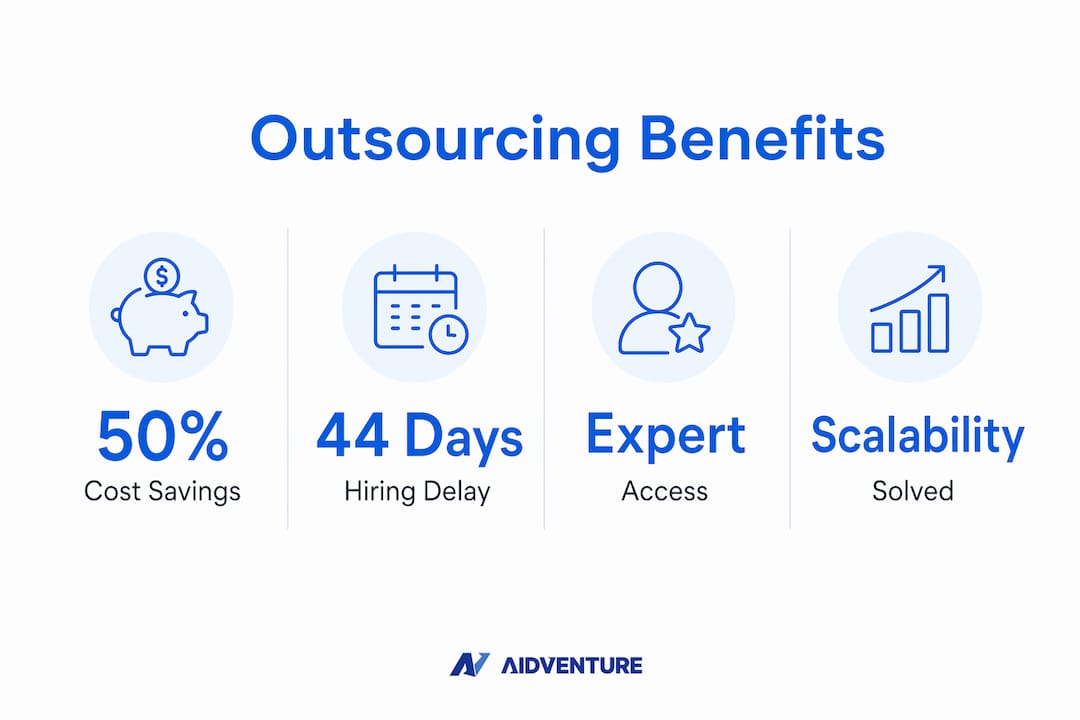
Entrepreneurs outsource finance because it cuts costs by up to 50%, eliminates the average 44-day hiring delay, and frees founders to focus on revenue instead of reconciliations. Outsourcing converts fixed overhead into variable operating costs, giving startups the financial agility that full-time headcount simply cannot provide. The core benefits at a glance:
- Cost reduction: Replace salaries, benefits, and office overhead with a predictable service fee
- Speed: Access qualified finance professionals immediately, bypassing lengthy recruitment cycles
- Expertise: Tap fractional CFOs and controllers with cross-industry benchmarking experience
- Scalability: Adjust the scope of services as your business grows or contracts
- Objectivity: Receive unbiased financial data that builds credibility with investors and boards
1. Why entrepreneurs outsource finance: the cost and efficiency case
Outsourcing finance functions delivers measurable cost savings that in-house teams rarely match. A full-time finance hire carries base salary, payroll taxes, benefits, paid time off, and software licenses. An outsourced provider bundles all of that into a single, scalable fee.
Beyond the direct savings, outsourcing converts fixed capital expenditures into variable operating expenses. That shift gives founders a far more predictable budget and the flexibility to scale spending in proportion to actual business activity. For a SaaS startup managing Annual Recurring Revenue (ARR) growth, that predictability matters at every board meeting.
Automation is another driver. Leading outsourced finance providers deploy cloud-based accounting systems and robotic process automation, improving efficiency and tightening data security without requiring the startup to fund the technology investment itself.
Stat to know: Finance outsourcing can reduce finance and accounting expenses by up to 50% while improving process accuracy and accelerating cycle times.
2. Access to specialized expertise you cannot easily hire
Hiring a qualified finance professional in the United States takes an average of 44 days. That gap is costly for a startup where financial reporting cannot wait. Outsourced providers maintain a bench of ready professionals, so coverage is immediate.

The expertise gap goes deeper than speed. A fractional CFO who works across multiple SaaS clients brings industry benchmarks, pricing strategy insights, and GAAP-compliant reporting practices that an early-stage internal hire rarely possesses. That cross-company intelligence is one of the clearest finance outsourcing advantages for startups preparing for venture capital due diligence.
Outsourced CFOs also professionalize financial reporting quickly and affordably, often at a cost below that of a single full-time bookkeeper. For a venture-backed company targeting 200% year-over-year growth, that speed to financial maturity has a direct impact on valuation.
3. Common challenges outsourcing finance helps you overcome
Managing finance in-house creates a predictable set of problems for founders. Recognizing them early is the first step to solving them.
- Talent shortages: 68% of U.S. finance organizations plan to increase their use of contract professionals, a clear signal that the full-time talent market is strained
- High turnover risk: When a key finance employee leaves, reporting gaps appear immediately; outsourced providers offer continuous backup coverage
- Compliance burden: Tax codes, payroll regulations, and GAAP standards change constantly; a reputable outsourcing partner maintains dedicated compliance expertise
- Reporting errors: Internal teams handling reconciliations alongside other duties produce more errors than specialists focused exclusively on finance
- Founder time drain: A CEO managing accounts receivable or chasing DSO metrics is not closing customers or recruiting talent
- Internal bias: In-house teams can unconsciously shade financial narratives; a third-party provider delivers verified, audit-ready numbers that boards and investors trust
Scalability is the challenge that catches founders off guard most often. During a growth sprint, the volume of payroll runs, journal entries, and investor reports spikes fast. Outsourcing absorbs that volume without the lag of hiring and onboarding new staff.
4. Strategic considerations when outsourcing your startup’s finances
Getting the most from entrepreneur finance outsourcing requires deliberate choices about what to outsource, who to hire, and how to manage the relationship.
Functions most commonly outsourced by startups:
- Bookkeeping and bank reconciliations
- Payroll processing and tax compliance
- Accounts payable and accounts receivable management
- Tax preparation and planning
- Financial planning and analysis (FP&A)
- Month-end close and financial statement preparation
- Fractional CFO and controller services
Criteria for selecting a provider:
- Demonstrated experience with early-stage SaaS companies and startup lifecycle dynamics
- Pricing aligned to value and efficiency, not hourly billing that penalizes speed
- Cloud-based systems with permissions-based access and a clear audit trail
- Capacity to scale services as your ARR and headcount grow
- Track record of producing board-level reporting and investor-ready financials
Risk management deserves specific attention. Data security is the most cited concern when outsourcing financial services. Verify that any provider uses encrypted, permissions-based platforms and maintains SOC 2 compliance. Misaligned pricing models are a subtler risk: old-school hourly billing structures do not incentivize efficiency, so favor providers with flat monthly or per-item fees. You can also explore managing finances without a full-time CFO as a complementary approach during early stages.
For routine financial process management, platforms like Lotus and resources like InvoiceLabs offer practical frameworks for reducing administrative overhead on day-to-day finance tasks.
Pro Tip: Choose a provider with cross-company benchmarking experience. A fractional CFO who sees the books of many SaaS companies can tell you whether your gross margin, churn rate, or customer acquisition cost is competitive, insight no internal hire can replicate from a single vantage point.
Aidventure brings financial clarity to SaaS startups
SaaS founders who need more than basic bookkeeping get a different level of support with Aidventure. The firm combines accounting operations, fractional CFO services, and data-driven financial strategy into one engagement, purpose-built for startups scaling toward their next funding round.

Aidventure’s approach addresses the exact gaps that sink early-stage financial operations: unclear reporting, missing KPI dashboards, and financial models that do not connect to the business model. Clients gain audit-ready financials, board-level reporting, and the kind of strategic insight that accelerates capital raises.
- Fractional CFO and controller services scaled to your ARR stage
- GAAP-compliant and non-GAAP reporting tailored to SaaS metrics
- Cash flow management, FP&A, and investor-ready financial packages
- Flexible engagements with no long-term commitment required
If you are ready to put your finances on a foundation that supports growth, explore Aidventure’s services and see what financial clarity actually looks like for a SaaS startup.
Key Takeaways
Entrepreneurs outsource finance primarily to cut costs by up to 50%, eliminate a 44-day average hiring delay, and access cross-industry expertise that internal hires cannot match.
| Point | Details |
|---|---|
| Cost savings | Outsourcing can reduce finance and accounting expenses by up to 50% versus maintaining a full in-house team. |
| Hiring speed | The average U.S. finance hire takes 44 days; outsourced providers deliver coverage immediately. |
| Expertise access | Fractional CFOs bring cross-company benchmarking and SaaS-specific insights unavailable to a single internal hire. |
| Scalability | Variable cost models let startups scale finance services up or down without the lag of recruiting or layoffs. |
| Aidventure | Aidventure delivers fractional CFO, accounting operations, and data solutions built specifically for SaaS startups scaling toward their next raise. |