Monitoring operating expenses is the single most direct lever business owners and financial managers have for protecting profitability. When you track expenses consistently, the observer effect alone reduces spending by 15–20% on average, without any deliberate restriction. That is not a marginal gain. It is the difference between a business that drifts into margin compression and one that catches cost leaks before they compound.
Here is why operating expense monitoring matters for every business:
- Cost control: Visibility into spending prevents budget overruns and exposes redundant costs like forgotten software subscriptions or fee creep.
- Profitability protection: Operating expenses sit directly on the income statement, reducing net profit dollar for dollar.
- Cash flow stability: Tracking recurring costs helps you forecast cash needs accurately and avoid liquidity gaps.
- Strategic alignment: Expense data tells you whether your spending matches your growth priorities or is drifting toward low-value activities.
- Business agility: Understanding your cost structure lets you respond to market shifts without making blind cuts that damage operations.
What are operating expenses and why do they matter?
Operating expenses, commonly abbreviated as OpEx, are the recurring costs a business incurs to run its daily operations. Rent, salaries, and utilities are the most familiar examples, but the category also includes marketing spend, insurance premiums, office supplies, and software licensing fees. These costs appear on the income statement and reduce operating income directly.
The distinction between OpEx and capital expenditures (CapEx) is worth understanding clearly. CapEx covers long-term asset purchases like equipment or property, which are depreciated over time. OpEx is fully expensed in the period it is incurred, which means it hits your bottom line immediately. The IRS also allows businesses to deduct operating expenses in the year they occur, provided the expenses are ordinary and necessary for profit-generating operations.
Fixed versus variable operating expenses carry different implications for financial forecasting. Fixed costs, such as rent and annual software subscriptions, remain constant regardless of revenue volume. Variable costs, like sales commissions or shipping, scale with business activity. Distinguishing fixed from variable costs is critical to accurate forecasting and resource allocation, particularly when revenue fluctuates.
Key categories of operating expenses include:
- Personnel costs: Salaries, payroll taxes, benefits, and contractor fees
- Facilities: Rent, utilities, and property maintenance
- Marketing and sales: Advertising spend, customer acquisition costs, and sales commissions
- Administrative: Office supplies, travel and expense (T&E), and insurance
- Technology: Software licensing, cloud infrastructure, and IT support
Common types of operating expenses businesses must track
Personnel costs are typically the largest single line item in a company’s OpEx. Salaries, benefits, payroll taxes, and contractor fees can account for the majority of total operating spend, particularly in service-based or SaaS businesses. Tracking cost per full-time equivalent (FTE) helps finance teams assess whether workforce spending aligns with productivity and revenue output.

Rent and facilities costs are fixed and non-negotiable in the short term, which makes them a baseline for understanding your minimum cash burn. For businesses with physical locations, rent often represents the second-largest operating expense after payroll. Remote or hybrid work models have allowed many companies to reduce this line item by renegotiating leases or downsizing office space.
Marketing and sales expenses are variable and directly tied to growth strategy. Customer acquisition cost (CAC) is one of the most watched metrics in SaaS finance, and it lives inside this category. Tracking marketing OpEx against revenue generated gives you a clear picture of whether your growth spending is producing returns or simply inflating costs.
Insurance, office supplies, and administrative costs tend to be underestimated because they accumulate in small increments. A single software subscription at $49 per month seems trivial. Across a team of 50 people with overlapping tools, that figure multiplies quickly. Regular audits of administrative spend routinely surface tools no one uses, duplicate subscriptions, and vendor contracts that have auto-renewed at higher rates.
Pro Tip: Build a dedicated line item for software and subscription costs in your chart of accounts. Many businesses bury these under “general and administrative,” which makes it nearly impossible to audit them without a full account reconciliation.
How to monitor and manage operating expenses effectively
Budgeting is the foundation of operating expense management. Without a budget, you have no baseline against which to measure actual spending, and variance analysis becomes impossible. An operating budget should break down expected costs by category and department, with monthly targets that can be compared against actuals in real time.

Expense classification matters as much as the budget itself. When costs are miscategorized, your financial reports give a distorted picture of where money is going. Establishing a consistent chart of accounts and training your team to code expenses correctly prevents the kind of data drift that makes month-over-month comparisons unreliable.
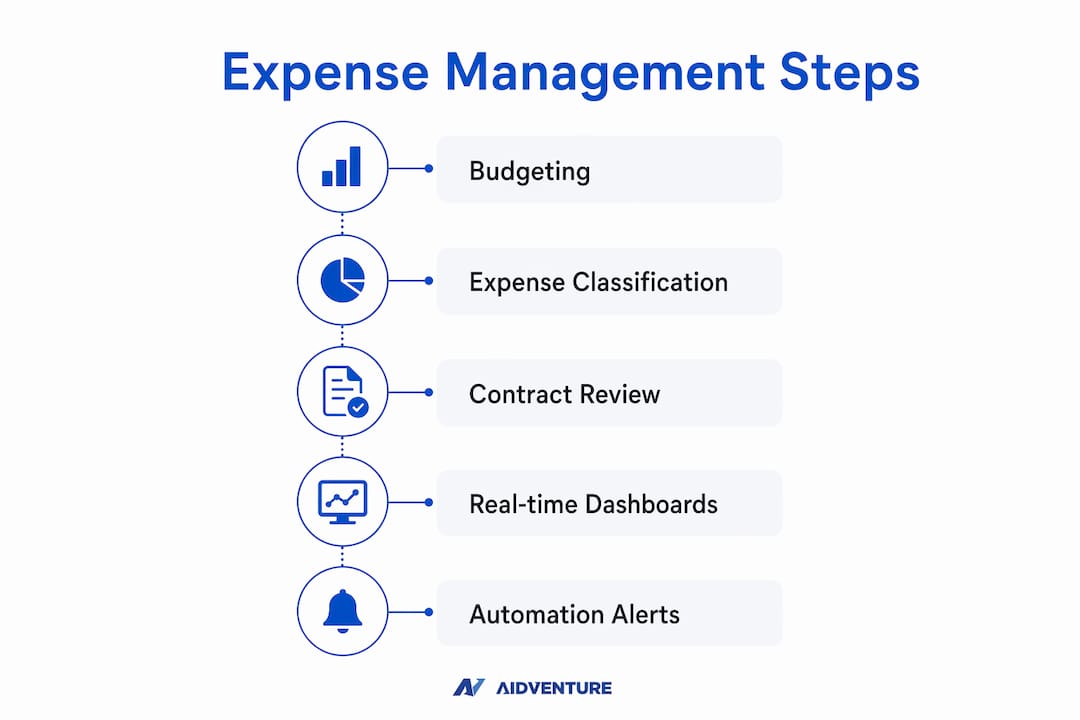
Contract reviews are one of the highest-return activities in expense management. Vendor contracts, software subscriptions, and service agreements often include automatic renewal clauses and annual price escalations. A quarterly review of active contracts typically surfaces renegotiation opportunities and cancellation candidates that would otherwise go unnoticed. For businesses processing payments, a payment processing cost audit can uncover fee structures that have drifted well above market rates.
Real-time dashboards improve identification of cost deviations far earlier than static monthly spreadsheets. Most businesses still rely on spreadsheets for expense tracking, but by the time a monthly report surfaces an overrun, the spending has already occurred. Integrated dashboards connected to your accounting system or ERP give finance teams the visibility to act before variances compound.
Setting an operating expense ratio (OER) target gives you a benchmark for efficiency. The formula is straightforward: operating expenses divided by net revenue. A lower ratio indicates stronger operational efficiency. Because OER benchmarks vary by industry, comparisons are most meaningful within your sector. Tracking your OER over time reveals whether cost discipline is improving or eroding as the business scales.
Useful tools for tracking and managing operating expenses include:
- Accounting platforms like QuickBooks Online or Xero for real-time expense categorization and reporting
- Expense management software like Zoho Expense or Expensify for employee T&E tracking and policy enforcement
- Financial planning and analysis (FP&A) platforms for scenario modeling and budget-versus-actual reporting
- ERP systems for larger organizations that need integrated cost center tracking across departments
Pro Tip: Automate expense report approvals and set spending thresholds that trigger alerts when a category exceeds its budget. Manual review processes create delays that allow overruns to persist for weeks before anyone acts.
Why monitoring operating expenses drives business growth
The behavioral case for expense tracking is well-documented. A Journal of Consumer Research study found that tracking expenses reduces spending by 15–20% on average, even without any conscious effort to cut back. The act of observation changes behavior. For businesses, this means that simply making expenses visible, through dashboards, regular reviews, or detailed reporting, produces cost discipline without requiring top-down mandates.
Loss aversion amplifies this effect. Behavioral economics research shows that visible losses feel roughly twice as painful as equivalent gains feel good. When expense monitoring surfaces a forgotten $800-per-month subscription or a vendor fee that has crept up 30% over two years, the psychological response is immediate. Abstract budgeting rarely triggers the same corrective action because the loss remains invisible.
Regular financial monitoring also correlates with 40% higher savings and reduced financial stress, according to a University of Cambridge longitudinal study of 12,000 participants. While that research focused on individuals, the mechanism applies directly to business finance: visibility creates accountability, and accountability produces better decisions.
Beyond cost control, OpEx management supports agility. Finance leaders increasingly recognize that monitoring operating expenses is not just a cost-cutting exercise. It is how businesses maintain sustainable margins while preserving the capacity to invest in growth. Zero-based budgeting (ZBB), which requires every dollar of operating expense to be justified from scratch each period, is one framework that forces this discipline. It promotes transparency and alignment between spending and strategic priorities.
The operating expense coverage ratio, which measures how much recurring revenue or operating income a business generates relative to its cost base, is a direct indicator of financial resilience. A ratio above 1.0 means income exceeds expenses. Below 1.0, the business depends on external funding or reserves to stay operational. Tracking this metric consistently tells you whether your cost structure is sustainable at your current revenue level, or whether growth needs to accelerate to cover the base.
How operating expenses connect to your financial statements
Operating expenses appear on the income statement, sitting between gross profit and operating income. The structure follows a clear sequence: revenue minus cost of goods sold (COGS) equals gross profit, and gross profit minus operating expenses equals operating income. Every dollar of unmanaged OpEx reduces operating income directly, which flows through to net profit and, ultimately, to the cash available for reinvestment or distribution.
“While revenue fuels growth, it’s disciplined control of OpEx that ensures sustainable margins, operational efficiency, and agility to respond to market changes.” — Anaplan finance leadership perspective
The connection to cash flow is equally direct. Operating expenses are ongoing, day-to-day costs that appear on the cash flow statement as operating outflows. When OpEx rises faster than revenue, operating cash flow deteriorates even if the income statement still shows a profit on paper, particularly when accrual accounting creates timing differences between when expenses are recognized and when cash leaves the account. Monitoring expenses at the cash level, not just the accrual level, prevents the kind of liquidity surprises that catch businesses off guard.
Accurate OpEx tracking also underpins reliable financial forecasting. Forecast accuracy, measured as the difference between projected and actual OpEx, reflects the quality of your financial planning process. When forecasts consistently miss actual spending, it signals either poor cost visibility or undisciplined spending behavior. Both problems are solvable, but only if the data exists to diagnose them. Businesses that track expenses rigorously produce forecasts that hold up under scrutiny, which builds credibility with investors, lenders, and boards.
Key Takeaways
Monitoring operating expenses is the foundation of sustainable margins, accurate forecasting, and the financial agility businesses need to respond to market changes without making blind cuts.
| Point | Details |
|---|---|
| Observer effect reduces costs | Tracking expenses alone cuts spending by 15–20% on average, without deliberate restriction. |
| Fixed vs. variable distinction | Separating fixed and variable OpEx is critical to accurate forecasting and knowing which costs can flex. |
| Real-time dashboards outperform spreadsheets | Static monthly reports surface overruns too late; integrated dashboards enable early corrective action. |
| OER benchmarks guide efficiency | The operating expense ratio measures cost efficiency against revenue; track it over time within your sector. |
| OpEx connects directly to cash flow | Rising expenses reduce operating cash flow even when the income statement still shows profit. |
How Aidventure helps you take control of operating expenses

For SaaS startups and growing businesses, operating expense management is rarely a spreadsheet problem. It is a visibility and process problem. Aidventure’s fractional CFO services give your finance function the structure it needs to track, classify, and act on expense data in real time, without the overhead of a full-time hire.
Aidventure builds the financial reporting frameworks, dashboards, and budget processes that turn raw expense data into decisions. Whether you need to establish your first operating budget, tighten your OER, or prepare your cost structure for a funding round, Aidventure delivers the clarity and precision that growing businesses need to scale with confidence. Learn more about managing finances without a full-time CFO and how Aidventure can support your next stage of growth.