Financial alignment in SaaS marketing is the process of synchronizing marketing objectives, metrics, and investments with a company’s financial goals to drive measurable growth. Without it, marketing operates as a cost center rather than a revenue engine, and that framing costs you budget, credibility, and growth. Why SaaS marketing requires financial alignment has become one of the most pressing questions for founders and marketing professionals in 2026, especially as CFO pressure on marketing performance has risen 52% since 2023. Aidventure works with SaaS startups to close exactly this gap, connecting financial reporting to marketing execution so every dollar spent has a defensible return.
How does financial alignment improve revenue growth in SaaS?
Financial alignment between marketing and finance is not a soft benefit. It produces hard revenue results. Organizations with strong CMO-CFO partnerships achieve nearly 2x higher revenue growth compared to companies where those functions operate independently. That gap exists because aligned teams can make longer-horizon investment decisions, rather than defending every campaign spend quarter by quarter.

The revenue impact compounds when sales joins the alignment. Companies with aligned sales and marketing teams generate 208% more revenue from their marketing efforts than misaligned organizations. That figure reflects what happens when messaging, targeting, and budget decisions all point toward the same financial outcome.
The mechanisms behind these results include:
- Better budget allocation: Finance understands which channels produce pipeline, not just clicks.
- Longer investment horizons: Marketing earns the right to run multi-quarter campaigns when finance trusts the measurement model.
- Causal measurement: Teams can trace revenue back to specific marketing inputs, not just correlate spend with growth.
- Shared accountability: Both teams own the same Annual Recurring Revenue (ARR) targets, reducing internal friction.
Pro Tip: Never present marketing to you’re CFO as a list of activities. Present it as a portfolio of investments with expected payback periods. That framing shifts the conversation from cost control to capital allocation.
The marketing-finance divide is fundamentally about proof of performance, not competing priorities. Marketing teams that lead with evidence-based outcomes, contribution margin, and payback periods earn investment freedom. Teams that lead with impressions and click-through rates get their budgets cut.
What operational infrastructure does financial alignment actually require?
Most SaaS startups treat alignment as a communication problem. They schedule more cross-functional meetings and assume the issue is solved. Forecast accuracy failures are organizational design problems requiring integrated infrastructure, not cultural fixes. The real work is structural.
A unified revenue engine requires three foundational elements:
- Single source of data: Marketing, sales, and finance must pull from the same CRM and reporting system. Siloed spreadsheets produce conflicting numbers and destroy trust between teams.
- Shared metric definitions: Terms like “qualified lead,” “pipeline,” and “closed revenue” must mean the same thing across every department. Inconsistent definitions cause commission disputes and forecast inaccuracies.
- Common incentive structures: When marketing is rewarded for lead volume and sales is rewarded for deal size, the two teams optimize against each other. Shared ARR targets fix this.
The CRM stage structure matters more than most founders realize. Building an explicit Sales Accepted Lead (SAL) stage in your CRM creates formal lead ownership and documented feedback loops between marketing and sales. Without a SAL stage, marketing has no visibility into lead quality after handoff, and sales has no accountability for following up on qualified pipeline.
Pro Tip: Lock your metric definitions in writing before a campaign launches. Agreeing on what “success” means after the fact leads to disputes that damage cross-functional trust and make future budget conversations harder.
The data infrastructure supporting this alignment does not need to be complex. It needs to be consistent. A SaaS startup with 20 employees can achieve full alignment with a well-configured CRM, a shared dashboard, and a weekly revenue review that includes marketing, sales, and finance in the same room.
| Infrastructure Element | Aligned State | Misaligned State |
|---|---|---|
| Data source | Single CRM, shared dashboards | Multiple spreadsheets, conflicting reports |
| Lead definitions | Documented, agreed upon | Informal, team-dependent |
| Incentives | Shared ARR targets | Separate volume and deal-size metrics |
| Reporting cadence | Weekly joint revenue review | Monthly siloed updates |
Why does CFO involvement in GTM strategy keep growing?
CFOs are not taking over go-to-market (GTM) strategy because they want control. CFOs increase their involvement in GTM as a structural response to the absence of causal measurement in marketing. When marketing cannot prove which investments drive revenue, finance fills the gap with conservative cost controls. The solution is not to push back on CFO involvement. The solution is to give finance the measurement framework it needs to say yes.
Correlation-based analytics are the core problem. A marketing team that shows a chart of spend rising alongside pipeline growth has not proven causation. Finance knows this. When the measurement model cannot distinguish genuine revenue drivers from coincidental trends, the CFO defaults to cutting spend.
“Causal measurement allows finance to track exactly which marketing investments drive revenue. Without it, every budget conversation becomes a negotiation based on opinion rather than evidence. With it, marketing earns a seat at the investment table.”
A causal model identifies the specific campaigns, channels, and touchpoints that move prospects through the funnel. It gives finance a defensible framework for approving marketing spend. The role of finance in SaaS marketing then shifts from gatekeeper to growth partner.
The benefits of this collaboration are concrete:
- Marketing budgets are protected because spend is tied to measurable pipeline contribution.
- GTM investment decisions are made on evidence, not executive intuition.
- Finance can model the revenue impact of increasing or decreasing marketing spend with confidence.
- Marketing gains the credibility to request longer-horizon investments in brand and content.
Scenario planning becomes far more accurate when marketing and finance share a causal model. Instead of guessing what a 20% budget increase will produce, both teams can model the expected ARR impact based on historical conversion data.
How does financial alignment affect CAC, retention, and win rates?
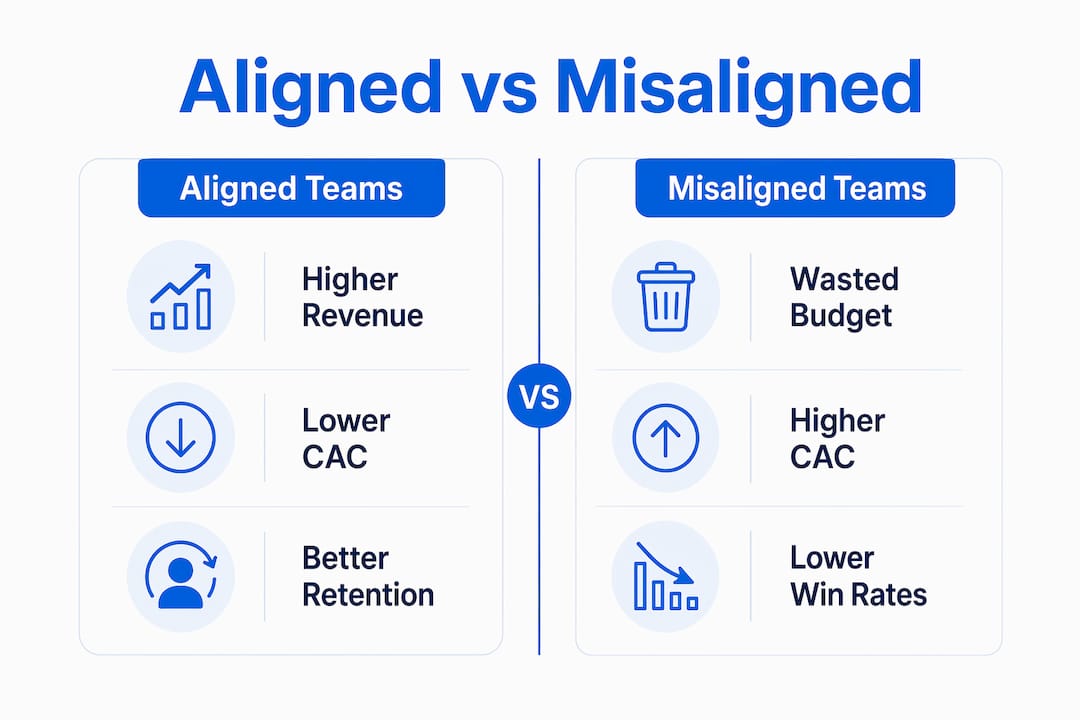
Financial alignment directly improves the SaaS metrics that determine long-term profitability. Aligned sales and marketing teams achieve 36% higher customer retention rates and up to 38% higher win rates. Both numbers reflect what happens when pre-sale education, messaging, and targeting are coordinated rather than fragmented.
Customer acquisition cost (CAC) drops for two reasons. First, aligned teams eliminate duplicated effort. Marketing stops generating leads that sales ignores. Sales stops pursuing prospects that marketing has already disqualified. Second, consistent messaging shortens the sales cycle. Prospects who arrive at a sales conversation already educated on the product’s value close faster and require less sales effort.
Misaligned teams waste approximately 10% of their annual marketing budget on non-converting leads and mismatched messaging. For a SaaS startup spending $500,000 per year on marketing, that is $50,000 in direct waste before accounting for the opportunity cost of sales time spent on poor leads.
The impact on key SaaS metrics looks like this:
| Metric | Aligned teams | Misaligned teams |
|---|---|---|
| Revenue from marketing | 208% more | Baseline |
| Customer retention rate | 36% higher | Baseline |
| Win rate | 38% higher | Baseline |
| Marketing budget waste | Minimal | ~10% annually |
A SaaS KPI audit is the fastest way to identify where misalignment is costing you. It surfaces the gaps between what marketing measures, what sales tracks, and what finance reports, giving you a clear starting point for building a unified revenue model.
Key Takeaways
SaaS marketing requires financial alignment because misaligned teams waste budget, miss revenue targets, and lose the credibility needed to secure future investment.
| Point | Details |
|---|---|
| Revenue impact is measurable | Aligned CMO-CFO partnerships produce nearly 2x higher revenue growth. |
| Infrastructure beats communication | Unified CRM data, shared definitions, and common incentives are the real alignment levers. |
| Causal measurement earns budget | Finance approves spend when marketing can prove which investments drive pipeline. |
| Misalignment has a direct cost | Teams without alignment waste roughly 10% of their annual marketing budget. |
| Retention and win rates improve | Aligned teams achieve 36% higher retention and 38% higher win rates. |
What I’ve learned about alignment that most articles get wrong
Most articles on financial alignment focus on communication: schedule a monthly meeting between marketing and finance, share dashboards, speak each other’s language. That advice is not wrong. It is just insufficient.
The startups I’ve seen struggle most with alignment are not struggling because marketing and finance don’t talk. They’re struggling because their data infrastructure makes honest conversation impossible. Marketing reports one pipeline number, sales reports another, and finance is working from a third. No amount of cross-functional goodwill fixes a broken data model.
The most effective thing a SaaS founder can do is lock the measurement framework before the first campaign launches. Decide what “pipeline” means. Decide what a qualified lead looks like. Decide which metrics will determine whether a campaign succeeded. Write it down. Get sign-off from marketing, sales, and finance before spending a dollar. That single step eliminates more downstream conflict than any amount of alignment workshops.
The other thing I’d push back on is the idea that CFO involvement in GTM is a threat to marketing autonomy. In my experience, it’s the opposite. When finance understands how marketing creates revenue, marketing earns more budget and more freedom. The CFOs who cut marketing budgets are the ones who don’t trust the measurement model. Give them a model they can trust, and they become your strongest advocates for growth investment.
Build the infrastructure first. The culture follows.
— Sergio
Aidventure’s approach to SaaS marketing and finance alignment
SaaS startups that want to grow without burning through capital need marketing and finance working from the same playbook.

Aidventure provides fractional CFO services and SaaS KPI audits specifically designed to connect marketing performance to financial outcomes. The team helps startups build unified revenue models, define shared metrics, and present marketing as a capital allocation decision rather than a cost line. Founders who have worked with Aidventure report clearer reporting, faster budget approvals, and measurable improvements in ARR growth. If your marketing and finance teams are operating on different numbers, managing finances without a full-time CFO does not have to mean operating without financial discipline. Aidventure fills that gap.
FAQ
What is financial alignment in SaaS marketing?
Financial alignment in SaaS marketing is the process of synchronizing marketing objectives, budgets, and metrics with a company’s financial goals. It ensures marketing investments are measured by their contribution to ARR, payback periods, and contribution margin rather than activity-based metrics.
Why do SaaS companies struggle with marketing and finance alignment?
Most SaaS startups treat alignment as a communication problem rather than a data infrastructure challenge. The real cause is inconsistent metric definitions, siloed reporting systems, and mismatched incentive structures across marketing, sales, and finance.
How does CFO involvement affect SaaS marketing budgets?
CFOs increase scrutiny of marketing spend when causal measurement is absent. When marketing can prove which investments drive revenue, finance shifts from cost control to growth partnership, and marketing budgets are protected and expanded.
What metrics should aligned SaaS marketing teams share with finance?
Aligned teams track contribution margin per channel, CAC payback period, pipeline sourced by marketing, Sales Accepted Lead (SAL) conversion rates, and ARR influenced by marketing. These metrics connect marketing activity directly to financial outcomes.
How quickly can a SaaS startup achieve meaningful financial alignment?
A startup with a well-configured CRM, documented metric definitions, and a shared weekly revenue review can achieve functional alignment within one quarter. The prerequisite is locking measurement frameworks before campaigns launch, not after.